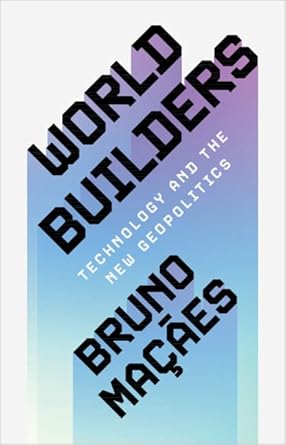
 World Builders: Technology and the New Geopolitics
By Bruno Maçães.
Cambridge University Press, 2025.
Hardcover, 274 pages, $29.95
Reviewed by Trevor Shelley.
The geopolitical analyst, former diplomat, Harvard PhD (under Harvey Mansfield), global columnist, and public intellectual, Bruno Maçães, argues that the competitive dynamics between superpowers today no longer simply involve an effort toward supremacy in the world but now entail (re)building of the world itself. “Technology has created the possibility that one could one day be living in a Chinese or American world,” a statement he suggests we consider “as literally as possible.” Maçães’s literal interpretation proposes that the “geo” in “geopolitics” takes on new, technological, meaning, insofar as the earth alone is no longer the surface or space of kinetic encounter; rather, “this new battlefield is synthetic or virtual”—comprising the realms of technology, energy, trade, and finance—and “the way to win is to reprogram the system, to step outside the game world.”
In one sense, Maçães is simply updating and translating the terms of geopolitics into the idiom of the digital age. For it is hardly novel to think of politics in terms of play, games, and rules as he does, given the long tradition of related articulations from Plato (see, Laws) to Johan Huizinga (see, Homo Ludens). The video game and app are Maçães’s preferred analogies, and he offers a “cybernetic model” for viewing geopolitics. Most are players or users, while a few are programmers or creators. Among the latter, whose intentions are not reducible to innovation for its own sake, commercial gain, or enhanced entertainment, Maçães calls “world builders,” as for them “the world game is more than a metaphor.” Instead, it is a reminder that they are “building a global platform that is setting the terms for global power competition.” Thus, at a deeper level, Maçães is describing—and often advocating for—a transformation in our view of, as well as in the very constructivist capacity of, such builders.
Maçães’s “world builders” are more than political founders who establish a regime by laying down laws and ordering offices and institutions that establish a way of life—or regimen—for a people. After all, the stakes in his account are global. The liberal international rules-based order—a prior but limited construction—has failed in his view. Its builders did not go deep enough in laying their foundations; they still operated like traditional founders, reliant as they were on human laws, reason, institutions, and judgment. They were still constrained by (human) nature, as it were, and lacked today’s robust and growing digital, virtual, and intelligent technologies. Thus, the global stakes are further raised by Maçães when considered in the fullness of recent technological developments. Late in the work, Maçães writes, “There is something I would call a ‘technological order’ that is deeper and more fundamental than political and economic orders, albeit less visible and often taken for the way nature presents itself.” Changes in the technological order (about which he does not elaborate, and readers need to piece together for themselves) have often been accidental or have had the appearance of exogenous necessity. Consequently, the political and economic effects have likewise been accidental or unplanned. Now, however, the world builders of Maçães’s account (who are rarely named; whether they are in fact individuals or states is obscure) are able to intentionally direct the political effects of their technological creations—that is, the technological and the political are, for the first time, truly fusing. Hence, the earth is supplanted by artifice: “geo” must now likewise comprise the virtual.
It is hard not to see this fusion or synthesis as really the subsumption or surpassing of politics—a fact Maçães hints at when he speaks of the prospect of states that “operate within a global system that has been considerably automated and seems increasingly able to dictate outcomes.” To this he adds: “How futile and childish look the machinations of even a brilliant statesman by comparison.” The full-throated technocratic ‘world’ Maçães sees emerging is not only the consequence of accelerated technological innovation but likewise of global events, the latter two most poignant and pressing for him include the recent COVID-19 pandemic and what he calls “the climate crisis.” The ongoing battle for technological supremacy among rival nations—primarily between China and America—revealed for Maçães “the same lesson” as the global pandemic, namely, the need to “build a secondary world protected from [a] sudden intruder.” While such an aspiration is not entirely novel in the face of an epidemiological or a martial threat, Maçães argues that now, however, “the important point is that modern technology increasingly promises—or threatens—to liberate us from the natural landscape that in the past has been relied upon as a playing field for different nations and empires.” Maçães thus draws the following conclusion: “We live ‘after nature,’ and that cannot but change the terms of geopolitical rivalry.” And it is the “climate crisis” that especially signals a change in “the technological order,” for in Maçães’s telling, we “no longer live in the Anthropocene.” The longstanding effort to protect and then free ourselves from the natural environment has caused changes to our environment that have now made it overwhelmingly hostile to human life. We are therefore compelled to build anew:
In order to escape the remorseless logic of diminishing returns, human progress will have to be built on new artificial grounds, a novel civilization where technological progress leaves no physical footprint in the larger environment. Those who first succeed in designing and building this world will enjoy a form of power largely exceeding that present in previous world building exercises.
Maçães’s book is a combination of discursive reasoning, political analysis, technological advocacy, and what one is tempted to call prophecy (or soothsaying?). He blends description and prescription in often subtle and obscure ways, as he draws from a range of sources, letting his own voice trail off at some of the more striking suggestions. The events he takes to be revelatory—the global pandemic and “the climate crisis”—he also takes to be self-evident in their interpretation: controversy over the severity, excesses, and constitutionality of lockdowns and vaccine mandates do not factor into Maçães’s discussion, nor do ongoing technical scientific and nuanced policy disagreements about changes in the climate and appropriate responses. Human science and industry are responsible for the “climate crisis,” but will likewise beget the solution; he does not acknowledge that virology created the very pandemic he now says further catalyzes the need for a novel technologically based artificial civilization. The “climate transition,” according to Maçães, will not merely entail adopting a new energy source but instead involve passage “to a new, human-built world,” which will follow the logic of “dematerialisation” and in turn make possible “limitless growth.” This will apparently be “a world of free energy”—one of “zero marginal cost”—as we transition from energy as “fuel” to energy as “flow,” so that “the constraints of matter gradually wither away.” One presumes the old limitations of tradeoffs, externalities, and unforeseen costs will likewise somehow (magically, er, technologically) wither away. Thus, “the green energy revolution must be seen as one element in our final migration to virtual life.” The effectual truth of necessity, it would appear, is to go beyond necessity, which virtualism will facilitate.
Here Maçães builds on themes from his previous works in discussing (and again, embracing) the emerging metaverse. For Maçães, the prospects of endless choice and immersive experience are deeply attractive: “the obvious temptation will be to live many parallel lives at once. Biography becomes biographies.” To this, he adds: “There will be nothing to lose because no one will feel too invested in one particular avatar.” It’s hard to see what, in the end, is gained either, from such endlessly detached and iterated ‘lives.’ And as he tries to think (or imagine) through what the “great migration” to virtual life will be like, he offers some stunningly banal conclusions: the metaverse “will become a concurrent and real-time platform where billions of people can meet to conduct business, shop and have fun.” Thus, the “joyless quest for joy” will go virtual, and somehow it is to be celebrated.
In the end, he seems to suggest that whether it is a Chinese or American “world,” it doesn’t matter much. While “artificial intelligence is never neutral,” for Maçães, “the alignment problem” will really just solve itself, in and through victory among—or by—the “world builders” or the “masters of the metaverse.” On two separate occasions, he speaks of the forthcoming world as one many of us will be “forced to inhabit” (emphasis added). The only point at which he ever directly raises the question of a totalitarian bent to such a regime where “the metaverse and AI will form a single complex”—nothing other than a situation of unsurpassed surveillance and state if not corporate-control—he deflects by suggesting that “metadata targets the individual as a virtual avatar. Therefore, one could plausibly argue that the real person is left alone.” One certainly can make all sorts of arguments; their plausibility and their threat to human liberty and dignity, however, are another matter. Maçães’s proleptic prose often takes on the guise of science fiction, neglecting some of the most fundamental and timeless questions of political philosophy. Nevertheless, reading his work invites reflection on a sophisticated mixture of techno-enthusiasm and ironic resignation—a strange but increasingly prominent brew in our contemporary present.
Trevor Shelley is Assistant Professor and Director of Graduate Studies at the School of Civic and Economic Thought and Leadership at Arizona State University. He is the author of Globalization and Liberalism: Montesquieu, Tocqueville, and Manent (2020) and co-editor of Citizenship and Civic Leadership in America (2022) and Renewing America’s Civic Compact (2023), and has published various book chapters and journal articles on topics in political theory.
Support the University Bookman
The Bookman is provided free of charge and without ads to all readers. Would you please consider supporting the work of the Bookman with a gift of $5? Contributions of any amount are needed and appreciated!

