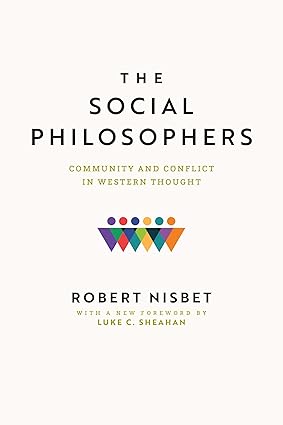
 The Social Philosophers: Community and Conflict in Western Thought
By Robert Nisbet, with a new Foreword by Luke C. Sheahan.
American Philosophical Society Press, 1973/2025.
Paperback, 440 pages, $26.95.
Reviewed by Michael Lucchese.
Academia is hardly considered a hospitable environment for conservatives today, but sociology has become particularly antagonistic toward dissenting points of view. Just this fall, the Chronicle of Higher Education published an essay, “Left-Wing Bias Is Corrupting Sociology,” arguing that the field has become little more than a “political monoculture.” Rather than rigorously pursuing an account of reality using the discipline’s tools, its practitioners have largely become nothing more than sophistical activists seeking out new justifications for progressivism.
One titan of the field, though, prophesied this dire state of affairs. Robert Nisbet, a longtime sociologist at the University of California, Berkley, the University of Arizona, and Columbia University, turned to the discipline as an antidote to ideology. Inspired by great thinkers such as Alexis de Tocqueville, he attempted to develop a sociology that aimed higher than instrumentalization. Although he is now mostly remembered for his 1953 masterwork, The Quest for Community, a new edition of his more neglected book, The Social Philosophers, more fully reveals the extent to which Nisbet’s particular approach revolved around a profound appreciation for—and allegiance to—the “Permanent Things.” While he was no doctrinaire or mouthpiece for a faction, it is for this allegiance that Nisbet deserves to rank foremost among conservative minds.
Of course, Nisbet was not the only conservative mind looking to revitalize twentieth-century scholarship. Around the same time that he emerged as a leading thinker in sociology, the humanities—and specifically the history of political ideas—were undergoing a renaissance due in no small measure to the influence of Leo Strauss. Confronted by the problems of modern tyranny and nihilism, Strauss and his students turned back to ancient political philosophy to rearticulate the transcendent truths around which our civilization has been established. Whereas most political scientists adopted a vulgar materialism and scientism in this period, these true and better scholars sought out a more enduring, even spiritual, way of thinking about politics. And like these efforts in the political sciences, Nisbet’s achievements in the social sciences primarily direct his readers to the highest human activity: philosophy.
Indeed, it is this “philosophical habit of mind” that distinguished scholars such as Strauss and Nisbet as distinctly conservative thinkers. Russell Kirk, for example, in one essay labeled Strauss a “philosophical historian” for perceiving beyond the veil of time “the contract of eternal society which joins our mundane order to an abiding, transcendent order.” He used the same term to describe John Lukacs in his masterwork The Conservative Mind, and drew a connection between the philosophical historians’ analysis of Tocqueville and Nisbet’s sociological conservatism. “Conservatism is not an ideology, but instead a mode of looking at human nature and society,” he wrote. “These scholars are linked, however loosely, in the assertion of the permanent things against the demands of ideology.” By turning first and foremost to philosophical questions, these scholars actively preserved the true heart of Western civilization against those intellectual forces that threatened to overthrow it.
Nisbet’s most powerful critique of ideological social science came in his 1982 book Prejudices—and his specific target was the field’s self-importance. During the twentieth century, sociologists, economists, and scholars in related fields increasingly adopted a scientistic view of mankind that reduced human beings to their behaviors. “More and more writing in the social sciences came to look as though it had been done by a mediocre chemist or geologist,” Nisbet observed. He went on to argue that this scientism was nothing more than a cloak for legitimizing a political ideology; by reducing the study of man to mere behaviorism, these social scientists attempted to privilege the dominant liberalism and promote a centralizing vision of the state-as-provider.
By contrast, Nisbet attempted to pioneer a sociology rooted first and foremost in the history of ideas about society. “Everything vital in history reduces itself ultimately to ideas, which are motive forces. Man is what he thinks!” he wrote in The Twilight of Authority. “Above all, man is what he thinks the transcending moral values are in his life and in the lives of those around him. I know of nothing more absurd than the ‘realist’ position that ideas and ideals do not shape history. What else, in heaven’s name, could possibly shape history, lift it above the level of the statistically random or fortuitous?” Like Strauss’s ancient philosophers conversing in the Athenian agora, Nisbet set out to examine men’s opinions and raise them to the level of reflection.
The Social Philosophers best demonstrates the possibilities of Nisbet’s philosophic method when applied to sociology. Whereas Strauss and his disciples focused on competing theories about the best political regime, Nisbet turned his attention to the “quest for community” more broadly. Law, constitutions, and the balance of power certainly mattered to the sociologist, but he understood with Benjamin Disraeli that “nations are governed by force or by tradition.” He sought, rather, to articulate the ways the West has thought about community and society beneath and beyond centralizing politics.
In the book, Nisbet surveys a number of leading ideas about community, from militarism to kinship and religion. But two modes stand out: what he calls the “Revolutionary Community” and the “Plural Community.” Although Nisbet’s allegiances clearly lie with the latter, it is also certain that he believed the former stood out as “the most remarkable of all forms of community in modern thought and life” because “revolution is basically nothing less than overthrow of constituted authority in society.” The revolutionary mindset—expressed by Jacobins, fascists, Marxists, and other ideologues—is devoted to a totalizing effort to completely remake society. Fueled by utopian ambition, this sort of radicalization threatens to uproot the very elements of civilization that make philosophy possible.
Throughout his many works, Nisbet is clear about what gives revolution such a deracinating effect: the way centralized, despotic power pulverizes true community and reduces mankind to a mass of individuals. In both The Quest for Community and The Social Philosophers, he credited Tocqueville for this insight. “Individual versus State is as false an antithesis today as it ever was,” he wrote in the former. “The State grows on what it gives to the individual as it does on what it takes from competing social relationships—family, labor union, profession, local community, and church.” States pursued sovereignty in the name of the people, but as Tocqueville pointed out, that pursuit can only ever end in despotism. “The merit of Tocqueville’s analysis is that it points directly to the heart of totalitarianism—the masses,” Nisbet asserted, “the vast aggregates who are never tortured, flogged, or imprisoned, or humiliated; who are instead cajoled, flattered, stimulated by the rulers; but who are nonetheless relentlessly destroyed as human beings, ground down into mere shells of humanity.”
Against these depravations, Nisbet set the idea of pluralism. “The good community is not founded upon a single objective or pursuit—whether kinship, religion, or politics,” he wrote, “but upon a plurality of communities, each holding its proper and due place in the larger social order.” To be clear, Nisbet was not endorsing the values-neutrality or individualizing anthropology of insipid liberalism, but rather reinterpreting the Aristotelian notion that, though the city “originates for the sake of staying alive, it exists for the sake of living well.” In other words, a certain idea of justice is at the heart of Nisbet’s pluralism. It therefore recognizes both “a hierarchy of traditions” and a “hierarchy of communities.” Rather than banishing the idea of the Good from the public square, the true pluralist seeks to adjudicate the claims of diverse, overlapping communities by reference to it. Put another way, one could argue that this pluralist society is the best environment for philosophic activity.
In The Social Philosophers, Nisbet argues that it is Tocqueville who best translated the Stagirite’s pluralism to modern conditions. One could almost argue that, had Aristotle been called upon to write a guidebook for modern constitution makers, he would have written something very closely approximating Democracy in America. Drawing on Tocqueville and his priestly forerunner Lamennais, Nisbet argued that the Middle Ages were in fact the freest era in Western history because Christendom operated according to more-or-less pluralist principles. Rather than concentrate all power in a central state, the medievals divided it among the nobility, the Church, and a plethora of other institutions.
Despite this nostalgia for antique modes and orders, though, Tocqueville cannot endorse an unthinking return to them either as a conservative or as a philosopher. He regarded the democratic revolution as an inevitability that statesmen must accept. As he put it in a January 1835 letter to a political ally:
I cannot believe that God has for several centuries been pushing two or three hundred million men toward equality just to make them wind up under a Tiberian or Claudian despotism. Verily, that wouldn’t be worth the trouble. Why he is drawing us toward democracy, I do not know; but embarked on a vessel that I did not build, I am at least trying to use it to gain the nearest port.
This faith in Providence—and in the Permanent Things ordained by it—is what distinguishes Tocqueville as a philosopher. In an excellent essay, Harvey Mansfield has observed that the Frenchman addresses himself to “the true friends of freedom and human greatness,” philosophical concepts he set against both the hubris of the ancients and the pettiness of the moderns. Against the worst individualizing and materialist assumptions of the democratic revolution, Tocqueville held out the spiritual “possibility of greatness” to “inspire the practice of self-government.” As Mansfield puts it, “Freedom and human greatness belong together, and Tocqueville’s philosophy gives substance and support to the friends of both.”
A later letter by Tocqueville beautifully illustrates the profundity of this insight. Arthur de Gobineau was a French politician who initially sided with Tocqueville in contemporary political disputes. As their correspondence continued into the 1850s, however, it became clear that Gobineau was committed to early racialist theories utterly at odds with Nisbet’s pluralist philosophers. Tocqueville was especially disgusted by the determinism and materialism of these theories. On January 24, 1857, he wrote a thundering rebuke:
To me, human societies, like persons, become something worthwhile only through their use of liberty. I have always said that it is more difficult to stabilize and to maintain liberty in our new democratic societies than in certain aristocratic societies of the past. But I shall never dare to think it impossible. And I pray to God lest He inspire me with the idea that one might as well despair of trying. No, I shall not believe this human race, which is at the head of all creation, has become a bastardized flock of sheep which you say it is, and that nothing remains but to deliver it without future and without hope to a small number of shepherds who, after all, are not better animals than we, the human sheep, and who are indeed often worse. You will forgive me when I have less confidence in you than in the goodness and in the justice of God.
Nisbet argued that Tocqueville’s hopes for both human freedom and human greatness can only be achieved in plural community. “At the base of Tocqueville’s pluralism lies his rigorous distinction,” he submitted, “between social authority—the kind of plural social authority that is to be found in the very fabric of the diversity of social associations and communities—and the sovereign power, in political government alone, that so easily becomes transmuted into despotism unless it is incessantly checked by counterauthorities.” The actual content of modern citizenship—at least in the American Republic—is then a kind of philosophic activity, judging the legitimacy of authorities and counterauthorities. Not every political or social dispute necessitates a debate over natural right, but a notion of it provides an essential foundation for good order.
The great crisis of our time, which Tocqueville prophesied and Nisbet diagnosed, is the collapse of those intermediary institutions that can resist the drift toward democratic despotism. The communities necessary for true human greatness are declining, pushed aside by an omnicompetent state, interminable bureaucracy, and the materialist expectations of a deracinated society. Freedom retreats and proletarianization advances.
Other sociologists, most prominently Robert Putnam, have also noted the decline in community—but none have proposed solutions more profound than Nisbet’s. For the most part, even the most imaginative in their number seek to merely replace or shore up community by means of more government spending. Many in the world of think tanks have argued for a new “family policy,” a series of incentives and subsidies they believe could make family formation easier. Even on the Right today, policy wonks seem enamored with the possibilities of the sovereign state centrally planning citizens’ lives. But Nisbet would have maintained that no such strategy could truly bring about the “restoration of authority” necessary to revitalizing communities.
By contrast, Nisbet argued for a “new laissez faire,” policies by which we might free groups from the clutches of the omnicompetent estate. As the late Ted McAllister put it, his actual practical program is somewhat vague, but the general outlines are easily discerned: “We must recover social pluralism, stress localism, accept and embrace some forms of hierarchy, and allow social institutions to have real functions that can’t be abridged by a single governing power.” Nisbet would plead with the New Right to abandon the temptations of sovereignty and political monism. The decline of community cannot be solved by a suite of public policies—human nature is too complex to be reformed by the simple direction of government power.
Rather than writing endless policy whitepapers and bills that will never pass through Congress, sociologists should instead turn to the important task of helping the American people understand the meaning of community and imagine new ways to recover it. More necessary than diktat or wonkery is the philosophical habit of mind encouraged by the serious study of the history of ideas. In The Social Philosophers and elsewhere, Robert Nisbet showed us the way—it is only up to the conservative movement to follow the trail he blazed.
Michael Lucchese is the founder of Pipe Creek Consulting, an associate editor of Law & Liberty, and a contributing editor to Providence.
Support the University Bookman
The Bookman is provided free of charge and without ads to all readers. Would you please consider supporting the work of the Bookman with a gift of $5? Contributions of any amount are needed and appreciated!
