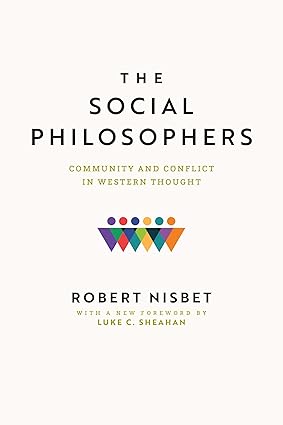
 The Social Philosophers: Community and Conflict in Western Thought
By Robert Nisbet, with a new Foreword by Luke C. Sheahan.
American Philosophical Society Press, 1973/2025.
Paperback, 440 pages, $26.95.
Reviewed by Daniel J. Mahoney.
Robert Nisbet was one of the most erudite and thoughtful academics and intellectuals of the twentieth century. He wrote golden, lucid prose wholly free of the jargon that stems from an undue concern for “scientificity” and/or the excessive politicization of thought. He called himself a “sociologist,” but his concerns and thinking transcended narrow disciplinary distinctions. They were those of a civilized human being wrestling with enduring questions of freedom and responsibility, community, despotism, and human dignity, in his case set against a backdrop of modern alienation and social and spiritual drift. He was a sociologist attuned to philosophy, history, and religion who took aim at the widespread caricature of sociology that is “sociologism.” This crude (but by no means rare) distortion of sociological inquiry oscillates between aimless empiricism and “pinkish ideology” (as another unclassifiable sociologist, the late Irving Louis Horowitz, so suggestively put it). Such sociologism leaves the wisdom of the sociological classics, such as Tocqueville’s and Weber’s, far behind.
Nisbet accordingly took aim at philosophical, political, and sociological “monists” such as Hobbes, Rousseau, and Marx, who flattened the world of human endeavor and took destructive aim at tried-and-true traditional institutions and modes of thinking. Instead, he drew on the wisdom of such diverse advocates of “plural community” across the ages as Aristotle, Althusius, Burke, Bonald, Lamennais, Tocqueville, the anarchist Kropotkin, and the sociological pluralist par excellence Max Weber. In the process of doing so, he created his own rich, idiosyncratic yet coherent “canon” of indispensable sociological classics.
Nisbet was not an obviously religious man. But his work was free of any hostility to religion, and he considered human beings to be religious as well as social animals. In the book presently under consideration, The Social Philosophers, recently reissued in a beautiful new edition by American Philosophical Society Press with a thoughtful and informative new foreword by Luke C. Sheahan, Nisbet wrote intelligently and sympathetically about St. Augustine’s The City of God, Benedict of Nursia and Western monasticism, Erasmus’s modernizing Christian humanism, Thomas More’s complex and non-fanatical “utopianism,” and Cardinal (now St.) John Henry Newman’s luminous articulation of the aims and purposes of the Christian university, and Søren Kierkegaard’s Christian and Socratic rediscovery of authentic individuality and his scorching critique of mass conformism and mass society in his 1846 book, The Present Age. (The latter, a too little-known gem of a book, should be read in conjunction with Alexis de Tocqueville’s portrait and analysis of the democratic mind and soul in volume II of Democracy in America.)
In all this, the chief lesson is clear: There can be no authentic human community without due attention to the “sacred” realm of human existence. Nor can there be serious engagement with the Numinous, and the religious dimensions of human experience and human community, without serious, respectful, and sustained engagement with the great exemplars of Western religious and philosophical reflection. Both crude secularism and dogmatic atheism close human beings off from the heights and depths of the soul and the full range of human experience. Moreover, as Nisbet demonstrates throughout The Social Philosophers, these reductionist forms of thought gave (and give) rise to destructive ersatz secular religions which have proven far more fanatical than the most millenarian manifestations of biblical religion. The natural human religious impulse, and the intimations of transcendence to which it responds, cannot be so easily dismissed.
We therefore are all indebted to Luke Sheahan’s indefatigable (and successful) efforts to bring The Social Philosophers: Community and Conflict in Western Thought back into print. In his “Foreword” to the new edition of the book, Sheahan gives an account of how Nisbet’s “most thorough and philosophically adept account of his understanding of community in its varying historical and theoretical typologies” was almost lost to the world, since its original publisher, the Thomas Y. Crowell Company, went out of business not long after the publication of the book. (There were other aggravating circumstances as well). To his credit, Sheahan saw that this book of impressive erudition and insights addressed intimate communal relations and the conflicts that arose from them in a way that brought “war, politics, religion, revolution, withdrawal, and plurality” together in a truly remarkable way. While not “exhaustive,” its treatment of these issues may well be unsurpassed.
This is because Nisbet did so by looking through a distinctively political and philosophical lens. To begin with, he demonstrated the limits of a “monist political philosophy” which distorted social and political phenomena by insisting too much on “unity and oneness in the political order.” In contrast, Nisbet defends traditional institutions and modes of thinking to the extent that they are compatible with liberty and human dignity, and highlights the “manyness and plurality” inherent in social orders not distorted by revolutionary mania. As in all his works, Nisbet defends a humane conservatism equidistant from traditionalist stagnation and the tyrannizing abstractions beloved by impatient intellectuals and destructive revolutionaries. More generally, he is the sworn enemy of centralization, revolutionary inebriation, and power worship in all its forms.
As we have already indicated, Nisbet’s conservative defense of pluralistic social and political philosophizing enlists a litany of intellectually high-powered and morally serious heroes and inspirations. This is one of the many charms of this work. With reason, Nisbet finds in Aristotle the West’s first great humane conservative, as well as a political pluralist of unusual depth and insight. In The Social Philosophers as well as in 1975’s Twilight of Authority, he appeals to Aristotle’s critique of the “communism” of Plato’s “city in speech” (See Politics, Book Two, Chapters 1-5) to highlight the high-minded sobriety and lucid good sense that always marked Aristotle’s political and social reflection. It was Aristotle who, in “less brilliant but no less penetrating fashion than Plato, called for plurality, diversity, and division in the good community and saw in the search for unity carried too far the danger of not only tyranny and suffocation of the political community itself but even subversion of the political community itself.” This is very aptly put. Too much unity destroys a political community by denying genuine heterogeneity and fatally undermining individual responsibility. Such efforts paradoxically undermine civic friendship or concord itself. The well-constituted civic community must be a “heterogeneous whole,” as the political theorist Mary P. Nichols has put it. Like a musical score where notes collapse into a numbing and unmusical unison, the quest for total community guarantees the loss of both individuality and community.
Likewise, in Edmund Burke’s eloquent critique of the French revolutionary mania for perfect unity through a frenzied ideological pursuit of egalitarian “fraternity,” along with its equally frenzied assault on the traditional neighborhoods and provinces of France in the name of new geometrically-shaped “départements,” Nisbet saw a renewal of Aristotle’s wise, sober conservative pluralism. Conservative pluralists know that the subordinate loyalties of a free people—their families, towns, and provinces—are the “resting places” that gave rise to real “public affections.” Nisbet heartily endorses Burke’s memorable summary of how conservative pluralists view the proper conjugation of our plural familial, social, local, provincial, and national loyalties and affections: “The love to the whole is not extinguished by this subordinate partiality.”
Writing a generation or two after Burke in a world where the egalitarian “democratic revolution” had advanced considerably, even exponentially, Alexis de Tocqueville, too, combined a profound love of political and intellectual liberty (“a liberalism of a new kind”) with conservative pluralism in the tradition of Aristotle and Burke. Tocqueville’s forceful defense of local liberties and “the art of association,” his warnings against an unprecedented form of centralism in the name of politically-enforced equality, and his fears that social atomization and democratic individualism could give rise to a new form of “democratic despotism,” are signal contributions both to political philosophizing and social theorizing of a pluralist and liberal- conservative kind.
Writing in a more social scientific idiom, the great German sociologist Max Weber similarly wondered if tradition, charismatic leadership and authority, and true intellectual independence could survive the bureaucratization of politics and the triumph of Nietzsche’s degraded and degrading “last man” who no longer aimed at anything high, noble, or challenging.
Drawing on all these great intellectual forbears, Nisbet shows that freedom and nobility (or excellence) can only survive when civic and social pluralism allows authentic human individuality and real (as opposed to ideologically-induced) community ample room to flourish. Only then can real “diversity” flourish, at the salutary meeting point where community and genuine individuality cohere.
Nisbet is not only a historical sociologist and social philosopher of the first rank, but also a great anti-totalitarian thinker. Chapter 4 of The Social Philosophers, dedicated to the rise of totalitarianism in the form of “The Revolutionary Community,” is a tour de force. Here, too, widespread erudition is synthesized and given a personal stamp. Drawing on the writings of Burke and Tocqueville, the historian Professor Robert Palmer, the intellectual historian Norman Cohn, and a political theorist such as Hannah Arendt, Nisbet brilliantly captures the totalitarian pretensions of the French Revolution as opposed to those of the American one. The Jacobins aimed, as Burke put it, at a “compleat revolution,” and terror at home inexorably led to “armed doctrine” abroad. As Nisbet writes, “The work of the revolution must be seen, therefore, as continuing into ever-higher levels of mind and morality, into ever-more-intimate spheres of the individual’s life, and into the most private recesses of institutions and personalities. Only thus is it possible to envisage the arrival on earth in the remote future, for the first time in human history, of the absolutely virtuous society.”
Marx and Lenin would jettison the language of revolutionary “virtue,” but their appeals to historical necessity were informed by no small dose of Jacobin voluntarism and fanaticism, and an openness to violence on an unprecedented scale. As Nisbet would write in his 1982 book Prejudices: A Philosophical Dictionary, in the entry on “Enthusiasm,” revolutionary community and ideology were coextensive with a secular religious enthusiasm and intensity that gave rise to unprecedented violence and crimes. Nisbet writes:
What Rousseauism, Marxism, Leninism, and Maoism are about at bottom is nothing less than the redemption of mankind, his secure emplacement in a socialist utopia. And for this any extremes of power are justified, however murderous and devastating. Far more people have gone into paroxysms of behavior from hearing appeals to the general will or to communism or to national socialism than appeals to Heaven and the inner light. All antinomianism is evil, but as between the religious and political expressions, the latter is infinitely more deadly.
Treatments of Sorel’s early twentieth-century valorization of violence as a liberating end in itself, and Frantz Fanon’s call for redemptive violence and bloodletting in the name of fevered anti-colonialism, round out the picture. Thus, there is nothing dated about Nisbet’s portrait of revolutionary community and ideology, since the secular religion he describes seems to haunt late modernity even after the collapse of the Soviet Union and the fall of the Iron Curtain. Secular fanaticism has in no way lost its appeal, and the “end of ideology” is nowhere in sight.
If Homer nods, so too does the pluralist social philosopher sometimes nod. He tends to conflate Rousseau and Robespierre, which is a disservice to Rousseau. It is true that Rousseau’s thought was too easily vulgarized and appropriated by the Jacobins, and for that Rousseau bears genuine responsibility. But the Genevan philosopher never gave a principled defense of tyranny or terror, and explicitly wanted to avoid a revolution in France. That distinction must be respected.
Likewise, Nisbet could also have done more to distinguish between authentic political community, eschewing the monistic drive for unity at all costs, and the undue politicization of the social order. His admirable conservative pluralists of choice (Aristotle, Burke, and Tocqueville) are political philosophers of the first order, if not more so, than political sociologists. The place of politics, rightly understood in “social philosophy” as Nisbet understands it, could have used a more precise and exacting articulation.
These caveats aside, The Social Philosophers remains a book to inspire, inform, and delight the serious student of politics, history, society, and of the ideas that have shaped (and deformed) the modern world.
Daniel J. Mahoney is Professor Emeritus at Assumption University, Senior Fellow at the Claremont Institute, and Senior Visiting Fellow at Hillsdale College. He is the author, most recently, of The Persistence of the Ideological Lie: The Totalitarian Impulse Then and Now (Encounter Books, 2025).
Support the University Bookman
The Bookman is provided free of charge and without ads to all readers. Would you please consider supporting the work of the Bookman with a gift of $5? Contributions of any amount are needed and appreciated!
