
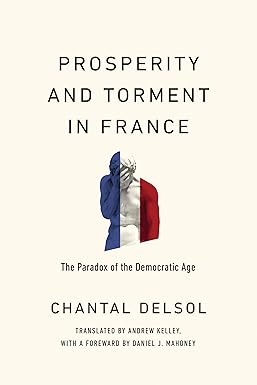
 Prosperity and Torment in France: The Paradox of the Democratic Age
By Chantal Delsol.
University of Notre Dame Press, 2025.
Hardcover, 154 pages, $30.
Reviewed by Godefroy Desjonquères.
Reading Chantal Delsol’s Prosperity and Torment in France as a French person is a discomforting experience. As Delsol rightly points out, the French people are haunted by the memory of their former grandeur, and having their biggest flaws so bluntly exposed to their powerful ally cannot but trigger a sense of patriotic irritation. Of course, it is all the stronger given that Delsol’s assessment is, as often, very much on point. Her book provides Americans with an excellent entryway into the peculiarities of the French mindset and the causes of their political troubles.
Delsol takes as her starting point the contradiction—which in France has inspired numerous essays in recent years—between the nation’s objective prosperity and the pervasive sense of dissatisfaction among its people. Of course, France is not as prosperous as it once was, and the present political situation, which has crystallized over the past few months around the increasingly problematic issue of our spiraling debt, provides objective grounds for concern about the country’s situation. Yet this does not alter the heart of the matter: the French did not wait for the crisis to start complaining, and, as Delsol shows, the malaise runs deeper.
The strength of her analysis lies in her ability to highlight the great diversity of causes behind this malaise, while simultaneously demonstrating their underlying coherence. France’s shortcomings—statism, individualism, corporatism, egalitarianism, etc.—feed into and reinforce one another, even in their apparent contradictions. She paints France in the manner of an impressionist, layering broad strokes drawn as much from her vast erudition as well as her personal opinions and experience; and though some of these strokes, taken in isolation, are open to debate, the overall composition proves undeniably compelling.
This global picture is shaped by a few central ideas, the most important of which runs as follows: French people’s love for ideas, indeed for ideology, often puts them at odds with the pragmatic requisites of a mature democracy and with reality itself. France is, as she very aptly puts it, “a country of dreamers who fall into melancholy when reality catches up with them.” But far from being merely a psychological explanation for French unhappiness, this idealism is the key to a political understanding of our complicated relationship with the very principle of democracy. How so?
Chantal Delsol traces this love of ideology to the tradition of centralization, which has been at the core of France’s political formation since long before the Revolution. When every aspect of daily life is governed by an omnipotent central power, all that is left to the elites are metaphysical quarrels and imaginary republics, which come to be confused with life itself. Solzhenitsyn showed in The Red Wheel that the French Revolution was “prepared, nurtured and inspired by intellectuals.” It is hardly surprising that these intellectuals, whose thought had seldom been tested against reality, remained blind to the concrete conditions in which their ideals might take flesh. The “republican universalism” to which the nation has laid claim since the Revolution is a striking case in point, one that Delsol analyzes with great subtlety. Fraternity, she shows, is the French Republic’s attempt to breathe life, in the age of individualism, into an ideal that is historically and philosophically holistic: the exaltation of a civic friendship with a tangible, almost corporeal dimension, meant to foster authentic communion between modern individuals. In the mind of these thinkers, such an ideal could only be universal in the proper sense of the word—a brotherhood not of the French people, but of all men.
Such an ideal is obviously contradictory: “it crumbles by its very utopianism. Indeed, every friendship concerns specific circles: one cannot be a friend to all of humanity.” Yet that is exactly what revolutionary France claimed to be, and it is the ideal that continues to drive contemporary France. To this day, for many French intellectuals, being French is not a particularism, because it is first and foremost a question of values, and values are universal. We are but the vanguard of a universal brotherhood. As Delsol rightly points out, such a sentiment can only endure in the face of reality in the debased form of a tepid compassion, whose universality is possible precisely because it is utterly devoid of political substance.
This naïve exaltation of unity, which goes hand in hand with a strong egalitarianism and a natural distrust of differences, is essential to Delsol’s explanation of what she sees as France’s democratic immaturity. Democracy rests on the possibility of distance and dissent, something with which France was never at ease. From Bonaparte to De Gaulle, we have a natural attraction towards providential figures that claim to embody the common good and national identity beyond partisan disputes. In Chantal Delsol’s view, attachment to unity turns against democracy when it reaches this intensity. At this point, one is reminded of Carl Schmitt’s analysis of political life: when the only party one claims is that of humanity itself, one’s opponents can never be political adversaries to contend with, but only ideological enemies to be destroyed. As Chantal Delsol shows, Emmanuel Macron embodies this French perversion of republicanism against democracy: because he claims to transcend the divide between left and right, the far right is the only enemy he acknowledges, an enemy that he routinely identifies with evil itself. His electoral results prove the effectiveness of the tactic.
Against this corrosive vision of politics, Delsol argues for the irreducible relevance of the political divide between right and left. She endorses David Goodhart’s opposition between the “anywhere” and the “somewhere” as its relevant contemporary expression, geographically and symbolically embodied, in France, in the opposition between Paris and the Provinces. Delsol has long been an advocate of rootedness and patriotism as conditions of possibility of democracy. In this regard, she belongs among the important conservative thinkers of contemporary France, such as Pierre Manent and Rémi Brague, whose works remind us that the universal can only exist and be embodied through the particular.
She nevertheless sets herself apart by a distinctive insistence on federalism as an indispensable condition for genuine rootedness and a properly functioning democracy. As Daniel Mahoney rightfully points out in his introduction to the book, she is a truly original and unclassifiable thinker in the French intellectual landscape. Prosperity and Torment offers an interesting defense of this federalist position by showing how these two flaws—the naïve universalism and the refusal to engage in democratic confrontation—are linked to the complete absence, in the French political tradition, of any authentic sense of subsidiarity.
This might be one of the starkest differences between France and the United States, the latter’s political tradition being rooted, as Tocqueville saw two centuries ago, in the importance of its intermediate bodies. On the contrary, France was built on the relentless effort to diminish the importance of these bodies, an effort initially undertaken by the Capetian kings and brought to its peak by the French Revolution, which went so far as to make it illegal to “instill in citizens any intermediary interest, to separate them from public affairs through a spirit of corporatism” (loi Le Chapelier, 1791). This radical position fosters individualism and, in turn, a loss of the sense of personal responsibility. Contemporary France is plagued, Delsol argues, by the refusal to hold citizens responsible for their own well-being, the State being blamed—and willingly blaming itself—for every negative aspect of their daily life. Hence the complete inability to control public spending: our current financial situation is but a consequence and a symptom of our deeper political issues.
As I suggested earlier, Delsol’s analysis stands out for the breadth of its perspective. Her essay covers topics as varied as corporatism, the French love for status and strikes, immigration, religion and secularism, populism and the role of intellectuals, Jacobinism, and the EU. Her point of view, while always informed, is presented in a very personal manner and suggests an informal discussion one might have with an American friend or colleague. This makes for an engaging and pleasant read, and certainly a thought-provoking one. If that friend or colleague holds France’s interests at heart, he might very well be alarmed by the harshness of her diagnosis.
In The End of Christendom, Delsol’s civilizational pessimism was balanced by her religious hope. Prosperity and Torment in France, which focuses primarily on politics, offers no such consolation. Its conclusion is all the darker because, if one follows Delsol’s demonstration, any solution can only be implemented in opposition to our deepest and most longstanding historical and political instincts. Delsol’s work opens with a quotation from Tocqueville’s The Old Regime and the Revolution, which provides a lucid description of the French people, “more capable of genius than of common sense.” This is both cruel and flattering—the pride of the French extends even to their most harmful traits. Earlier in the same passage, Tocqueville had described another of these French traits, one which might help spare us from despair: “naturally fond of home and routine, yet, once driven forth and forced to adopt new customs, ready to carry principles to any lengths and to dare any thing.” Impossible n’est pas français…
Godefroy Desjonquères is a doctoral candidate in political philosophy at the Ecole des Hautes Etudes en Sciences Sociales in Paris. His dissertation focuses on the political philosophy of Alasdair MacIntyre. He recently translated MacIntyre’s Ethics in the Conflicts of Modernity into French (Presses Universitaires de France, January 2026).
Support the University Bookman
The Bookman is provided free of charge and without ads to all readers. Would you please consider supporting the work of the Bookman with a gift of $5? Contributions of any amount are needed and appreciated!

