
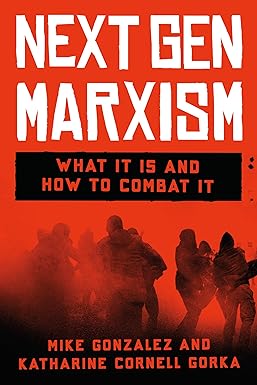
 NextGen Marxism: What It Is and How to Combat It
By Mike Gonzalez and Katharine Cornell Gorka.
Encounter Books, 2024.
Hardcover 332 pages, $34.99.
Reviewed by Jeffrey Folks.
NextGen Marxism is one of the most informative and relevant books I have read in years. It addresses issues that lie at the heart of political and cultural divisions now evident in America. As the authors write, “the social upheaval we are experiencing in the United States today is the result of a zero-sum view of the world…in which the open exchange of ideas is replaced by a rigid orthodoxy…in which people are reduced to their skin color or sexual orientation.” As the authors explain, the prioritizing of race and gender is not an end in itself but the means of fomenting conflict with the goal of securing power. This strategy is a familiar technique of Marxist politics stretching back through Black Lives Matter, radical environmentalism, the radicalism of the 1960s, the Frankfurt School, Gramsci, Lenin, and to Marx himself. What the authors refer to as “NextGen Marxism” can be understood as a direct descendant of a long line of Marxist theory and practice.
The object of NextGen Marxism, as always with Marxism, is to instill a sense of grievance in a particular population and to foment a crisis within society at large with the intention of securing an opening for leftist “solutions.” In this way, the left is following the familiar playbook of those in the past who have applied the same procedure: identify a real or supposed grievance, fuel confrontation and anger, and then “ride into power through elections, promising stability and utopian change,” but delivering only repression and permanent control. It is no accident that the left has endlessly repeated the mantra of “chaos” and, more recently, the lack of “affordability”: these are versions of the conventional leftist rhetoric of social disorder and lack of equity deployed in the service of obtaining power.
All such grievances should be understood as “fronts in a larger war” with the intention of “seeking to dismantle capitalism and the political order.” Cultural Marxists such as Antonio Gramsci recognized, after the failure of leftists to seize power by force in Germany and other Western European countries during the 1920s and 1930s, that capitalism could be undermined by a determined assault on institutions and culture, including the political order, the church, the family, and the rule of law. What one sees today in America and in other countries is precisely this sort of Gramscian dismantling of the established order in an effort to make way for totalitarian Marxist rule.
Clearly, the Founders of our nation understood the crucial role of these institutions and cultural traditions in terms of preserving benevolent order and freedom, or, more precisely, as what Ellis Sandoz has described as “an antimodernist recovery and rearticulation of Western and English constitutionalism.” It was perhaps inevitable that the long war of Marxism against capitalism would come to center on the United States, a nation with a strong and longstanding constitutional system in the service of precisely those institutions that Marxism seeks to destroy.
The concept of “warfare” is not too strong a term to apply to this conflict. As with every major feature of NextGen Marxism, the conception of opposed forces with no room for compromise is deeply rooted in Marxist theory and practice. Marx himself portrayed capitalism as entirely evil and in need of elimination, not reform. Indeed, any tendency toward reform is invariably greeted with derision by leftists and associated with those, like classical liberals, who would defend established institutions and who themselves need to be “canceled.” That tendency of radicals to turn on liberal reformers has been on display in American politics for many decades, but it is more pronounced now than at any time in the past. The problem is that this oppositional mentality takes the form not just of healthy debate but of physical violence, as one has seen in this country and throughout a long history of genocidal campaigns in Marxist countries from the Soviet Union to communist China, North Korea, Cambodia, and many other countries, but genocide and unrestrained violence against political foes are the logical result of a bifurcated vision of the world.
It is not just political opposition but the entire culture of the past that Marxists wish to destroy. One of the finest sections of NextGen Marxism is its discussion of the thinking of Antonio Gramsci and his influence on followers, especially in the United States. “The object of Gramsci’s lifework,” the authors write, “was to transfer hegemony from the capitalist, the parliamentary democrat, and the faithful to the worker,” and not just “the worker” but to activists who sought total state control of the economy and of the private lives of workers themselves. In the pursuit of this utter transformation of existence, Gramsci sought to play the long game of infiltrating educational institutions, the media, corporations, and government, and gradually turning them against capitalism and religion.
It is not difficult to see Gramsci’s legacy in the millions of American Marxists who have exploited similar tactics of gaining a foothold in power, often on false pretenses such as environmental justice, racial equality, women’s rights, and most recently “opportunity,” only to revert to their hard-left ambitions of state control (with, of course, themselves as central agents of that control). It is disturbing to realize just how far these ambitions go, for they include not only political control but complete censorship, elimination of religious freedom, corruption of the franchise, confiscation of private property, and an end to the rule of law. Given the opportunity, there is little doubt that today’s radicals would establish permanent rule and total stranglehold over the lives of every person.
Among ideological descendants of Gramsci, the authors single out the adherents of Critical Race Theory (CRT), American Marxists who, particularly following the inflammatory murder of George Floyd, gained influence from racial divisions that they themselves exacerbated at every turn. Yet, as David Horowitz put it, “the issue is never the issue” (quoted on p. 98). It is not racial justice, gender equality, environmental progress, or other forms of social justice that Marxists seek to achieve: it is totalitarian control with race, gender, class, or environment as the pretext for achieving it.
In American politics, the authors focus on Herbert Marcuse, Tom Hayden, Bill Ayers, Eric Mann, Abbie Hoffman, Isadore Rubin, Angela Davis, C. Wright Mills, Harmony Goldberg, and Nikole Hannah-Jones, author of the 1619 Project. One might also include the useful idiots in the media, such as Bill Moyers, who at every turn abetted the rise of Marxism in America. During the 1960s, the Students for a Democratic Society played a pivotal role, and many of its members and adherents continued to influence later radicals who would feature in the emergence of the current generation of Marxists. NextGen Marxism includes a detailed history of the destructive activities of SDS, including dozens of bombings and murders, and an informative account of the intricate web of its associations and influences that continue to this day, such as the close relationship of activist Bill Ayers and Barack Obama.
In addition, the assault on the established order must include undermining the traditional family and conventional ideas of gender, and once again the theorizing of such a transformation can be traced back to Marx and his socialist predecessors, even to Rousseau and Plato, and it holds a prominent place in the thinking of Lenin, Lukács, Horkheimer, and Marcuse, to name a few. This line of thinking has evolved to yield an influential body of thought in the United States, culminating in Critical Race Theory, which itself has grown into what is known today as “woke” thinking, a “benign term for what it truly entails, which is obliteration of anyone who dares to dissent from the new intellectual orthodoxy.” Once again, violence and censorship are accepted as the means of gaining power.
In regard to education, Gonzalez and Gorka make it clear that Marxists have largely gained control of administration and teaching and that education is being employed as a means of undermining the family. Certainly, in many school districts, the rights of parents to be informed and have a say in their children’s education are ignored, as for instance in teaching and counseling regarding gender identity, often with children who are too young to comprehend what is being imposed on them. Many of the practices now common in public schools—including, in some cases, support for adolescent transgender surgery—run counter to traditional ideas of gender and to traditional morality, but when parents object, they are met with the same censorship and canceling that typifies Marxism in all areas.
The scope of NextGen Marxism is too broad even to be suggested in a short review. Gonzalez and Gorka have performed an important service in bringing together a wide range of fact and theory and in establishing a coherent line stretching directly from Marx through many important figures to the present day. Their knowledge of this history is impressive, as is their perceptiveness in unraveling the countless connections between Marxists of the past and their present-day followers. The importance of what they have to say cannot be overestimated. NextGen Marxism is a book that should be read by everyone who is concerned about the direction of our constitutional democracy and our traditional culture of capitalism and religious faith. It could well serve as a textbook in upper-level classes on American politics and culture. It is a book that takes aim at the heart of the ideological struggles taking place in America today, and that clarifies and connects many strands of Marxist thinking.
As Gonzalez and Gorka write in their conclusion, what we face today is a reemergence of Marxism, the legacy of Gramsci and the Frankfurt School, that shares “a constructivist view of the world that denies nature, and is at war with reality.” The constructed reality that Marxists wish to establish in place of past traditions and beliefs is truly frightening, and all persons of good will need to unite in opposition to it.
Jeffrey Folks is the author of many books and articles on American culture, including Heartland of the Imagination (2011).
Support the University Bookman
The Bookman is provided free of charge and without ads to all readers. Would you please consider supporting the work of the Bookman with a gift of $5? Contributions of any amount are needed and appreciated!

