
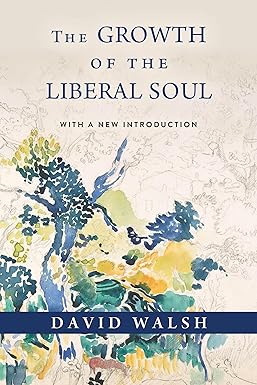
 The Growth of the Liberal Soul (2nd Edition)
By David Walsh.
University of Notre Dame Press, 1997/2025.
Paperback, 416 pages, $39.
Reviewed by Barry Cooper.
In The Modern Philosophical Revolution (2008), David Walsh tells us where he changed his mind on several empirical and philosophical problems. In the Preface he said the book was “the third in a series hitherto unannounced.” He did not mean that one thing randomly led to another but that, looking back from the perspective gained in The Modern Philosophical Revolution to his earlier books, After Ideology (1990) and The Growth of the Liberal Soul (1997), it was evident to him that they formed a “retrospective” trilogy because they all dealt with aspects of a common subject matter, namely modernity, and did so with increasing intellectual penetration. The purpose of the earlier books, he said, “was to deal comprehensively with the character of the modern world” in the sense that the issue of what, precisely, made the modern world “modern” was not self-evident, and thus required analysis. The purpose was not, therefore, to indulge in one more conventional presentation of, or lamentation regarding, the “crisis of modernity.” One reason to avoid such a temptation is that succumbing to it was a way to avoid doing anything other than discuss, chatter, or lament endlessly about the alleged “crisis.” Eventually thoughtless chattering contributes to and helps constitute the crisis. Walsh indicated as much in After Ideology by his choice of subtitle: Recovering the Spiritual Foundations of Freedom suggested a move beyond analysis towards remediation. To be sure, the ability of “our world” to erupt “into orgiastic homicide” has been often noted, Walsh said, but it is equally “capable of maintaining civilized societies of impressive stability.” Accordingly, it is impossible to do justice to the modern world by emphasizing exclusively one or another set of its attributes. On the contrary, Walsh argued, if we are to understand that element of ourselves that is historical and “modern,” it is necessary to “dwell with the contradictions” and await the appearance of the “inner vitality” of the world in which we live. Such, at least in retrospect, was the aspiration of Walsh’s earlier volumes as well as the “culminating member” of the previously unannounced series.
Walsh’s approach to the question of modernity as requiring meditation on contradictions and paradoxes distanced him from a perspective that argued that, precisely because of the “orgiastic homicide” conducted by modern human beings, it was necessary to adopt a non- or rather a pre-modern approach in order that modern perversities be fully understood. The hermeneutic assumption of such a position is that pre-modern accounts of tyranny, for example, would be (or were) more comprehensive than modern discussions of totalitarianism.
In contrast, Walsh argued that only those individuals who had confronted the most harrowing aspects of orgiastic homicide and found at that point the meaning of existence had the “moral authority” to discuss the truth of the modern world. For this reason, After Ideology was understood by Walsh not as a study of totalitarianism but of the catharsis evoked and even imposed by the experience of a spiritual crisis for which totalitarian domination was a symptom or an expression. His focus was not on the suffering of the inmates of the extermination camps but on the spiritual resilience of the survivors. This necessarily meant engaging with the way in which revealed religion and philosophy were distorted into ideological perversity but also with the way in which spiritual resources were assembled from the experience of totalitarian domination to resist those perversions.
Previous commentators on Walsh’s work, and the author himself, observed that to apprehend a crisis the analyst must be moving beyond it even while it exists as a reality, a horizon within which he or she must operate. Good and evil may be the boundaries of existence, but those boundaries could not be prescribed ahead of time or a priori. Who knew what humans were capable of doing before they actually did it?
Human historicity thus meant that the character of liberal democracies can be specified as something other than a stage on the way to the crisis for which totalitarianism is the most visible manifestation. Totalitarian ideology and orgiastic homicide conducted by totalitarian regimes were confronted by, and then destroyed, not by “the heroic witness of individuals” but by military and political action, which fact raised a major geopolitical and philosophical question: why did the liberal democracies fight? Why did they not simply accommodate themselves to an admittedly wicked regime in an equally wicked world? This was a puzzle not least of all to liberal democrats whose major purpose appeared to be the enhancement of private satisfactions over public virtue.
The easiest answer to such puzzles simply ignores the question of ethical differences between liberal democratic and totalitarian regimes and considers only their respective and potentially conflicting long-term pragmatic and geopolitical interests. Much has been made, for example, of the “inevitability” of a clash in the Western Pacific between the United States and the Empire of Japan because during the early decades of the twentieth century the two countries had competing and then conflicting economic and political interests in that part of the world. By this interpretation, the rhetoric of liberal democratic leaders was window-dressing. There was no “day that will live in infamy.” Likewise, Churchill’s characterization of Hitler as “a monster of wickedness, insatiable in his lust for blood and plunder” was evidence only of rhetorical overkill. Similarly, no iron curtain ever descended upon Europe and certainly no “evil empire” or “axis of evil” ever existed.
Indeed, many liberal democrats found and find language that invoked good and evil embarrassing. The interesting question is: why? Were they uncomfortable with the centrality of ethics in politics (forget about Aristotle) or were they sufficiently unrealistic to find the realism of interests uncongenial? That is, the commitments by many liberal democrats to fanciful expectations of progress (or fear of its mirror image, decline) made the balance between old-fashioned realism, which protected interests, and ethical expectations, which transcended them, a serious problem. One answer: if the focus of politics, including politics among nations, is exclusively on interests and what might be called the economically rational accommodation of them, one is compelled to embrace not simply the grotesque consequence of equating liberal democratic regimes with totalitarian ones, but one is incapable of understanding why liberal democracies bother to fight at all; fighting—war—was clearly not in their national interests when accommodation was an option. For genuine progressives, all interests are fungible, and no threats are existential. However, without understanding why liberal regimes fight, one cannot understand why they exist. As an inevitable consequence, such “rational interest” approaches to politics have had to introduce external irrationalities or “conspiracy theories” as explanations. One example of such external irrationality would be that Roosevelt knew that Japan would attack but did nothing. Walsh however argued that democratic leaders in reality do practice a kind of virtue even if their own self-interpretation on this point may not be particularly coherent.
The Growth of the Liberal Soul began from this commonsensical observation and sought “to address this mystery of inexplicable [liberal-democratic] success” by considering not the fractured arguments in favour of liberalism and its “surface incoherence,” which has been pointed out by generations of opponents and critics, but by considering liberal political practice, “which recurrently called forth an actualization of the virtues indispensable for sustaining it.” Thus, support of individual liberty entailed a refusal to specify how it was to be exercised, in the same way, for example, that freedom of speech does not specify what must be said nor how. Walsh’s point therefore was that the promotion of individual liberty entailed the promotion of a liberty that was not simply the right of an individual. There was an “inward coherence” to liberal practice even if liberal theory was less than systematic.
The obvious point to be made with respect to liberalism or the liberal constitutional soul based on recent history is: it has worked. The “most formidable powers on the world scene” over the past two centuries have been those that invoked natural and human rights. Even critics of liberal democracy who based their criticism on the hypocrisy of proclaiming liberal rights but not actualizing them, supported Walsh’s argument. “Look at African Americans,” they say. “Look at Canadian Indians or Australian Aborigines,” they add. “Look at Pakistani immigrants in the UK.” Exactly. The remedy for the unquestioned imperfection of liberal democracy has never been to advocate repression or increased coercion but to advocate and work towards greater actualization of liberal practices, which implicitly proclaims the reality of liberal virtue, notwithstanding the imperfections or vice of existing liberal practices. Liberal hypocrisy is the bad conscience that leads to liberal virtue.
That is, liberalism in practice or, as Walsh prefers to say, in “existence,” was more important than liberalism in theory. In The Modern Philosophical Revolution Walsh made several additional analogies to generalize the insight he was describing here. Just as liberalism exists in practice before it exists in theory, or social and political order exists in a more fundamental way than do the discussions of philosophers that aim at coherent accounts of political order, so too “faith is already there even before we begin to believe; otherwise, there would be no way of arriving at it.” Indeed, The Modern Philosophical Revolution was “a study that has sought to be a meditation on the priority of existence over all reflection.” Thus, philosophy cannot have either a pre-philosophical beginning or a conclusion. There are two reasons for this inconclusive conclusion. First, there can be no goal outside the movement that draws our existence towards what we do not know. And second, this is so because we cannot possess intellectually or in any other way what possesses us, a sense of participatory movement.
Looking back again from what The Modern Philosophical Revolution has achieved to After Ideology and The Growth of the Liberal Soul, it is clear why Walsh discovered a “retrospective” unity. After Ideology was able to effect a recovery of the spiritual foundations of freedom as promised by its subtitle by remaining in the present. There was no discussion of a post-ideological world, a world where murderous ideological militancy had somehow receded. This was not a matter of prudence, of anticipating that the conflicts of the Cold War might well be followed by other wars, as arguably has happened at least in the non-liberal world. Rather, it was to insist that the anticipation of a nonexistent post-ideological order would itself be an apocalyptic fantasy.
Likewise, if we look at the non-apocalyptic component of the modern world, namely the practice of liberal democracy, modern history becomes primarily a practical struggle against orgiastic murderers. Walsh could give voice to a devastating criticism of the critics of liberal democracy because they forgot the most important aspect of what they chopped to pieces: there can be no analysis of liberal democracy outside the convictions that underpin it, namely mutual respect for the dignity and rights of others. There is no higher purpose possible than the affirmation of the infinite worth of each human being, of each “person,” and the political consequences of that affirmation: to build that insight into the regimes of self-government. Once that recognition emerges, the stability of liberal regimes discloses itself. Initially, as we saw in practice during the long war that began in 1939 and ended with the deconstruction of the Wall, liberal regimes defended only themselves. But later, in victory, they sought to bring out the best in others. Of course, that carries its own temptations, the first being our response when others refuse what we think are acts of generosity. Our response may express a second and far worse temptation: to try to force the non-liberal soul to be free, which never works because it cannot be done. And here we have seen that the burden of real economic and political interests and of their synthesis, geopolitics, has reasserted its real weight.
Barry Cooper is Professor in the Political Science Department at the University of Calgary.
Support the University Bookman
The Bookman is provided free of charge and without ads to all readers. Would you please consider supporting the work of the Bookman with a gift of $5? Contributions of any amount are needed and appreciated!
