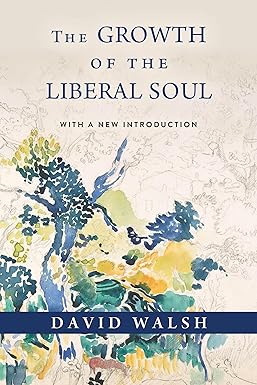
 The Growth of the Liberal Soul (2nd Edition)
By David Walsh.
University of Notre Dame Press, 1997/2025.
Paperback, 416 pages, $39.
Reviewed by John von Heyking.
The publication of the second edition of Growth of the Liberal Soul is a testament to David Walsh’s deep understanding of the history of political philosophy, of liberal theory, and of the depths of the liberal soul. He illuminates why yesterday’s arguments are also today’s and perhaps of all times. The title of the Introduction to this new edition is “The Secret of Liberal Resilience,” and as a sign of that resilience the last sentence contains the provocative claim that Plato was the first liberal! Resilience indeed!
The debates over the liberal order have many of the same arguments today as nearly thirty years ago. However, there seem to be fewer defenders in the liberal camp today than back then, and today’s liberal critics seem more confident. Even so, as with then, the alternatives to the liberal order rarely go beyond it and when they do they are often unappealing.
Part of the reason liberal critics enjoy momentum today is the intervening history since the 1990s. Walsh published the first edition in 1997. The collapse of the Berlin Wall gave liberal democrats a boost of confidence, which was perhaps most famously (and erroneously) expressed by Francis Fukuyama’s end of history argument. Walsh’s attention to the crisis of the liberal order even at that time was prescient, and he was in the minority of its defenders in basing his arguments upon premises other than progressive history. In Guarded By Mystery (1999), which he published a couple of years later, he raised the prospect of finding hope when the progressivist hope in history had vanished. I recall some students recoiling in despair over the prospect of not having history to hope in. The Iraq War, the 2008 economic crisis, the rise of populism, COVID, and the deteriorating economic prospects for young people have shot holes into the liberal order’s claims to superiority, and despair seems ubiquitous. Yet, the liberal order proves resilient and the republication of Walsh’s Growth of the Liberal Soul proves a valuable reminder why because it shows how and why the liberal order is not predicated upon liberalism, at least not completely.
Those familiar with Walsh’s more recent work will see in the Introduction to the Second Edition how that later work derives from his thinking about the growth of the liberal soul, and now illuminates his earlier arguments in Growth. For example, his work on the German idealists in The Modern Philosophical Revolution (2008) grew out of his work on the liberals because the former provide a deeper account of modern liberty than the latter who had been covered in Growth. The German idealists seem to have understood well how the practice of the moral life in liberty points towards our obligations to the other, and the inadequacy of philosophical vocabulary to capture fully the essence of moral life. Walsh’s subsequent books on the person (Politics of the Person as the Politics of Being [2015] and Priority of the Person [2020]) elaborate their move towards a metaphysics beyond metaphysics revealed in the modern discovery of the person.
Dostoevsky, covered in his early After Ideology (1990), makes a reappearance in the new Introduction of Growth in Walsh’s appreciation of the Christ figure in the Grand Inquisitor as the paradigm of modern liberty. Walsh observes how the story presents a Christ whom no one proclaims but everyone recognizes. Christ’s response to the Inquisitor with a silent kiss is a sign of his unconditional love for his persecutor. Tom Holland’s recent book, Dominion (2019), demonstrates how modern, “secular” moral life is a product of Christ’s self-sacrifice. But Walsh shows us why: “It was the epiphany of love that arises from nothing more than the pure gift that love always is.” Only in love as pure gift do we realize our full liberty, and only in full liberty can love exist. The ancients’ emphasis on friendship showed they understood this, but Christ’s example shows it in its full purity.
One sees a similar spirit among dissident defenders of liberty, including Liu Xiaobo, whom Walsh cites, and whose motto of “no enemies, no hatred,” he announced at his trial that led to his final imprisonment and death. The example of Liu and other dissidents of totalitarianism demonstrates why self-interest alone cannot explain the liberal order and it is to Walsh’s credit that he shows the pure gift of the person precedes self-interest.
The Grand Inquisitor represents one of the greatest contemporary threats to liberty which is often referred to as “safetyism.” Walsh’s own critique of COVID restrictions represents this same spirit, though it was more verbose than Christ’s silent kiss. Perhaps the third edition of Growth could include that essay as an Appendix. Walsh identifies safetyism as a liberal “pathology,” as when it shunts conflict to the private sphere. While peace is a political good, liberal democracies need reminding it is not the highest good.
COVID exposed some of the fault lines within liberalism when those skeptical of restrictions appealed to personal liberty while those demanding restrictions asserted more communitarian arguments. Walsh does us invaluable service by showing how the person’s liberty also means responsibility to the other in the form of love and friendship. The person is relation, as one of his latest books is titled (Person Means Relation [2024]). The association of liberty and love can be seen in the Anglo words for freedom and friendship sharing the same root. Walsh renews his appreciation of Tocqueville’s arguments about civil association, which are the purest expression of civic friends working freely within one another to pursue common aims. The liberal constitutionalism of James Madison focuses on coalition building, not DOGE nor populism, as the essence of liberal democratic political activity, because it is the activity of civic friends, as Yuval Levin has also recently observed.
The new introduction of Growth shows Walsh bringing all of political philosophy to bear on the question of liberty and the liberal order. This explains why Walsh avoids speaking of “liberalism,” which is too restrictive in covering the range and depth of liberty’s meaning for us. Plato can be a liberal because the essence of liberty is choosing good over evil. More so than Locke or Mill, the Republic is the book par excellence that asserts this. Walsh rightly notes the ancient/modern divide is somewhat artificial. Kant’s kingdom of ends is closer to Aristotle’s sunaisthesis than usually appreciated. It is also edifying that even scholars of the Republic are coming around to seeing this, with recent books on Plato’s understanding of dignity that extend to the bronze and iron souls.
Walsh illuminates the resilience of the liberal order while also illuminating its fragility, or at least a vulnerability that deserves special attention. The liberal order is predicated upon the civic friendship of persons who as pure gift are irreplaceable and have absolute worth and dignity. He defends the New Deal as an important accomplishment of the state defending persons against arbitrary and absolute economic powers. The state had to grow more powerful to protect the weakest among us. Yet this argument was also made during COVID, which Walsh saw as the state going too far in turning persons into pincushions. The obligation to protect the weakest among us seems to incentivize aggrandizing Leviathan as their protector, leaving arguments to restrict Leviathan’s power to protect as an immoral abdication of its obligation to protect the weakest. St. George must not be hindered in his quest to slay all the dragons.
Conversely, the kingdom of ends that recognizes the absolute worth of the person is in tension with the sometimes coercive means to protect the person. So much of today’s “woke” politics stems from past attempts to use coercive state power to advance liberal ends. The later era sees the violence of the past but not always the cause. The absolute worth of the person can also be used as a bludgeon to coerce others into recognizing them or showing “respect,” and any perceived shortcoming in that effort is seen as violence.
Compounding the problem is the insight Walsh draws from Christ’s silent kiss of the Grand Inquisitor. At its deepest core liberty is silent. It is the gift that cannot be given. Nor can liberty be enforced. Inner liberty as a gift is radically different from the external “chains” that either enslave or free us. It is the silent gift of inner liberty that makes finding the right amount of government power so challenging to determine. The defense of inner liberty seems always to come as the long-awaited response and corrective to the modern state’s interventions whose inner limits get overlooked so long as the weakest remain vulnerable.
Yet the resilience of the liberal order seems rooted in the invisible power of inner liberty, as expressed by Christ’s silent kiss of the Grand Inquisitor: “The silent unaccusing Christ had said nothing and thereby had said everything…. The One who has endured all the evil that flows from the misuse of freedom has already evinced a victory that cannot be taken away.” The Grand Inquisitor has no response to “the silent unaccusing Christ” and therefore knows his efforts were baseless. If liberty is the pure gift that cannot be given, even less can the illusions that undermine liberty be imposed. Like the protagonists in Vaclav Havel’s plays, they may understand their game is an empty shell. The “auxiliary precautions” as Madison called them are there to manage the to-and-fro of inner and outer liberty. One course correction begets another, but within the constitutional framework predicated upon the dignity of the person.
Sooner or later those empty, illusory, and illiberal shells implode but their failures do not justify the liberal order, any more than the myth of historical progress did. Walsh’s radical defense of the liberal order entails arguing that the justification for the world’s most successful political form cannot be on any worldly basis.
The paradox of liberal resilience consists of its resilience residing on a level that does not measure resilience.
John von Heyking is Associate Director and Professor in the School of Civic and Economic Thought and Leadership at Arizona State University.
Support the University Bookman
The Bookman is provided free of charge and without ads to all readers. Would you please consider supporting the work of the Bookman with a gift of $5? Contributions of any amount are needed and appreciated!
