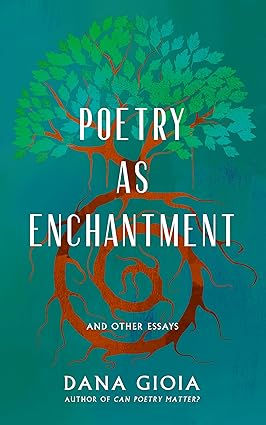
 Poetry as Enchantment: And Other Essays
By Dana Gioia.
Paul Dry Books, 2024.
Paperback, 272 pages, $21.95.
Reviewed by Oliver Spivey.
In his essay titled “Reading,” W. H. Auden sets forth what he views as the special duties of the literary critic:
What is the function of a critic? So far as I am concerned, he can do me one or more of the following services:
- Introduce me to authors or works of which I was hitherto unaware.
- Convince me that I have undervalued an author or a work because I had not read them carefully enough.
- Show me relations between works of different ages and cultures which I would never have seen for myself because I do not know enough and never shall.
- Give a ‘reading’ of a work that increases my understanding of it.
- Throw light upon the process of artistic ‘Making.’
- Throw light upon the relation of art to life, to science, economics, ethics, religion, etc.
The poet-critic Dana Gioia fulfills each of Auden’s enumerated responsibilities, at one point or another, in Poetry as Enchantment: And Other Essays. But Gioia contributes another, rarer quality to the critical act: he knows how to integrate autobiography and anecdote into his criticism in a relevant and charming way, which is no mean task. Most of today’s literary criticism—and yesterday’s, for that matter—is fated to end up in the wastebasket of history. Gioia’s latest book is a testament to the persistence of authentic criticism in an age suspicious of and even hostile to literary values.
Gioia neither deploys nor advocates any method or theory or -ism of reading, leaving his mind open to “the unpredictable encounter literary works require.” Reading creative writers who were also critics—George Orwell, W. H. Auden, Randall Jarrell, D. H. Lawrence, and others—the young Gioia noticed how they “relied on no special method except their full human intelligence, a knowingness that included emotion, imagination, memory as well as intellect.” Although he thought of these authors as his “heroes,” he found them “too idiosyncratic to serve as models.” Gioia wanted to develop an original writerly voice based on the same principles he applied to his poetry. These essays bear the fruit of Gioia’s striving: a prose by turns lyrical and analytical, witty and sober, folksy and urbane—and, for all that, never less than supremely lucid.
The topic of Gioia’s lead essay is enchantment, a word that “should cause responsible readers to cringe. What comes next? A damsel with a dulcimer? The horns of Elfland faintly blowing?” What comes next is, in fact, an illumination of the nature of poetry. Enchantment is sewn into the ancient and richly layered garment of poetry itself; it is among those “primal aspects of verse” to which modern scholarship has paid scant attention. Gioia claims that poetry “speaks most effectively and inclusively (whether in free or formal verse) when it recognizes its connection—without apology—to its musical and ritualistic origins.” We can still experience the form’s musical, incantatory power in the poems of Shakespeare, Tennyson, Yeats, and the homespun rhymes and rhythms of Frost. Poetry has the potential to cast a magic spell on us that goes beyond the realm of the conceptual or philosophical. The “primal and primary” objective of poetry is to enchant, “to create a mild trance state in the listener or reader in order to heighten attention, relax emotional defenses, and rouse our full psyche, so that we hear and respond to the language more deeply and intensely.”
Talk of enchantment or wonder must strike contemporary literary scholars as intellectually naïve. But the amateur brings something to poetry that the professional has forgotten. As Gioia argues, amateurs “respond to poems in the sloppy fullness of their humanity. Their emotions and memories emerge entangled with half-formed thoughts and physical sensations.” The experience of literature cannot be confined within the walls of a classroom or between the front and back covers of an anthology. Gioia believes that the “amateur response to poetry comes closer to the larger human purposes of the art—which is to awaken, amplify, and refine the sense of being alive—than does critical commentary.” There’s much truth in this, if one doesn’t take it too far.
How might we justify the teaching of poetry to new generations? Gioia has several ideas. We ought first to dispense with the belief that a literary education exists simply to produce new professors who comprehend the latest trends in the field. A true literary education must, instead, assist in forming human beings and cultivating the interior life, which is the life of the mind and the soul. A true literary education must combine analysis and interpretation with activities like memorization and recitation, imitation and parody, reading aloud and careful listening. Literary educators must “respect non-conceptual forms of knowledge,” the “physical and sensory power of verse” residing in the images and rhythms of a poem. A true literary education must, above all, “augment methodology with magic.”
Gioia attends to the critic’s job of work—book reviewing—with the same gusto evident in his title essay. No matter the book or author under consideration, his commentary coruscates with keen observations and unexpected aperçus. Even when remarking on poets who have attained canonic permanence, Gioia manages to surprise us. The “special quality” of Elizabeth Bishop’s poetry, for instance, confounds our favorite adjectives, for her “quiet perfection is hard to express without making it sound like a Swiss time piece.” But Gioia recognizes her peculiar genius: “She was, in the highest sense, a prosaic poet, who like the supreme prose masters—Flaubert, James, Nabokov—could create a verbal fabric so fine that nothing was lost to it.” Gioia also understands the necessity of separating the art from the artist, especially when the artist in question is Philip Larkin. Whatever the demerits of Larkin’s personal life, the merits of his poetry are redemptive: “The reason to read Larkin is that his work, like all great poetry, transcends the virtues and vices of its creator and lives as a special form of language that invites and rewards sustained attention. A better man would probably not have written so well.”
There are several other strong pieces here: Gioia’s reminiscences of his former teacher, the English poet-critic Donald Davie; an essay on the significance of Frost’s neglected narrative poetry; an assessment of the poems of John Allan Wyeth, “the missing figure in the American literature of World War I—a soldier-poet still worth reading”; a touching tribute to the underrated Ray Bradbury, whom Gioia knew during the last decade of the author’s life; and an appreciation of W. H. Auden, whose masterly combination of sound and sense, music and ideas, is a “passionate dance of intellect and emotion.”
Gioia’s criticism is so good, so necessary, that one is reluctant to conclude by noting a lapse in judgment. Yet it isn’t mere caviling to say that Gioia’s tolerant spirit, his openness to sundry forms and styles, is sometimes at odds with his obligation to be discriminating. His essay “The State of Poetry: Loud and Live,” however sincere and thoughtful, is too optimistically latitudinarian for comfort. Gioia sees no reason to believe that poetry is in decline; it is thriving in the age of social media, taking many guises and reclaiming its oral and auditory origins. “The poetry scene,” writes Gioia, “isn’t a cemetery; it’s a crowded, noisy maternity ward.” We are told not to panic, that poetry is in no more danger “than usual.” Gioia’s assurance in quantity as a measure of the art’s wellbeing—”Poetry now has as many categories as popular music”—fails to reassure us. How will this glut of new poetry be evaluated? What qualitative, aesthetic criteria will be brought to bear? Surely not all of this new poetry generates enchantment? Maybe Gioia is justified in what seems to be his demotic faith. Maybe the highbrow Cassandras should relax and do a little slumming. Maybe hip-hop, pop verse novels, and poetry slams will prove just as enduring as the lyrics of Wordsworth or Dickinson. A levelized culture may be inevitable in any case, and it sounds creatively liberating: “All styles are possible, all approaches open, and everyone is invited.” Fine. But then what use can such a culture have for serious literary criticism, of which Gioia himself remains an exemplary practitioner?
Oliver Spivey is a professor of English at Sandhills Classical Christian School near Pinehurst, North Carolina, where he teaches literature, rhetoric, and the history of ideas. His critical writings have appeared (or are forthcoming) in such outlets as Literary Matters, Academic Questions, Modern Age, VoegelinView, and Pietas.
Support the University Bookman
The Bookman is provided free of charge and without ads to all readers. Would you please consider supporting the work of the Bookman with a gift of $5? Contributions of any amount are needed and appreciated!