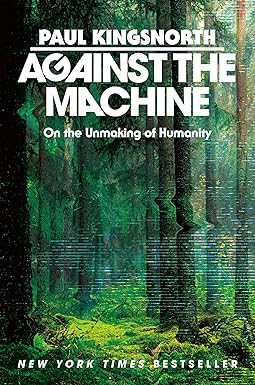
 Against the Machine: On the Unmaking of Humanity
By Paul Kingsnorth.
Thesis/Penguin Random House, 2025.
Hardcover, 368 pages, $32.
Reviewed by Paul Krause.
In the beginning was the garden. That is a very standard myth to start. Many cultures have foundation myths that begin in a garden, the most famous being the Garden of Eden in the Bible. The garden is a paradise; it is where humans dwell in communion with each other and with the rest of creation in harmony. Not only the Bible, but the great poets of antiquity like Theocritus and Virgil also dreamed of an Edenic paradise. But when we look around us, is this the world we see? Why has the garden disappeared, left behind in ruins, with tall metallic skyscrapers and boxy hunks of metal built on wheels as its replacement?
The story of the “unmaking of humanity,” told in Against the Machine by Paul Kingsnorth, is not a new thesis. The idea of decline in the face of the relentless pursuit of scientific and industrial progress was perceived by individuals hundreds of years ago like William Blake and Henry David Thoreau. After all, Blake spoke of those “dark, Satanic mills” polluting England’s beautiful verdant lands. One can go as far back as Virgil to find skepticism toward the urban project as it encroached on pastoral life. Literary scholars of the past century, such as Leo Marx in The Machine in the Garden, also noted this prominent motif in American literature.
Before we can turn to the unmaking of humanity, we must begin with culture. What is culture? Implicitly, Kingsnorth understands culture as belonging to a shared story. Regardless of language, even time and place, people who share a story can build a culture together, but the culture built around the story of Eden has “die[d], leaving only ruins.”
Kingsnorth’s interest in the story of the fall of the garden, the dying of humanity, and its replacement by the machine is a gripping story. It is ironic that some consider Kingsnorth a reactionary. Not long ago, a deep concern for environmentalism and conservationism was a progressive cause. Kingsnorth, though, having converted to Orthodox Christianity, has made the taboo of joining with the bulwark against technological utopianism that dominates elite culture in the ruinous West. Yet his story is one many can sympathize with, including myself.
I, too, have an attachment to the basic principles of environmentalism. We do, and should, have a need to preserve the open spaces and pastures of our world, our homes, our communities. We do, and should, have a need to spend time in the beauty of the natural world that still surrounds us. We do, and should, have a need to seek healing in the cathedral of the garden as John Milton knew when writing Paradise Lost. I remember some of my most passionate moments in class as an undergraduate defending deep ecology, environmentalism, and conservationism. I still have that green heart beating and bleeding inside me as a hiker and lover of pastoral poetry.
What Kingsnorth brilliantly exposes in Against the Machine is how the progressive vision of scientific, industrial, and technological progress is actually destroying the wisdom of the past in its merciless pursuit of perfection. Kingsnorth reminds us of the great taboo of modernity: “There is no such thing as a perfect society, and anyone who tries to build one will either go mad or become a tyrant.” That is the wisdom of Original Sin and the Fall of Man in the Christian tradition—in choosing the fruit of knowledge, Adam (and Eve) chose for themselves the power to decide right and wrong and want to create a more perfect state of existence than what God provided them. The result of this decision was exile, alienation, and conflict. Not merely conflict between the human and the divine, though that was part of it, but also between humanity itself (between man and woman), and between humanity and creation.
The liberal narrative that the West is the creation of the Enlightenment is actually pernicious (and often deceitful) when you realize it. It jettisons several millennia that came before it, though it may have some nice things to say about Greece and Rome. The West, in this story, is the product of rationalism, science, and industry. It is the “New Science” of Sir Francis Bacon which sees the world as a malleable playground to be molded and transformed into the “empire of man” which, once accomplished, will produce the “relief of man’s estate.” In short, science, industry, and economics will create utopia on earth. Capitalism and socialism are both the outgrowth of this mentality and that’s why capitalism and socialism fight so viciously with each other—they are two sides of the same story and only one can win.
As Kingsnorth looks back over history, literature, and philosophy, he weaves together the story of the machine that leads to “disenchantment.” Older cultures were steeped in enchantment because of mystery. But the rise of science and the idol of mammon have stripped mystery from our world, banished it, and now mocks it. This has seized all political discourse: “Across the spectrum, from conservatives to liberals, Marxists to fascists, believers to atheists, very little serious criticism of the entwined myths of progress, growth and materialism will ever be heard in the public square.” Importantly, Kingsnorth reminds us what many political philosophers who are not wedded to ideological Marxism have also long acknowledged: “Communism and fascism—in reality variations on the same theme—sold themselves as alternatives to the ‘decadence’ of liberal capitalism. Both promised to create universalist utopian societies, but both were in fact Machine ideologies.”
The culture of the machine is the culture of disenchantment and discontentment. The present is never good enough. The past is useless and worthless. The future is all that matters. The future will be perfect, but it can only be perfect by riding the world of whatever ills the elite of the machine agree upon. And without saying it out loud, Kingsnorth says what thoughtful people can sense, “the West must die” and, ultimately, humanity—imperfect and therefore a problem to be solved—must die as well. The Machine is the new Moloch.
But is there another story?
Yes. Let us return to culture as a story. Kingsnorth asserts, “A culture…is above all a spiritual creation.” The spiritual realm, the stories of the spirit, connect us to the eternal. What is eternal? “People, place, prayer, the past. Human community, roots in nature, connection to God, memories passed down and on. These are the eternal things.” The vibrancy of the West was in the debating and building from the stories of the past, the truths that they embodied, and the wisdom that they conferred to the present generation of the living.
Kingsnorth ends his weighty tome on the end of Western civilization, and it is over, with the hope of renewal. “Raindance” he calls it. He says we must return to dreams and plant our feet in the deep soil of the garden still beneath our feet. I wholeheartedly agree. “Enter the dreamtime,” he says. I have said this to others as well. Dreams become reality. We can dream a better story. That story was already told. We get to live it. We can, in fact, “reclaim” the story we know to be true.
Paul Krause is the editor-in-chief of VoegelinView and the author of, most recently, The Incredible Adventure of Passer the Sparrow (Resource Publications, 2025) and Dante’s Footsteps: Poems and Reflections on Poetry (Stone Tower Press, 2025).
Support the University Bookman
The Bookman is provided free of charge and without ads to all readers. Would you please consider supporting the work of the Bookman with a gift of $5? Contributions of any amount are needed and appreciated!

