
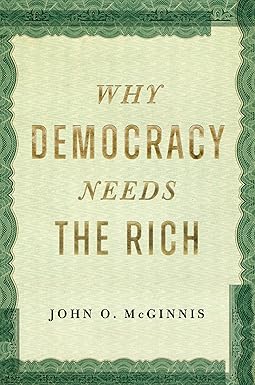
 Why Democracy Needs the Rich
By John O. McGinnis.
Encounter Books, 2026.
Hardcover, 280 pages, $32.99.
Reviewed by Michael Munger.
Hostility toward wealth is not an American value. But that has changed in the past 15 years, with a culturally salient event being Barack Obama’s famed 2012 pronouncement that “You didn’t build that.” The hostility has hardened from a critique of inequality into a moral and institutional indictment of wealth itself. The claim that every billionaire represents a policy failure, voiced most famously by Bernie Sanders, is no longer rhetorical excess; it has become a premise embedded in contemporary democratic theory, public finance proposals, and constitutional argument. In this intellectual climate, John O. McGinnis’s Why Democracy Needs the Rich is not merely contrarian—it is corrective, even redemptive.
McGinnis’s central claim is stark: the attack on wealth is not only mistaken but destructive of democratic governance. It misunderstands how capital is created, misstates the political power of the wealthy relative to other elites, and misidentifies the true sources of democratic distortion. The real danger to democracy, McGinnis argues, lies not in wealth concentration per se, but in the expansion of a transfer state capable of generating enormous rents, which then attracts rent-seeking coalitions of all kinds.
This argument places McGinnis in direct opposition to the most influential inequality theorist of the past decade: Thomas Piketty. The contrast between the two is not merely empirical, but conceptual, normative, and institutional.
Piketty’s core claim, developed in Capital in the Twenty-First Century and expanded in Capital and Ideology, is that capital accumulation tends toward self-reinforcing concentration (r > g), producing durable inequalities that threaten democratic equality. For Piketty, wealth inequality is not just economically inefficient or socially unjust; it is politically corrosive. Wealth begets political power, which then reshapes institutions to preserve and amplify that wealth.
This logic leads naturally to Piketty’s policy conclusions: progressive wealth taxes, inheritance taxes, and constraints on capital accumulation are not regrettable tradeoffs but democratic necessities. Inequality is treated as a negative externality of capitalism—one that must be actively counteracted by the state. McGinnis’s book can be read as a systematic rebuttal to this entire moral framework. (Piketty’s conclusions have already been thoroughly debunked as an empirical matter, of course.)
A striking feature of Piketty’s work is how abstract “capital” becomes—often detached from entrepreneurs, firms, innovation, or risk. McGinnis begins instead with descriptive grounding. Roughly two-thirds of the Forbes 400 are self-made entrepreneurs, and this proportion has been increasing, not declining. These fortunes are overwhelmingly held as productive capital, not idle hoards or luxury consumption.
This matters because Piketty’s moral intuition—that wealth is socially harmful because it reflects inherited privilege and extractive power—fits poorly with a world in which wealth is increasingly contestable, entrepreneurial, and fragile. Even inherited wealth, McGinnis notes, is largely invested rather than consumed, funding enterprises, research, philanthropy, and institutional experimentation.
Moreover, McGinnis punctures a key rhetorical move in inequality discourse: the idea that the rich inhabit a fundamentally different material universe. In consumption terms, the gap between rich and middle-class citizens has compressed, not widened. Everyone flies, communicates globally, accesses vast information, and uses similar technologies. Differences today are marginal—speed, comfort, convenience—rather than categorical in the pre-industrial sense.
Piketty’s framework, by contrast, implicitly relies on a vision of wealth as social separation, when much contemporary wealth actually generates convergence in lived experience.
The most serious charge against wealth is not consumption but political influence. Here the divergence between McGinnis and Piketty is sharp. Piketty treats political influence as largely proportional to wealth. The solution, therefore, is to compress the wealth distribution so that influence equalizes.
McGinnis rejects both premises.
First, he argues that equal influence is not—and cannot be—a feature of representative democracy. Influence flows through persuasion, agenda-setting, credibility, organization, and expertise, not through mechanically equalized resources. To condemn unequal influence per se is to misunderstand how representation works.
Second, McGinnis challenges the empirical claim that the rich are the dominant political actors. Journalists, academics, entertainers, and bureaucrats—the “professional influencers”—exercise far greater systematic and agenda-setting power, and do so with remarkable ideological homogeneity. Universities, media institutions, and administrative agencies shape the long-run policy frontier in ways that dwarf the episodic interventions of wealthy donors.
In this sense, McGinnis flips Piketty’s story. The wealthy are not the primary threat to democracy; they are one of the few counterweights to ideologically uniform elites who face weak market discipline and minimal political accountability.
The deepest disagreement between McGinnis and Piketty concerns the mechanism of democratic failure. Piketty locates the problem in private accumulation. McGinnis locates it in state-created rents. Where government has the power to tax, regulate, subsidize, and transfer on a massive scale, the returns to political influence explode. Rent-seeking follows—not just by the wealthy, but by unions, professional guilds, regulated industries, NGOs, and bureaucracies.
From a public-choice perspective, this is decisive. If rents are large, political competition becomes destructive regardless of the initial distribution of wealth. If rents are limited, wealth loses much of its political salience.
Piketty’s solution—expanding the fiscal and regulatory state to neutralize wealth—intensifies the very mechanism that generates distortion. McGinnis’s solution—constraining the state’s capacity to create and transfer rents—addresses the root cause.
This is the point at which Why Democracy Needs the Rich implicitly aligns with Buchanan and Tullock rather than Rawls or Piketty: democratic pathology arises from institutional incentives, not moral failings.
McGinnis further argues that democracy has inherent tendencies toward conformity, mediocrity, short-termism, and what Tocqueville famously called “soft despotism”. Wealth, far from exacerbating these tendencies, often mitigates them: In the film “Caddyshack”, the snooty old money judge, Elihu Smails, was disgusted by real estate developer Al Czervik. But Czervik was still a member; in fact, when Czervik offered to “buy the club” in response to being told he couldn’t do something, the Judge was apoplectic. Wealth is a leveler as much as it is a divider.
This leveling is underappreciated, and McGinnis is right to emphasize it. Because wealthy actors are less dependent on the state, they may be more willing (and they certainly have more capacity) to resist paternalism, fiscal illusion, and bureaucratic expansion. Because they possess long time horizons, they can support unpopular or minority causes that democratic majorities neglect. Because they fund civil society, philanthropy, and institutional experimentation, they generate public goods that neither markets nor governments reliably produce.
Piketty’s framework largely omits these functional roles, treating private wealth primarily as a rival to democratic legitimacy rather than a contributor to democratic resilience. Of course, as Robert Nozick famously observed in “Why Intellectuals Oppose Capitalism,” any system where the Smails-Pikettys of the world have to accept the Czerviks of the world as equals, or superiors, simply must be unjust. And the self-anointed elites are clever enough to come up with reasons that are not as embarrassing as simple envy.
The book has weaknesses. McGinnis acknowledges, but underplays, the extent to which state expansion can reshape wealth formation itself. As the regulatory and fiscal state grows, wealth increasingly arises from political access rather than market success.
The wealthiest county in the U.S., for example, is not in the financial centers of New York or Chicago, or the value-creating machine of Silicon Valley. The center of wealth in America is in Loudon/Falls Church, VA., home of the elites flocking to government contracts and transfers. In such cases, Piketty’s critique has considerable force—not because wealth is inherently corrupting, but because it has become endogenous to state power.
While the book is otherwise well-situated in the literature, it pays insufficient attention to the Public Choice literature that would have buttressed the central claim, while allowing that using the transfer state to plunder legitimate wealth would, in fact, be subject to exactly the critiques the political left is offering. A fuller treatment would distinguish more sharply between market-generated wealth and politically mediated wealth, and acknowledge that the latter strengthens the case for institutional reform rather than blanket defenses of “the rich.”
Why Democracy Needs the Rich succeeds because it forces a reorientation of the inequality debate. Against Piketty’s moralized diagnosis, McGinnis offers an institutional one. Against the assumption that wealth is democracy’s enemy, he argues that unchecked state power is the real threat.
The book’s ultimate claim is not that the rich are virtuous, but that a democracy hostile to wealth will not become more equal—it will become more centralized, more bureaucratic, and less free. In that sense, McGinnis’s argument is less a defense of inequality than a defense of constitutional humility.
For readers who are committed to returning to the world of Piketty fences, a world that never really existed but in which inequality was less, and the world was fair, this book will be unsettling. Good.
Michael Munger is Pfizer/Pratt University Professor of Political Science, and Economics, at Duke University. He was President of the Public Choice Society, and is currently President of the Philadelphia Society. His most recent book, The Sharing Economy, was published by the Institute for Economic Affairs in 2021.
Support the University Bookman
The Bookman is provided free of charge and without ads to all readers. Would you please consider supporting the work of the Bookman with a gift of $5? Contributions of any amount are needed and appreciated!
