
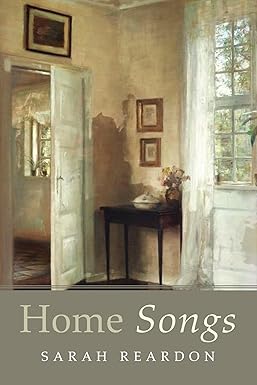
 Home Songs
By Sarah Reardon.
Resource Publications, 2025.
Paperback, 46 pages, $6.
Reviewed by Annmarie McLaughlin.
Sarah Reardon’s Home Songs, a collection of twenty poems about marriage and family life (seven of which were previously published individually), has many endearing qualities, but perhaps most striking is the narrative thread that runs throughout the entire book. Each poem maps a path on the journey by sharing the personal and religious experiences of a young woman falling in love, getting married, and then expecting and welcoming children. As a reader who tends to prefer prose to poetry, I appreciate the narrative arc as well as the opportunity to reminisce, through Reardon’s work, on my own similar experiences. Reardon’s writing is intensely religious, elevating the seemingly mundane aspects of home life to a spiritual level. Because it draws such powerful connections, it invites readers to ponder how even the simplest details of their lives can lead to the divine.
One could read the entire collection in half an hour, but doing so would be a grave injustice to the intensity and symbolism of each poem, which instead demands prolonged reflection. Reardon lays out the premise of the book in the preface, noting that the earthly home is the site of preparation for our future heavenly home, and that, as such, it is to be both revered and indulged. We are not called to retreat from the world but to fully immerse ourselves in it. The images Reardon conjures are accordingly rooted in Scripture, mythology, and modern works such as T.S. Eliot’s Four Quartets. In this way, the timelessness of Reardon’s message echoes throughout the pages of her book.
The collection opens on a note of hope and anticipation: “The Introduction” speaks of the springtime that beckons us forth from the bleakness of winter, which is likened to the desolation that one feels prior to union with one’s beloved. But only the call to union, not the union itself, is alluded to here, with the narrator arising and answering the call to search for the beloved. The open-endedness of this poem segues into the next poem, “Behold, He Comes,” in which, despite the title, the arrival of the beloved is sensed and imminent, but not yet achieved. Reardon awakens the irrepressible spark of excitement that characterizes the initial stages of love and laces it with suspense. “Behold, He Comes” speaks of the reassurance that she will eventually find her beloved. Simultaneously, it highlights the inevitable turning away from others that true love entails and the bliss of knowing that the wait is almost over.
Then, at long last, the beloved makes his appearance in “Beneath the Cedar.” Evoking images of the desirable cedars of Lebanon that were used in King Solomon’s construction of the Lord’s temple, the beloved stands out among all other trees for his longevity and steadfastness. Though, for the narrator, the beloved is chosen from among many for her, he is “the only tree of health”; thus, he also seems to signify Christ, the only one who can save us. In this way, Reardon associates the exclusivity of the marital bond with divine unity. Yet, in keeping with New Testament directives—as mentioned in the book’s preface—this union involves humility as a first step. The narrator yields to her beloved and entrusts herself to the shade of his protective boughs.
Subsequent poems intimate that at a fraction of his age, the narrator is the beloved’s second wife. Such details underscore the narrator’s modesty and submissiveness to the man she takes as her husband in “The Wedding,” written in just four lines of iambic pentameter. The terseness of this poem was somewhat unexpected, given that the “wedding feast” was foreshadowed in “The Introduction,” but perhaps the intention is to leave it shrouded in mystery. The wedding is spoken of in universal terms (“the world will wed before her time to mend”), stressing that the union of any two people has eternal significance that far surpasses the individuals themselves. The closing line, “A ceremony of great joy and doom,” is surprisingly portentous, perhaps evoking, as foretold of Mary by the prophet Simeon, the great suffering that accompanies sacrificial motherhood. On an even deeper spiritual level—and I speculate here—it arguably alludes to the Second Coming, the “Day of the Lord,” which in the prophetic books of the Bible is eagerly anticipated because the people expect rewards, though they overlook the judgment that also awaits.
My personal favorite of the collection, “Early Days,” follows next. It is one of the simpler poems, less replete with symbolic imagery and more lighthearted in tone. The appeal is its timeless wisdom, captured in the second stanza, which notes that though the newness of early marriage inevitably fades, “under heaven, each receives a season./These early days are ours—to clasp and hold,/…/To learn what does, and what does not, grow old.” From there, the couple moves into their first home, filling it with children and guests, all while keeping God at the center. Together, they endure the vagaries of parenthood, with rich biblical and literary imagery in the background. Occasionally, the narrator ventures beyond her own hearth, but the looming presence of home is like the beacon of a lighthouse, always beckoning her back to a place of warmth and solace (“Downtown”).
The final two poems fast-forward to contemplate the reality of death, but with the recognition that the end of one’s earthly existence is just the beginning of eternal life with God. “Imperishable” opens with an allusion (I presume) to the book of Ecclesiastes, translating the hebel of the Bible as “vapor” rather than the more common “vanity,” and reminding us that “there is yet a time to watch the mists,/To search the grass for beauty that persists.” The focal character here seems to be an older woman who is able, once past the prime of her life, to find the time to pick flowers and chat with strangers. The mood of the poem is peaceful despite the fleetingness of life. Such acceptance is possible only by anticipating the life that is yet to come. Finally, “Exiles on the Earth” indicates that we are just that—exiles who are sent to this earth for a while. We may get caught up in the busyness of life here but must eventually bow to the end goal, which is to reach “the better land,” where God dwells.
Ultimately, heaven is the only home that matters. In the meantime, however, our earthly homes can be microcosms of the one to come, if we place a stool in the center (“Home Song”), invite God in, and treat him as our most esteemed guest. That is the definitive message of Reardon’s collection, and each poem, like the various stages of one’s life, effectively contributes to the final product.
Annmarie McLaughlin is Associate Professor of Writing and Research and Associate Professor of Scripture at St. Joseph’s Seminary, Dunwoodie, New York.
Support the University Bookman
The Bookman is provided free of charge and without ads to all readers. Would you please consider supporting the work of the Bookman with a gift of $5? Contributions of any amount are needed and appreciated!

