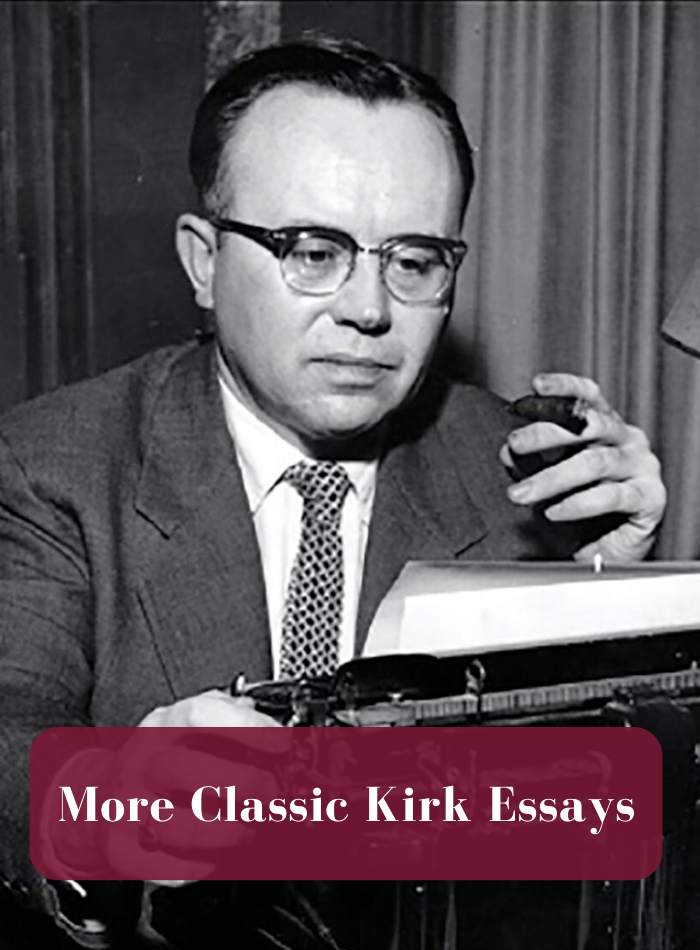
Classic Kirk Essays
A Culture’s Road toward Avernus
From “Essays on Our Times,” The Institute for Cultural Conservatism, July, 1988.
Our inherited culture is involved in great difficulties: I suppose that most educated people nowadays will assent to that statement. Forty years ago, not long after the Second World War, I encountered often people who waxed indignant at my venturing to suggest the possibility of cultural decadence among us. It is otherwise now.
Sometimes, true, I come upon men and women too well satisfied with our world, and with their diversions—rather nasty diversions, not infrequently—therein. Yet these are not what I call tranquil people: instead they bring to mind a poem of two lines by Adam Mickiewicz:
Your soul deserves the place to which it came,
If having entered Hell, you feel no flame.
Our present discontents and distresses are not the subject of this essay; my subject just now is the cause of the descent of modern culture toward the pit of decadence. So a single paragraph from my friend Malcolm Muggeridge’s essay “The Great Liberal Death Wish” must suffice here as a succinct analysis of our plight.
“As the astronauts soar into the vast eternities of space,” Muggeridge writes, “on earth the garbage piles higher; as the groves of academe extend their domain, their alumni’s arms reach lower; as the phallic cult spreads, so does impotence. In great wealth, great poverty; in health, sickness; in numbers, deception. Gorging, left hungry; sedated, left restless; telling all, hiding all; in flesh united, forever separate. So we press on through the valley of abundance that leads to the wasteland of satiety, passing through the gardens of fantasy; seeking happiness ever more ardently, and finding despair ever more surely.”
Just so. Some years ago, I was sitting in the parlor of an ancient house in the close of York Minster. My host, Canon Basil Smith, the Minster’s Treasurer then, a man of learning and of practical faith, said to me that we linger at the end of an era: soon the culture we have known will be swept into the dustbin of history. About us, as we talked in that medieval mansion, loomed Canon Smith’s tall bookcases lined with handsome volumes; his doxological clock chimed the half-hour musically; flames flared up from his coal fire. Was all this venerable setting of culture, and much more besides, to vanish away as if the Evil Spirit had condemned it? Basil Smith is buried now, and so is much of the society that humorous, high-minded Yorkshireman ornamented and tried to redeem. As we sat beside his fireplace, I thought him too gloomy then; but already much that he predicted has come to pass.
On the occasion of my last visit to him, indeed, there had occurred a small but significant incident that is related to my concept of why our culture seems in the sere and yellow leaf. The bells of York Minster had pealed over the city for centuries, every Sunday morning. But in the year of my visit, the proprietor of Young’s Hotel, across a medieval street from the Minster, had complained that the bells disturbed the slumbers of his guests who had been heartily at their potations the preceding night. With a meekness of a sort not enjoined by Jesus of Nazareth, the bishop and chapter had agreed not to ring those confounded bells on the Sabbath. The decaying “sensual culture” (as Pitirim Sorokin would call it) had triumphed over a remnant of an enfeebled ”idealistic culture.” That process continues; with increasing speed, in Britain, America, and elsewhere. The dismissal of the sacred: that rejection lies at the heart of our difficulty. But I run on too fast. If we are to arrest the decay of our culture, first we must diagnose the malady called decadence.
In the ten-volume Century Dictionary, published at the beginning of this century, we find this succinct definition of this word decadence: “A falling off or away; the act or process of falling into an inferior condition or state; the process or state of decay; deterioration.” The term “The Decadence,” in historiography, specifically refers to the closing centuries of the Roman empire. Is twentieth-century civilization suffering from ills very like those of fifth-century Roman civilization? But, postponing an answer to that inquiry, let us pursue our business of definition.
In Britain, forty-two years ago, D. R. Hardman, parliamentary secretary to the ministry of education, spoke candidly of the decline of culture. “The age of industrialism and democracy had brought to an end most of the great cultural traditions of Europe, and not least that of architecture,” he told an audience of teachers. “In the contemporary world, in which the majority were half-educated and many not even a quarter educated, and in which large fortunes and enormous power could be obtained by exploiting ignorance and appetite, there was a vast cultural breakdown which stretched from America through Europe to the East.”
T. S. Eliot commented on Hardman’s sentences, in his cautionary way, “The exploitation of ignorance and appetite is not an activity only of commercial adventurers making large fortunes: it can be pursued more thoroughly and on a larger scale by governments.” Indeed it has been so pursued by many governments, worst of all in the Third World, since 1946: that is one of the principal marks of our decadence.
But back to definition! A lively if dismaying book on the subject is Decadence: A Philosophical Inquiry, by C. E. M. Joad, published at London in 1948. Professor Joad writes that a society or an individual that has become decadent has “dropped the object”; or, in less abstract terms, in a decadent state people have lost any aim, end, or object in life: to decadent folk, life has no significance except as mere process or experience; they live as dogs do, from day to day. The essence of the decadent understanding of the human condition, in Joad’s phrases, may be found “in the view that experience is valuable or is at least to be valued for its own sake, irrespective of the quality or kind of the experience, and in the appropriate beliefs about life, morals, art, and society which entail and are entailed by this view, together with the scales of values and modes of taste associated with these beliefs.”
Joad sets down certain characteristics of a decadent society: luxury; skepticism; weariness; superstition; preoccupation with the self and its experiences; a society “promoted by and promoting the subjectivist analysis of moral, aesthetic, metaphysical and theological judgments.” Anyone who does not recognize the acuteness of Joad’s analysis here—why, he must lead a life singularly sequestered.
The mordant wit of C. Northcote Parkinson, in The Law of Longer Life, published ten years ago, is directed toward the history of social decadence. Parkinson distinguishes six stages, historically regarded, through which civilizations pass on their way to dissolution. Here are those stages, very briefly put:
First, political over-centralization, as in Babylon, Persepolis, Rome, Peking, Delhi, Paris, and London.
Second, inordinate growth in taxation, which becomes “the means of government interference in commercial, industrial, and social life… Taxation, taken to the limit and beyond, has always been a sign of decadence and a prelude to disaster.”
Third, “the growth of a top-heavy system of administration.” A great characterless political machine develops. “Those who are theoretically men of power have surprisingly little real authority, being caught up in a machine which moves slowly in some unintended direction.”
Fourth, “promotion of the wrong people.” In the labyrinth of political bureaucracy, “To have original ideas would be a bar to success. This situation is probably inevitable and eternal but the same tendency, in a decadent society, rubs off on other people….The whole society, as well as the whole organization, becomes lethargic and cumbersome, routine-ridden and tame.”
Fifth, “the urge to overspend.” After years and decades of excessive public expenditure, “Lacking the courage to reduce its expenditure, lacking the means of improving the revenue (the taxes having hit the ceiling), the government incurs a vast debt and loads it on to the shoulders of some future generation.”
Sixth, “liberal opinion”—that is, a feeble sentimentality which weakens the minds and the wills of a great part of a nation’s population. “What concerns our argument is not that the world’s do-gooders are mistaken but that their attitude is decadent. They are moved by sentiment rather than by reason and that is itself a symptom of decay. Still more to the point, their interest is solely in the present and for them, too, the future is merely the end.”
Hard truths! Hardman says that the triumph of industrialism and democracy have led to cultural decadence—in architecture and the visual arts, comparable to the sudden transition in such concerns from the early years of the reign of Diocletian to the late years of the reign of Constantine. Joad says that a state of mind called subjectivism has done the mischief to culture, particularly in obsession with “the self and its experiences.” Parkinson, having in mind principally political structures, says that decadence comes to pass through lack of political vision and resolution. All three writers, I believe, are painfully correct.
And yet no one of these three, it seems to me, has touched directly on the principal cause of the ruinous decay of great cultures. The writer who describes that principal cause most movingly is Aleksandr Solzhenitsyn, in his address on receiving the Templeton Prize, in 1983. I give you this one passage:
“Over half a century ago, while I was still a child,” Solzhenitsyn said, “I recall hearing a number of older people offer the following explanation for the great disasters that had befallen Russia: ‘Men have forgotten God; that’s why all this has happened.’”
For culture comes from the cult. For the past three centuries, the cult of our civilization—that is, the Christian religion—has been declining in power. The principal reason for this decay has been the growth of the anti-cult of scientism, which is by no means the same thing as natural science. The religious rationalism of John Locke has trickled down, among a great many of the educated or half-educated of our own time, to perfect indifference or positive hostility toward a transcendent religion. And so the culture itself, the core of which was faith, begins to fall to pieces.
A cult is a joining together for worship—that is, the attempt of people to commune with a transcendent power. It is from association in the cult, the body of worshippers, that human community grows. This basic truth has been expounded in recent decades by such eminent historians as Christopher Dawson, Eric Voegelin, and Arnold Toynbee.
Once people are joined in the cult, cooperation for many other things becomes possible. Systematic agriculture, armed defense, irrigation, architecture, the visual arts, music, the more intricate crafts, economic production and distribution, courts and government—all these features of a culture arise gradually from the cult, the religious tie. And especially a web of morals, rules for human conduct, is the product of religious beliefs.
Out of little knots of worshippers, in Egypt, the Fertile Crescent, India, or China, there grew up simple cultures, for those joined by faith can dwell together in relative peace. Presently such simple cultures may develop into complex cultures, and those intricate cultures into great civilizations. American culture of our era is rooted, strange although the fact may seem to us, in tiny gatherings of worshippers in Palestine, Greece, and Italy, thousands of years ago. The enormous material achievements of our civilization have resulted, if remotely, from the spiritual insights of prophets and sages.
This historical truth came home to me, decades ago, when I was strolling through the Chicago Institute of Art. I came upon a halfdarkened corridor in which, on either side, was displayed an exhibit of miniature models of medieval buildings, composing a town. And at the far end of the exhibit, in a case dominating the display, was the model of a Gothic cathedral. The placard below that building read much as follows: “This exhibition fitly culminates in the great church, the center of all human activity, the mother of architecture and the other arts, the core and source of civilization.” I was at that time a fairly thoroughgoing secularist, never having been baptized, let alone a communicant of any church. The legend beneath the miniature cathedral, nevertheless, struck me with some force: first, because it was posted in a building maintained by public funds (what of the first clause of the First Amendment?); second, because what the legend said was historically true, though never put to me so visually before. Civilization, the civilization we have known, is the child of the church.
How is it that we human beings, in our savage state two-legged wolves, subject only to our ravening egos, moved by lust, avarice, envy, and other deadly sins—how is it that we are able to dwell in a civil social order, most of us abstaining from violence and fraud? Because we have acquired moral habits. But what authority lies behind the habits, giving them sanction? Without religious convictions, we would be so many Cains, every man’s hand against every other man’s, and society could not cohere. Out of the cult comes moral order; without which even the simplest culture could not come into being.
But suppose that with the elapse of centuries, faith diminishes and the cult withers. What then of a civilization that has been rooted in the cult? For an answer to that uneasy question, we can tum to a twentieth-century parable. G.K. Chesterton instructs us that all life being an allegory, we can understand it only in parable.
The author of my parable, however, is not G.K. Chesterton, but a very different person, Robert Graves, whom I once visited in Mallorca. I refer to Graves’ romance Seven Days in New Crete—published in America under the title Watch the North Wind Rise.
In that lively book, we are told that by the close of the “late Christian Epoch” the world will have fallen altogether under a collectivistic domination, a variant of Communism. Religion, the moral imagination, poetry, and nearly everything else that makes life worth living will have been nearly extirpated by nuclear war and ideology. A system of thought and government called Logicalism, “pantisocratic economics divorced from any religious or national theory”, rules the world—for a brief period.
In Grave’s words, “Logicalism, hinged on international science, ushered in a gloomy and anti-poetic age. It lasted only a generation or two and ended with a grand defeatism, a sense of perfect futility; that slowly crept over the directors and managers of the regime. The common man had triumphed over his spiritual betters at last, but what was to follow? To what could he look forward with either hope or fear? By the abolition of sovereign states and the disarming of even the police forces, war had become impossible. No one who cherished any religious beliefs whatever, or was interested in sport, poetry, or the arts, was allowed to hold a position of public responsibility. ‘Ice-cold logic’ was the most valued civic quality, and those who could not pretend to it were held of no account. Science continued laboriously to expand its over-large corpus of information, and the subjects of research grew more and more beautifully remote and abstract; yet the scientific obsession; so strong at the beginning of the third millennium A. D., was on the wane. Logicalist officials who were neither defeatist nor secretly religious and who kept their noses to the grindstone from a sense of duty, fell prey to colobromania, a mental disturbance…”
Rates of abortion and infanticide, of suicide, and other indices of social boredom rise with terrifying speed under this Logicalist regime. Gangs of young people go about robbing, beating, and murdering, for the sake of excitement. It appears that the human race will become extinct if such trends continue; for men and women find life not worth living under such a domination. The deeper longings of humanity have been outraged, so that the soul and the state stagger on the verge of final darkness.
Yet in this crisis an Israeli Sophocrat writes a book called A Critique of Utopias, in which he examines seventy Utopian writings, from Plato to Aldous Huxley. “We must retrace our steps,” he concludes, “or perish.” Only by the resurrection of religious faith, the Sophocrats discover, can mankind be kept from total destruction. In an isolated colony of children, the Sophocrats who have supplanted the Logicalists succeed in reviving an ancient and elaborate religion, springing from the primitive soil of myth and symbol; and thus the human race escapes extinction.
Graves really was writing about our own era, not of some remote future: of life in today’s United States and today’s Soviet Union. He tells us that culture arises from the cult; and that when belief in the cult has been wretchedly enfeebled, the culture will decay swiftly. The material order rests upon the spiritual order.
So it has come to pass, here in the closing years of the twentieth century. With the weakening of the moral order, “Things fall apart; mere anarchy is loosed upon the world…” The Hellenic and the Roman cultures went down to dusty death after this fashion. And since the seventeenth century, Christian doctrine has been losing its hold upon the mind and the heart of the peoples of what is now called the West and once was called Christendom. From time to time, some reinvigoration of Christian belief has occurred, in forms so widely varying as Wesleyan enthusiasm at the end of the eighteenth century and the influence of Chateaubriand’s book The Genius of Christianity early in the nineteenth century; but in general rationalism, skepticism, and the indulgence of will and appetite have tended to win the field.
It is my argument that the elaborate culture we have known stands in grave peril; that our civilization may expire of lethargy, or be destroyed by violence, or perish from a combination of both evils. We who think that life remains worth living ought to address ourselves urgently to means by which a restoration of our inherited culture may be achieved.
A great many books have been published on this large subject of the decline of the influence of religious convictions; I cannot well enter upon details here. For the moment, I must state merely that my own study of such concerns has led me to conclude that a civilization, a culture, cannot survive the dying of the belief in a transcendent order that brought it into being. For an understanding of the character and importance of religion far more profound than the “fundamentalism” so commonly assailed in the newspapers and by persons like Norman Lear, I refer you to such twentieth-century scholars as Mircea Eliade, Rudolf Otto, Christopher Dawson, and Jaroslav Pelikan.
Now how are we to account for the widespread decay of religious impulse and religious conviction? (Here I remark that the survival of churches as humanitarian or political organizations merely does not signify that religious faith has survived.) It seems clear that the main cause of the loss of the idea of the holy is the attitude called “scientism”—that is, the popular notion that the revelations of natural science, over the past two centuries or longer, somehow have demonstrated the obsolescence of religious beliefs; have informed us how men and women are naked apes merely; have pointed out that the ends of existence are production and consumption merely; that happiness is the gratification of sensual impulses; that notions of the resurrection of the flesh and the life everlasting are superstitions of the childhood of the human race. Upon these scientistic assumptions, elevated to an ideology by John Dewey and his colleagues, public schooling in America is conducted nowadays; implicitly or explicitly.
This view of the human condition has been called—by C. S. Lewis, in particular—reductionism: it reduces human beings almost to mindlessness; it denies the existence of the soul. This attitude, somewhat clumsily called “secular humanism” often, is scientistic, but not scientific: for it is a far cry from the understanding of matter and energy that one finds in the addresses, during recent years, of Nobel prizewinners in physics, say. Popular notions of “what science says” are archaic, reflecting the assertions of the scientists of the middle of the nineteenth century; such views are a world away from the writings of Stanley Jaki, the cosmologist and historian of science, who last year was awarded the Templeton Prize for progress in religion. As Arthur Koestler remarks in his little book The Roots of Coincidence, yesteryear’s scientific doctrines of materialism and mechanism ought to be buried with a requiem of electronic music. Once more, in biology as in physics, the scientific disciplines enter upon the realm of mystery.
Yet the great public always suffers from the affliction called cultural lag. If most people continue to fancy that the vulgarized scientific theory of a century ago is the verdict of all serious scientists today, will not the religious understanding of life continue to wither, and civilization continue to crumble?
Perhaps; and yet, scientists being to the modern populace what priests were to the medieval populace, scientific techniques and speculations might themselves undo the reductionist notion of the human condition, and restore general awareness of the transcendent.
The Christian doctrine of the resurrection of the flesh and the life everlasting, for instance, was inexplicable in terms of natural science when Saint Paul enunciated it; and to nineteenth-century men of science it was a teaching plainly incredible. Yet we now know that the nineteenth-century of understanding of matter—including the human body—was mistaken. Twentieth-century physicists instruct us that you and I are composed of negative and positive particles of electricity, as is all other matter; that, in short, we are energy, rather than solid substance; and that energy may be neither added to nor destroyed—merely transmuted. What once has been assembled, and then dispersed, may be assembled once again. Conceivably these bones may rise again.
When one joins to this understanding the recent studies of the Shroud of Turin, believed to be the burial wrapping of Jesus of Nazareth, a startling supposal may come to mind. Members of the team of American scientists and technologists who studied the Shroud in recent years find themselves utterly unable to give any explanation of the image of a crucified man that appears upon the Shroud: they do not know how it might have been produced; it is like a photographic positive. Did nuclear fission have a part in the production of this image? Was indeed the energy of the Christ transmuted, to reappear in recognizable form beyond the jaws of death?
Here I have offered merely a supposal; it may be that we never will penetrate farther into the mystery of the Shroud. Yet it is conceivable that through study of the Shroud, or through some other work of modern science, the whole understanding of matter and life that has long prevailed among the educated may be radically altered; that through scientific speculation a Sign may be given; that once more the mass of men and women may come to believe in a transcendent realm of being. Should that occur, the cult which sustains culture would move humanity again. Cultures sometimes have been renewed, over the centuries, by the revival within them of a life-giving body of belief.
But such an event being in the hand of God, if it is to occur at all, meanwhile some reflective people do what they can to reanimate the culture, whether or not the cult may be reinvigorated. For they see about them already the evidences of what must occur, if there is no cultural renewal. These are some of the consequences of cultural decadence, sufficiently evident in the United States as the end of the twentieth century approaches:
The decay of popular faith in a moral order, so that no one may be trusted.
The diminishing of a willingness on the part of the individual to make sacrifices for the common good—so encouraging an individualism that shrugs at love of country.
Obsession with creature-comforts and the accumulation of wealth—often wealth that serves no purpose for its possessor, as if he were the dragon Fafnir lying upon his hoard of gold: “Let me rest: I lie in possession!”
A frantic pursuit of sexual pleasures, including those of the wilder shores of lust, which lead only to personal satiety and frustration, and to ghastly social diseases.
A swift decay of manners—though, as James Russell Lowell put the matter, “It is manners that keep the bowie-knife from our throats.”
A failure of political imagination, so that our cities have become great wens of abomination, most of them, and foreign affairs are conducted confusedly, and the greater domestic problems of the civil social order—among them, the growth of a formidable proletariat—receive no consistent competent attention.
A lunatic eagerness for the violent sensations of the moment, regardless of consequences tomorrow—most notoriously, in reckless addiction to narcotics that burn out brain and body.
A horrifying increase in the commission of what used to be called capital crimes, and in the perpetration of frauds.
A weakening of even the nuclear family, the fundamental human institution, and the widespread neglect or abuse of children.
The degradation of the democratic dogma, as shown in the character of many public men, the increasing of centralized power, and the lack of intelligent popular participation in politics—so that in time we may have our American Caesars.
The mediocrity, or sometimes inanity, of our educational structure, from kindergarten to graduate school—about which many complain, but with respect to which no noticeable improvements occur.
Why enlarge this catalogue? Involved in partisan disputes about this season’s ephemeral difficulties, we find next to no time in which we might address the deep-seated afflictions of our culture.
It is my argument that the elaborate culture we have known stands in grave peril; that our civilization may expire of lethargy, or be destroyed by violence, or perish from a combination of both evils. We who think that life remains worth living ought to address ourselves urgently to means by which a restoration of our inherited culture may be achieved.
“Redeem the time; redeem the dream,” T. S. Eliot wrote. It remains possible, given right reason and moral imagination, to confront the age’s disorders boldly. We need not go down to dusty death meekly. The restoration of learning, humane and scientific; the reform of many public policies; the brightening of the corners where we are—such approaches are open to those among the rising generation who are looking for a purpose in life.
Such a restoration, painstaking labor, cannot be accomplished by the ideologue, the violent revolutionary. Conceivably the politics of this country, to the end of this century and beyond it, may be much more concerned with the reinvigoration of culture than with the economic issues which have dominated elections, most of the time, for the past six decades and longer. And whether or not modern people are given a Sign from on high, those men and women who are concerned for the moral order, and for the civilized order derived from moral habits, need to repair to the sources of wisdom—to religious insights.
Copyright © The Russell Kirk Legacy, LLC