
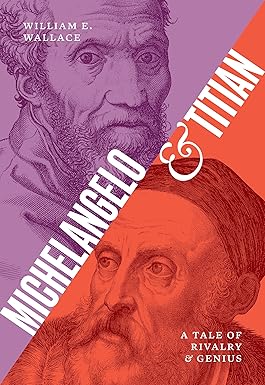
 Michelangelo and Titian: A Tale of Rivalry and Genius
By William E. Wallace.
Princeton University Press, 2026.
Hardcover, 248 pages, $35.00.
Reviewed by Jesse Russell.
There is a running joke that Americans remain perpetually torn between Puritanism and pornography. Indeed, such a contrast is pronounced in Nathaniel Hawthorne’s 1837 short story “The May-Pole of Merry Mount,” which pits the typically American tension between pagan revelry and Puritan sobriety. This tension can be found in the perennial American admiration for and suspicion of the enormous proliferation of Italian Renaissance art. As a telling example, Mark Twain famously commented in his 1880 A Tramp Abroad that Titian’s Venus of Urbino was “the foulest, the vilest, the obscenest picture the world possesses.” Americans have tended to prefer the sober and strong nudes of the pious Michelangelo to Titian’s more sensual and softer work. Both Michelangelo and Titian have been popularly perceived as rivals, and among scholars, there has been strong debate about the mutual influence of both painters on each other. In his recent work Michelangelo and Titian: A Tale of Rivalry and Genius, Washington University art historian William E. Wallace chronicles the rivalry and friendship of Michelangelo and Titian, noting that the two Italian geniuses were not as variant in outlook and craft as is popularly believed.
Professor Wallace begins his work with a description of not a Renaissance, but a 19th century painting by the French Pierre-Nolasque Bergeret, titled Charles V Picking up Titian’s Paintbrush. In this work the great Habsburg emperor of so much of the world is picking up a brush from the ground and handing it to the Venetian painter Titian. In a similar fashion, Wallace describes Cosimo Gamberucci’s 17th century depiction of a regally seated Michelangelo Buonarroti receiving a Medici prince. These paintings and Wallace’s narrative conveys the sense of respect and reverence with which painters were held in the Early Modern period. As Wallace notes, Titian or Tiziano Vecellio and Michelangelo were identified as the greatest artists of their time. They themselves were well aware of it. However, despite having only met in person twice, the two artists shared a common social network. Titian’s patrons were King Philip of Spain and his father Charles V, while Michelangelo was the chosen artist of a succession of popes.
As he states, Wallace hopes to answer scholarly questions about the influence the two artists had on each other. As any American visitor to Italy is usually surprised to learn, the country is diverse and has strong regional identities. Titian was a Venetian, and Michelangelo was a Roman. Michelangelo further primarily identified himself as a sculptor, signing himself Michelangelo sculptore or schultore. He had earned his fame from his Pietà, finished at 21 and, four years later, his David, which established his reputation as the greatest sculptor of his era. Titian earned his credentials painting a series of frescos on the life of St. Anthony of Padua in December of 1510. Wallace points out that the depiction of a husband murdering his wife (the husband was later shriven by St. Anthony) looks suspiciously like Michelangelo’s depiction of Adam and Eve in the Sistine Chapel. Wallace notes, however, that the paintings convey profoundly different theological and emotional messages.
This is one of Wallace’s key tasks: cleaning up and correcting some scholarly and popular perceptions of the two artists. Wallace argues that Titian may have heard of the Sistine Chapel depiction of the fall of Adam a bocca, that is, by word of mouth, and it thus may have influenced his depiction of the jealous husband. The oral culture of the Italian Renaissance functioned as a sort of proto-social media, allowing for ideas to spread and develop. This is one of Wallace’s most important historical points: an exploration of the ways in which Early Modern Italians communicated ideas. Wallace argues that Titian and Michelangelo largely developed independent of each other, however.
Michelangelo gained the moniker “il Divino” while Titian was called the “New Apelles.” They both sought the patronage of the Farnese family. Titian had painted his Danaë for Cardinal Alessandro Farnese and traveled to Rome in 1545 to deliver it to the Cardinal. Cardinal Farnese took Titian under his wing and provided him with rooms at the Vatican Belvedere. While in Rome, Titian painted his triple portrait of Pope Paul III and His Grandsons. Titian was a tireless promoter of himself as well as his family, lobbying for an ecclesiastical benefice for his son, Pomponio. This lobbying is another dimension to Wallace’s exploration of how Renaissance artists communicated and were promoted by others. Wallace notes that Titian even sought help from Michelangelo, who only granted a limited amount of favors to his dear friends. Wallace notes that one of the reasons why Michelangelo refused is because of the fact that Titian was not a member of the Roman aristocracy, as was Michelangelo.
Michelangelo also had a relationship with the Farnese. Like Titian, he was supported by “Il Gran Cardinale,” Alessandro Farnese. Farnese, who became Pope Paul III, was with Michelangelo, a product of the humanist circle of Lorenzo de’ Medici in the 1490s. Paul III also shared with Michelangelo a strong Christian identity and desire for Church reform. This is one of the great riddles of the Italian Renaissance: the combination of Machiavellian (both soft, Christian and harder edged forms) with natural law theory and Aristotelian ethics as well as the seeming admixture of Christian piety and pagan excess in visual arts. Michelangelo was a devout Christian who celebrated the beauty of the human body as God’s creation. He was a moral man who was socially adept and clever.
Wallace ends Michelangelo and Titian with Titian’s final works, the San Salvador Annunciation, the Judith, and his own (lesser known) Pietà. These works, according to Wallace, contain elements of Michelangelo’s influence, but they also were Titian’s way of establishing his legacy—even vis-à-vis Michelangelo. Wallace further devolves into his theme of the ways in which ideas and art were promoted in Renaissance Italy. Michelangelo had, famously, Giorgio Vasari, to promote him, while Titian had Pietro Aretino and Lodovico Dolce. However, despite Titian’s promoters, it was ultimately Vasari who has shaped later generations’ understanding of the Renaissance. At the same time, Titian’s works accelerated in fame in the years following his death, while Michelangelo faded only to be revived in the 19th century. Wallace does note that Michelangelo’s major works are more popular than Titian’s today.
At the end of the classic 1981 Raiders of the Lost Ark, the Ark of the Covenant is mysteriously (and humorously) packaged in a wooden crate at the order of “bureaucrats” in an enormous warehouse full of other wooden crates. The tantalizing suggestion by the film’s creators, Stephen Spielberg and George Lucas, is that the Ark of the Covenant is just one of many secret treasures hidden by the US government. In a similar fashion, the young (or old) person on tour of Italy usually becomes overwhelmed by the sheer volume of gorgeous artworks. There is a temptation to look at all of, not only Italian Renaissance, but the wider catalogue of Western visual art as so much bric-a-brac. However, Michelangelo and Titian provide an intimate portrait of two Italian masters that helps focus and highlight the unique preciousness of their lives and art.
Jesse Russell has written for publications such as Catholic World Report, The Claremont Review of Books Digital, and Front Porch Republic.
Support the University Bookman
The Bookman is provided free of charge and without ads to all readers. Would you please consider supporting the work of the Bookman with a gift of $5? Contributions of any amount are needed and appreciated!


