
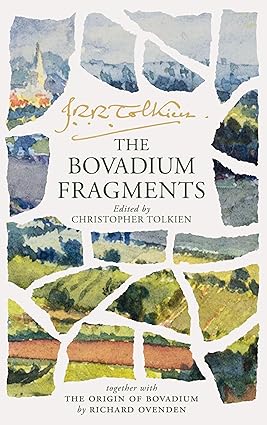
 The Bovadium Fragments: Together with The Origin of Bovadium
By J. R. R. Tolkien.
William Morrow, 2025.
Hardcover, 144 pages, $26.99.
Reviewed by Ben Reinhard.
When Russell Kirk decried the automobile as “a mechanical Jacobin”—a revolutionary naturally destructive of traditional ways of life and all “the more powerful for being insensate”—he was very much a voice crying in the American wilderness. The country’s long love affair with the automobile was only just beginning; the devastating social, economic, and ecological effects of a car-centered world would not be widely recognized for decades. But while Kirk remained a prophet without honor in his own country, he might well have found a more sympathetic hearing in England. That more settled country showed itself keenly aware of the automobile’s destructive potential from the beginning; Kirk’s conservative counterparts there were especially alive to its dangers. G. K. Chesterton, C. S. Lewis, Christopher Dawson—all in their way contributed to a robust tradition of anti-automobile discourse.
Now, with the publication of The Bovadium Fragments, we have J. R. R. Tolkien’s full entry into the conversation. That Tolkien was skeptical of the motor car is of course nothing new, and most careful readers of Tolkien are familiar with his occasional but cutting commentary on the subject: from the denunciation of the “‘infernal combustion engine” in his letters to the description of “mass-production robot factories, and the roar of self-obstructive mechanical traffic” in On Fairy-stories. Few outside of Tolkien’s most dedicated students, however, were aware that he had written an entire satirical story against the automobile. For those few, however, Bovadium was something of a white whale in the Tolkien corpus. First referenced in Clyde Kilby’s 1976 Tolkien and the Silmarillion and briefly outlined in Hammond and Scull’s authoritative Companion and Guide, Bovadium is (or rather was) the last significant piece of original Tolkien fiction to remain unpublished. It is difficult to overstate its value for the serious student of Tolkien. In the first place, the volume is outstanding among the recent publications from the Tolkien estate, which have tended to re-present materials already published elsewhere. Even more importantly, it gives us another witness to Tolkien’s original creative work in the years following the publication of The Lord of the Rings. For generations, Tolkien’s readers had only one tale (Smith of Wootton Major) from the latter period of Tolkien’s life. Now, with Bovadium, they have two.
To the volume itself. The Bovadium Fragments falls into three main parts: an editor’s introduction by Christopher Tolkien at the beginning and a 60-page historical essay by Richard Ovenden at the end, with Tolkien’s curious satire in the middle. The multi-layered presentation of the satire being somewhat daunting and disorienting, Tolkien’s own words may provide a helpful guide to the reader: it is a “nonsense” and “overelaborated” satire on “machine-worship,” “the pomposities of archaeologists,” and “the hideousness of college crockery,” and more besides. This is hardly the usual fare we expect from Tolkien; given this description, Bovadium’s decades-long delay in publication becomes more understandable.
For all this, Tolkien handles his satires well. The minor targets (crockery and, more pointedly, archaeologists) are brought in via a clever framing device. The central conceit of Bovadium is that Oxford (and indeed all of England) had perished in a massive automotive apocalypse in the latter years of the twentieth century; the work as a whole is presented as an academic study conducted by the archaeologists and linguists of a far-distant future, containing both the chronicles of the old world (the Fragments proper) and the scholars’ interpretations of them. Their conjectures—such as the assumption that scholarly Latin was the language of subjected and untutored rustics, or that Oxford was the central fortress of a backwards population—are ostensibly plausible, generally pretentious, and unfailingly ridiculous. But the most biting element of Tolkien’s satire is hidden from plain view. We are told, in passing, that the future Englishmen write from right to left—and therefore that they must read modern English words backwards “in order to discover their connexion, if any” with their “present tongue.” The same process, naturally enough, works in reverse as well. Colorful results occur when the reader applies this treatment to the scholars’ names: Gums, Rotzopny, Dwarf, and Sarevelk.
Ultimately, however, the tale is not about the pretensions of academics nor even the ugliness of college crockery, but a much more serious issue: the devastation wrought by the motor-car and (more broadly) the danger of machine-worship. The central story, written in Latin and English in a mock-historical tone reminiscent of William of Malmesbury or the Venerable Bede, can be briefly summarized. We begin in an idealized Edwardian Oxford in whose “time-honoured halls many men, both learned and pupils, pursued the liberal Arts.” This peaceful and prosperous existence is, sadly, not to last: some unknown Daemon creates “certain abominable machines”—the Motores. These rush through the streets of Bovadium, disturbing its quiet, “hunting” its citizens, and spoiling its beauty. But though the Motores are universally scorned, they are also universally coveted. The Daemon promises liberation: those who purchase and serve his Motores will be able to go wherever they wish, and arrive there quickly, unlike those who “live in narrow streets and walk like animals.” Most are seduced; some even come to worship their mechanical monsters.
But the Daemon lies. Though he offers godlike power, he delivers only destruction. Tolkien’s account of communities uprooted and environments destroyed in the name of automobile—of pollution and congestion and eminent domain and urban planning—reads like a precursor to the Strong Towns movement. Bovadium’s problem is similar to our own. Though the population is distressed by the effects Motores, the desirability and necessity of owning a Motor remains an unexamined and unassailable presupposition. Therefore, no one is willing to “listen to any plan that might hinder the supply of new monsters,” and nothing improves. Bovadium rushes headlong to its own destruction; the resultant apocalyptic vision is too biting, and too darkly amusing, to be spoiled in a review. The town perishes in fire, its citizens sink down to hell, and England moves through famine to a new, subsistence-level Dark Age.
This bleak vision of the future is not quite Tolkien at his bleakest: not yet. The grimmest note of all is sounded, not by the tale itself, but by the pseudo-scholarly commentary at its conclusion. Having related the historical accounts, Dr. Gums confesses that he doubts their truthfulness. It is “hard to believe,” he says, that Britain was ever so populous or prosperous, and flatly incredible that such an advanced civilization should destroy itself so foolishly. He takes consolation, however, that the lust for control and speed that doomed old Bovadium has no appeal for his people, who instead devote their attention to “peace, and food, and the visual arts,” as well as healing. There is a natural temptation to view this optimistically: the future men, chastened and corrected, seem to share a hierarchy of values with Hobbiton. But Tolkien will not allow us even this distant consolation. Dr. Gums confesses great confidence the future march of Medicine: “the hope is now near that we shall at last conquer mortality, and not ‘die like animals’: to quote the words of our leading Thanatologist. Some think that he is inspired.” The echo of the demon’s old promise is unmistakable, the suggestion of supernatural inspiration highly ominous, and the conclusion inevitable. The Motores may have been a passing fad, but the demonic temptation to reclaim Eden by force is perennial. The Machine will always reassert itself under different guises. The Daemon abides.
This tale, equally whimsical, amusing, and alarming, is presented in a volume that is, manifestly, a labor of love. A 60-page essay on mid-century traffic debates in Oxford provides exhaustive and comprehensive historical context for Tolkien’s tale while demonstrating the editor’s almost hobbitish passion for the minutiae of local history, “laid out fair and square and with no contradictions.” Bovadium is also liberally supplied with lovely full color illustrations and figures—some Tolkien originals, some historical photographs and planning documents, all contributing to the volume’s appeal. The codicological details of the book’s construction, minor though they may seem, also deserve mention. Few modern books will rival Bovadium’s beauty and elegance: from its embossed dust jacket and high-quality binding to the heaviness of its paper and generous margins. It might have been otherwise. The cheap Tolkien paperbacks we will always have with us. But Bovadium was made to endure.
So great is the care lavished on the volume that it seems almost ungenerous to find fault with it. And indeed most ordinary concerns—cavils about the proportionate length of the historical essay, or whether its information might have been more effectively communicated in endnotes—can and should be passed lightly over. One niggling doubt, however, refuses to be so quieted. In brief: Tolkien had said that “machine-worship” was the original heart of his tale. Alas, with the exception of Chris Smith’s introductory “Publisher’s Note” (as excellent as it is brief), the volume’s abundant critical commentary fails to do full justice to this theme, and indeed scarcely acknowledges it. Thus, while we hear a great deal about A. D. Godley’s satirical poem on the “Motor Bus” in Christopher Tolkien’s introduction, and a great deal more about the history of Oxonian traffic policy in the essay by Ovenden, we get precious little about this central theme from either one.
But perhaps this neglect is benign in the end. In those rare cases that the critical commentary in the volume does touch on the work’s greater theme, it obscures more than it illuminates. Indeed, Clyde Kilby’s fear that the “playfulness” of the tone would distract from the seriousness of its message seems to have been vindicated. Let us consider one particularly illustrative example from Ovenden’s essay:
Although satirical, [Bovadium] was good humoured and moderate in tone, though the message is clear—the role of planners in changing the environment in which people lived in order to work and live, and in giving priority to the motor car, was both dangerous and negative.
This sentence is as difficult to defend as it is to diagram. Good humoured the tone certainly is. Moderate it is not: did Ovenden miss Tolkien’s pastiche of Psalms and prophets in Fragment III, condemning both the Machines and their idolatrous servants? Similarly, while a polite penchant for understatement may be invoked to explain Ovenden’s decision to describe a civilization-ending Ragnarok as “both dangerous and negative,” the description strikes me, at least, as more bathos than litotes. Finally, while Tolkien certainly views planners with a skeptical eye, they are not the chief target of his satire. The Motores—and the attendant machine-worship—are.
Even Christopher Tolkien (so often the best and most reliable interpreter of his father’s work) shows a similar weakness in his treatment of the topic. In his explanatory notes, he takes pains to point out that the Daemon should not be understood as a Judeo-Christian demon, but rather as “an attendant or indwelling spirit” roughly equivalent to the Roman genius. By contrast, consistent indications in the tale show that demon is precisely the sense intended (guardian geniuses do not, as a rule, devise civilization-ending catastrophes, laugh at their victims’ misfortunes, or traffic with spirits in hell). The volume’s most glaring factual error is, curiously enough, likewise connected to just this question, and reflects the same general tendency of amelioration or softening. I confess that I find it difficult to account for all this. Perhaps the editors simply missed the point; perhaps they were indifferent to it. Perhaps, heeding Kilby’s warning that a frontal assault on Motores and the Machine would render Bovadium unappealing to mass audiences, they found it inconvenient. Whatever the reason, Tolkien’s most piercing notes are blunted.
This is unfortunate in more ways than one. Not only does it blur the clear lines of Bovadium—it also makes it more difficult to appreciate the story in the larger context of Tolkien’s thought. After all, for Tolkien, the Machine was very nearly the thing. It is there in his earliest attempts at his Legendarium (in which he imagines dragons, not as serpentine beasts, but animate war-machines); it is there in The Hobbit, whose slothful and efficient goblins are spiritual kin to Bovadium’s demon (they are responsible for “some of the machines that have since troubled the world, especially the ingenious devices for killing large numbers of people at once, for wheels and engines and explosions always delighted them”). It is there, repeatedly, throughout The Lord of the Rings and The Silmarillion: as Tolkien himself said, “all this stuff is mainly concerned with Fall, Mortality, and the Machine.” And it is here that we find Tolkien’s most pressing relevance for the twenty-first century. Will his readers find a way to live humane and God-fearing lives in an alarmingly technocratic age, or will the Daemon and the Machine triumph? Has the Long Defeat come at last? As Chris Smith notes in his publisher’s preface, Bovadium’s “themes remain both provocative and timely.” And so they do: would that the volume had presented them more thoughtfully.
A missed opportunity, perhaps. Nevertheless, Bovadium was worth the wait.
Ben Reinhard is Professor of English and a fellow of the Veritas Center for Ethics in Public Life at Franciscan University of Steubenville, where he teaches courses in medieval English literature, the epic tradition, and the Inklings. His most recent book, The High Hallow: Tolkien’s Liturgical Imagination, was published in 2025 by Emmaus Road Press. He lives in Steubenville, Ohio, with his wife and children.
Support the University Bookman
The Bookman is provided free of charge and without ads to all readers. Would you please consider supporting the work of the Bookman with a gift of $5? Contributions of any amount are needed and appreciated!

