
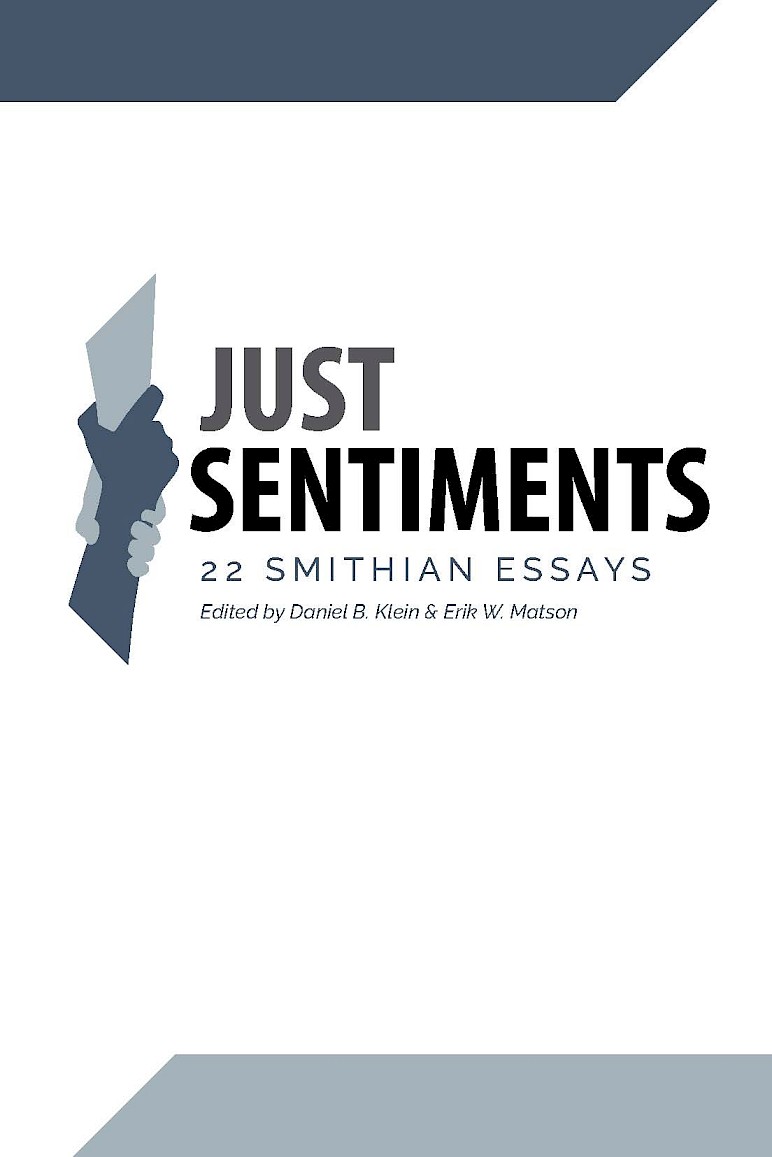
 Just Sentiments: 22 Smithian Essays
Edited by Daniel B. Klein and Erik W. Matson.
CL Press/Fraser Institute, 2024.
Paperback, 262 pages, $7.50 (free PDF download)
Reviewed by Michael Munger.
Just Sentiments is a curated, teachable set of serious interpretive essays. It is text-forward, conceptually pointed, and excellent for classroom or lunchtime discussion. In fact, it’s hard not to discuss many of the points made here. The book’s main limitation is that it is more a conversation within a particular Smithian-liberal scholarly network than a bridge across the full pluralism of contemporary Smith studies. But that is also the book’s strength, because it makes no pretense of being anything other than what it is: an extension of a deep and ongoing discussion. I will certainly be using the book in class, since the downloadable and searchable PDF makes it the perfect complement to primary texts and lectures.
The volume collects twenty-two essays published as a monthly feature on Liberty Fund’s Adam Smith Works in 2022 and 2023. The editors note that these pieces are presented in order of appearance, and were revised “only little or not at all.” Since the work was published online, there were hyperlinks (including links embedded in figures to underlying data) that were removed in the book version.
The book is not a unified monograph or a state-of-the-field survey. It is closer to a curated set of “research notes” or “interpretive interventions”: each author draws on longer work to offer arguments that are meant to be textually grounded and compact. The table of contents shows real topical range—from conceptual analysis of “natural liberty” and “natural convention,” to jurisprudence and enrichment narratives, to moral psychology, to theology and the “invisible hand,” to comparative cultural inquiry (Smith and Confucius), to applied questions such as education funding. The value of the book is therefore topical, like any collection of readings: if you are discussing one of these topics, having the PDF allows an easy way to assign one of these essays.
Of course, the same essays (almost exactly the same essays) are available at Adam Smith Works. But having the book reduces the search costs for faculty and interested scholars alike, and the consistent format and pagination allows discussions to point to a common reference: “If you look at the first paragraph on page 23….” It is also a defined and circumscribed “universe” for searches for topics, for students doing research and looking for insights. This curation function is becoming more, not less, important, as the corpus of text available for general searches becomes unmanageably dense and confusing.
The editorial framing also matters: Klein and Matson read Smith as an author who tries to shape readers’ sentiments, linking moral cultivation to social science and public policy judgment. That interpretive posture—Smith as both analyst and moral educator—threads through many of the essays even when the subject shifts.
The manuscript has two strengths. The first is form: short essays that are genuinely usable in teaching and discussion without abandoning scholarly habits. The volume standardizes citations to Smith via the Glasgow paragraph system (TMS, WN, EPS, LJ, etc.), which makes claims easy to verify and to assign across editions.
That “compact but checkable” style is on display immediately. The opening chapter anchors “natural liberty” in Smith’s own repeated formulations (e.g., leaving people free to pursue their interests “as long as [they do] not violate the laws of justice”) and then offers a clear interpretive move: natural liberty as the “flipside” of commutative justice—i.e., the jural condition of not being interfered with in one’s person, property, and due promises. Whether one ultimately accepts that framing, it exemplifies what this collection does well: it locates a conceptual claim in explicit textual references and then makes a clear and therefore debatable claim about that interpretation.
This is a meaningful contribution to “Smith studies” as a living literature because it lowers the cost of entry for serious engagement. Many introductions to Smith drift into slogan (“invisible hand,” “laissez-faire”) or into secondary-literature name-checking. Here the reader is repeatedly pushed back to primary Smith source text.
The second strength is thematic: the essays consistently circle back to Smith’s moral theory. This connects institutional analysis and policy judgment, rather than treating TMS and WN as separate “philosophy” vs. “economics” silos. The preface explicitly frames Smith’s project as shaping and ennobling sentiments, even suggesting that his political economy can be read as instruction toward “juster sentiments” about public policy.
Several chapters illustrate how this integration works across domains:
- The Klein essay on McCloskey and the Great Enrichment reframes Smith as a cultural and moral “authorizer” of ordinary commercial striving (“having a go”) while pressing jurisprudence as conceptually—and historically—central to liberal development.
- Mueller’s chapter explicitly links limited government arguments to a Smithian account of moral judgment under abstraction, warning against “governmentalization” as a slide from governance into over-governance when judgment becomes warped in highly abstract contexts.
- Santori’s chapter (on Smith, Philo, and the problem of evil) reads the early WN account of exchange and improvement as part of a theodicy—an interpretive angle that forces readers to reconsider what counts as “theological” in Smith and how moral anthropology and political economy interact.
- Tan’s “Smith and Confucius” essay (whatever one thinks of the counterfactual conversational device) showcases the ambition to treat Smith as working with claims about universal human nature while also tracking how norms of propriety are learned and revised—linking Smith’s “loose, vague, and indeterminate” propriety to a dynamic conception of li.
Even readers who disagree with the collection’s broad normative valence will find that it consistently models a way of reading Smith as a unified thinker about persons-in-society—morally formed agents embedded in evolving rules, conventions, and institutions.
The greatest weakness of the book is simply its (clearly stated and intentional) choice to have a narrow focus, both thematically and in terms of the work’s likely conversation partners. That is visible in the “about the authors” section: a large share of contributors is affiliated with, trained at, or closely connected to George Mason University and the Mercatus/Smith programs (including the editors). This is not, by itself, a flaw—specialized communities often produce excellent work. But it shapes what kinds of debates the essays do not stage. The essays tend to read as interventions within a broadly “Smithian liberalism” orbit rather than as engagements with (say) the rival interpretive traditions that have recently animated Smith scholarship in history, political theory, postcolonial studies, feminist theory, and global intellectual history.
A second, more practical aspect of the same weakness follows from the book’s origin as an online feature: removing hyperlinks and data-source links (while revising “only little or not at all”) sometimes strips away apparatus that mattered to the original argumentative presentation, especially when figures are invoked. The editors do tell readers to “recur” to the original web essays for sources, but in a printed/PDF book that move raises the transaction costs that the Glasgow citation system otherwise lowers.
I stared out the window of my office for a few minutes, thinking about who might want to read and use this book, and also who really should read it, but probably won’t want to. On the “who will read” question, I expect there are three categories:
- Teachers building upper-level undergraduate or MA-level readings in political economy, moral philosophy, or the Scottish Enlightenment—especially if you want short pieces that reliably send students back to TMS/WN with verifiable references.
- Readers who already like Adam Smith Works / Liberty Fund and want the monthly essays in a stable, citable format, with the editorial through-line about moral education and public-policy judgment.
- Scholars or advanced students who want “sharpening stones”: compact arguments you can assign, rebut, extend, or use as prompts for seminar papers.
As to “who should read it, but probably won’t want to,” I came up with these groups. If I could wave a magic wand, I think some folks would benefit, and the world might be a better place, if the book could appear on certain desks.
- Smith specialists in adjacent fields (history of capitalism, empire studies, postcolonial political theory, feminist history of ideas) who often dismiss “Smithian liberalism” work as apologetic or programmatic. They should read it because it models careful textual argument and reveals what an influential interpretive community is currently doing with Smith—but they may not enjoy it because the volume rarely meets their preferred questions on their own ground. The focus on liberalism here, which sensibly entails the omission of Smith’s attention to colonialism and empire, will likely be taken to justify such scholars ignoring the book.
- Policy people who cite Smith rhetorically but don’t read him: the chapters reward slow attention to concepts like justice, propriety, and judgment under abstraction; that’s exactly the sort of reader who most needs the book, and exactly the sort least likely to want its level of textual discipline.
I liked this book—but I am very much in the club that cares about exactly the conversation that these essays contribute to and advance. Adam Smith rewards study, and the contributions in Just Sentiments are a useful way of bringing new students and scholars into the ambit of that study.
Michael Munger is Pfizer/Pratt University Professor of Political Science, and Economics, at Duke University. He was President of the Public Choice Society, and is currently President of the Philadelphia Society. His most recent book, The Sharing Economy, was published by the Institute for Economic Affairs in 2021.
Support the University Bookman
The Bookman is provided free of charge and without ads to all readers. Would you please consider supporting the work of the Bookman with a gift of $5? Contributions of any amount are needed and appreciated!

