
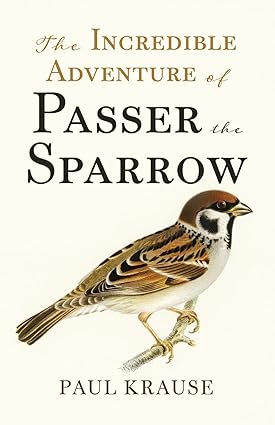
 The Incredible Adventure of Passer the Sparrow
By Paul Krause.
Resource Publications, 2025.
Paperback, 94 pages, $12.
Reviewed by Auguste Meyrat.
As any parent of reading-age children can attest, it is difficult to find good books for them. Beyond the challenge of finding something that matches their reading ability, there is the greater challenge of finding a text that is both engaging yet wholesome. Most books designed to appeal to children often lack substance, rely on cheap spectacle, and subvert traditional morality—they are the literary equivalent of junk food. Meanwhile, the books that do not suffer from these problems nonetheless lack the same appeal; usually, they are older, denser, and slower.
Moreover, many of the more popular children’s books quickly evolve into series, morphing from original stories to predictable soap operas that frequently lapse into unimaginative drivel. For example, I once was a fan of the children’s book series Dragon Masters by Tracey West. After a few decent episodes, the series soon degenerated into a kind of Pokemon/Harry Potter imitation and plunged ever deeper into woke narratives (i.e. girlbosses, racial tokenism, and alternative families). I finally gave up when the series introduced a “nonbinary” character—call me old fashioned, but this was not a conversation I wanted to have with my young children.
The whole process makes a parent yearn for books that somehow rise above the fray, delivering innocent, original, and aesthetically pleasing stories yet still mind the limits of younger readers. Sure, there are the classics of Roald Dahl, C.S. Lewis, and Laura Ingalls Wilder, but it would be nice to have some new books without the baggage of innumerable film adaptations and literary spinoffs.
Responding to this great need, writer and poet Paul Krause has recently written a beautiful little book The Incredible Adventure of Passer the Sparrow. The story is as delightful and charming as it sounds, recounting the odyssey of a virtuous sparrow named Passer who must move his family to a new home after “big yellow machines” appear at his home.
Despite taking place in a typical American suburb, Passer’s world is vast and teeming with life and color. Each tree hosts whole communities of birds, squirrels, and other creatures, and each has its own culture and atmosphere. Passer himself is part of a long dynasty of sparrows, carefully fulfilling his role as a young patriarch and abiding by the wisdom of the tree Birch, both a character and a setting. His new friend Kaw, an older father crow with a tragic past, becomes the ideal mentor, conferring his wisdom and providing support to Passer and his family. Though they are different birds with different backgrounds, Passer and Kaw come to complement one another and form a strong bond.
Although Krause takes care to keep the characters and plot relatively clear and simple, he still incorporates many important themes, motifs, and arguments in his story, almost all of which cut against today’s conventional wisdom. First and foremost, the trials of Passer and his friends are meant to illustrate the necessity of virtue. Each character radiates a kind of goodness that allows for the continuance of individual and communal life. They all take responsibility for each other, contributing in their own way, and remaining hopeful in success and accepting of risk.
On a deeper level, the story makes important points about the nature of fatherhood, home, and wisdom. Passer has to constantly negotiate the two key paternal obligations of protecting his family and providing for them, consider the best place to establish his new home, and make sure to consult with the old oak tree Birch and the even older owl Ash. Alas, the modern reader will wait in vain for the appearance of a strong female bird ignoring the advice of everyone and singlehandedly thwarting the incoming humans and scolding Passer for his stupidity and cowardice.
Overall, every element of the novella comes together to make it refreshing and pleasant to read. Krause proves that it is indeed possible to tell a compelling story with subtlety and depth without resorting to subversion, snark, or cynical gimmicks. Additionally, he avoids the other extreme of becoming preachy and obvious. His story is universal, timeless, and elegant.
At least, this was how I felt about The Incredible Adventure of Passer the Sparrow. In the interests of objectivity and fairness, I also had my 9-year-old daughter read the book and offer her thoughts. Indeed, she loved everything about it. While she may not have appreciated the more profound aspects of the book quite as much as her father, she instantly fell in love with Passer and his family, hoping for their eventual success in finding a new home.
Thus, for both the adult and child, I can confirm that Krause’s book is wonderful and suitable for any home library. With any hope, other whimsical writers can build on this kind of literature and offer more options for today’s families who want more truth, goodness, and beauty in their stories. Never has there been a greater need for it.
Auguste Meyrat is an English teacher and freelance writer in the Dallas area. He is the founding editor of The Everyman, a senior contributor to The Federalist, and has written for essays for The American Mind, The Stream, Religion and Liberty, The Blaze, and elsewhere. He is also the host of “The Everyman Commentary Podcast.”
Support the University Bookman
The Bookman is provided free of charge and without ads to all readers. Would you please consider supporting the work of the Bookman with a gift of $5? Contributions of any amount are needed and appreciated!

