
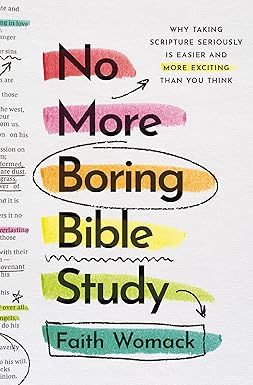
 No More Boring Bible Study: Why Taking Scripture Seriously Is Easier and More Exciting Than You Think
By Faith Womack.
Zondervan Books, 2025.
Paperback, 240 pages, $19.99.
Reviewed by Xavier Serrani.
The expansive scope, multiple genres, and occasional obscurity of the Bible can make anyone hesitant to embark on a serious study. Faith Womack’s No More Boring Bible Study is here to help. The book offers many important approaches to studying the Bible in a way that is easy to understand for a beginner. Two sentences into the preface succinctly illustrate both the invitation and the challenge of the book: “I believe all Christians everywhere should know and understand Scripture… You also won’t understand it until you realize how it was intended to be read.”
Womack grounds her lifelong study of and lessons learned from the Bible in her faith journey. Each chapter begins with a personal anecdote that Womack uses to illuminate the particular point for the chapter. Each chapter ends with “Bible Nerd Notes,” so named for Womack’s affectionate nickname for others studying the Word. These notes identify points to keep in mind as the Nerd does his or her own study.
In the opening section, Womack lays out a few rules of thumb that serve as foundational assumptions for the book. The first two concern reliability and translation. Womack argues that the Bible is reliable: it is inerrant and infallible. The Bible is both free of error and true in its message. It can be trusted as the authentic Word of God.
Womack discusses different translations of the original text of the Bible. She writes, “Just as the church is built of Pentecostals, Presbyterians, and Baptists, so also it is equipped with many different Bible translations.” She places them on a spectrum of formal equivalence to dynamic equivalence. Formal equivalence seeks word-for-word translation while dynamic equivalence renders thought-for-thought translation. Each method has its strengths and weaknesses, and Womack advocates that readers use a variety of translations to generate a richer understanding of the text. This discussion of translation leads to the third rule of thumb: don’t be distracted by arguments about the merits of different translations. Focus on the fact that it is the authentic Word of God.
In addition to these rules, Womack introduces several technical concepts that she uses in her examples of study throughout the book. One is hermeneutics, the study of reading and interpreting the Bible. Exemplifying the dangers of a flawed hermeneutic, Womack shares the story of how she learned about her parents’ divorce, and how her father abused Scripture to justify his actions. Her father had weaponized passages in Proverbs discussing marriage against his family. No hermeneutic, however fancy, can justify action that Jesus himself condemned.
Contrasted to this flawed method of reading, Womack provides several lessons on how to adopt a faithful hermeneutic. This is not to say that we should leave our own experiences aside when we approach the Word, but we should be careful lest it color our reading too much. Here Womack makes the important distinction between eisegesis and exegesis, or, roughly speaking, “me-centered” reading versus “God-centered” reading. She repeats throughout the book that the Bible is “the story of God redeeming his people for his glory.” Scripture is for us—but it is about God. While Womack believes the doctrine of perspicuity, that Scripture is “clear enough for anyone to understand salvation,” she warns lest one read herself into the Bible.
Womack herself exemplifies this humble attitude toward reading the Bible. Her exegeses display a hermeneutic that is fundamentally receptive, not combative. Too often one can read the Word seeking confirmation for a belief already held or decision already made. Womack cautions the reader not to approach the Word “only looking for solutions to our problems” or “manipulating it to be our own story.” It is tempting to go to the Bible for answers to life’s mundane challenges, discarding a faithful interpretation. Womack calls this out, but in a self-aware and understanding way. She experiences this temptation herself, sympathizes with others who do so, and provides tools to avoid it. In fact, she offers a powerful incentive for setting our egos aside when studying Scripture: “We are freed to find so much more richness in Scripture when we look at the truths in Scripture outside of us.”
Womack uses the four-point structure of Creation, Fall, Redemption, and Consummation (abbreviated as “CFRC”) to organize the storyline of the Bible and bring out its richness. Understanding where each book of the Bible fits into this structure is crucial to grasping its true meaning. Womack writes, “If I am in the Old Testament, the passage is looking forward to Jesus, the cross, Redemption, and Consummation… If I am in the New Testament, it’s likely that whatever I am reading is explaining or revealing the work of Jesus on the cross.” Using this framework helps the reader see where the Old Testament points to humanity’s need for a savior, how the New Testament reveals Christ as that savior, and how believers should now live according to that revelation.
Womack dedicates the next section to explaining how understanding genre, author, and audience are crucial to Bible study. She describes the seven forms of literature in the Bible: history, law, epistle, prophecy (including apocalyptic), gospel, poetry, and wisdom. There is a chapter dedicated to each of these seven genres. Womack explains how each genre is written in a different style by a different author for a different audience. For example, the prophetical books like Ezekiel “function as a sort of social commentary by God to his people, warning them of the consequences of their sin and idolatry and reminding them of their covenant.” The Gospel of Matthew was written to “Jewish Christians to encourage them in their faith and give them confidence.” Womack succinctly details the other genres similarly.
There is a section earlier in the book about biblical “studenthood” to begin the discussion of genre, but the last section is where the craft of study is fully developed. The penultimate chapter is an excellent summary of the book, and in fact I recommend reading it first. Womack lists resources such as Bible dictionaries, commentaries, concordances, lexicons, and, of course, good old-fashioned notetaking. She also includes points of literary criticism that can be helpful to Bible study. The last chapter encourages readers to simply go read the Word of God and not to be discouraged by its vast scope or occasional obscurity. These encouragements recall a verse referenced multiple times in the book, Hebrews 4:12: “For the word of God is alive and active.”
For beginners to Bible study or for former students needing a few reminders, No More Boring Bible Study is an excellent companion text. Womack introduces important concepts and provides helpful tools to her fellow Bible Nerds to discover the richness of the Word. She also effectively details the different genres of Scripture. These concepts, tools, and details are woven together with personal anecdotes that make the text easily relatable. The author’s love of Scripture shines through, and it can only help anyone honestly pursuing the truth of God’s Word.
Xavier Serrani holds an undergraduate degree in Political Science from The University of Chicago. He writes both fiction and non-fiction from his home in Indiana.
Support the University Bookman
The Bookman is provided free of charge and without ads to all readers. Would you please consider supporting the work of the Bookman with a gift of $5? Contributions of any amount are needed and appreciated!