
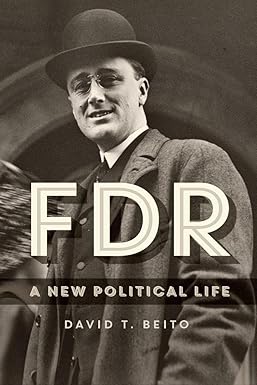
 FDR: A New Political Life
By David T. Beito.
Open Universe, 2025.
Paperback, 284 pages, $29.95.
Reviewed by Chuck Chalberg.
Did the presidency of Herbert Hoover and the New Deal of Franklin Roosevelt actually prolong what today might be remembered as the “panic of 1929?” Thanks to both Hoover and the Democratic candidate who defeated him in 1932, we will never be able to answer that question. That winning candidate, by the way, might have added to the “might-have-been-ness” of it all by campaigning against his Republican opponent’s budget-busting spendthrift policies.
In any case, thanks to Hoover alone, that potential panic will be forever remembered as the Great Depression. After all, it was President Hoover’s stroke of political genius that had led him to think that a temporary “depression” on that sometimes bumpy road of American prosperity sounded a whole lot better than calling the stock market crash of October 1929 anything approaching an event that would set in motion anything so frightful as a nineteenth-century “panic.”
But now, thanks to David Beito, we have renewed grounds for at least making some reasonably educated guesses about what might have been following the stock market collapse that brought a sudden halt to the otherwise roaring twenties. Renewed grounds? Burt Folsom, author of New Deal or Raw Deal, and Richard Vedder, among a few others, have come before him. But theirs has always been a minority view among academic historians.
Nonetheless, admittedly indirect evidence has been put forth, evidence which at least suggests that Hoover might have been inadvertently onto something when he successfully proposed replacing the notion of a relatively quick “panic” with something more drawn out, maybe even something as doggedly depressing as, well, as a “depression,” whether great or otherwise.
While we’re wondering, we can only wonder why neither Hoover nor FDR called to mind something of fairly recent memory, namely President Warren Harding’s refusal to leap to governmental quick—and/or possibly permanent—fixes in the face of the post-Great War economic doldrums, doldrums that might well have qualified as a panic. For that matter, one can only wonder what a re-elected Calvin Coolidge might not have done in 1929 had he, in fact, chosen to run in 1928.
By the way, that would be the same Calvin Coolidge who referred to his secretary of commerce as the “boy wonder,” and he was not complimenting him. We can conclude that because Coolidge was known to complain that the aforementioned wonder boy had kept trying to give him advice, “all of it bad.” Who might that cabinet secretary have been but one Herbert Hoover.
That would be the same Herbert Hoover whose misfortune it was to accomplish in 1928 what he had refused to attempt in 1920, namely, run for and win the presidency. During the lead-up to that presidential campaign, leaders of both parties had made serious overtures to the orphaned boy from Iowa who had amassed a small fortune as a mining engineer before serving admirably in the Wilson administration. But Hoover spurned them all.
Beito wastes little time on the eventual Hoover presidency, aside from joining candidate Roosevelt in criticizing this Republican’s penchant for turning to governmental solutions to deal with the panic that might have been. He notes that Hoover spent more on public works than the nine previous presidents combined. A few pages later he quotes from a Roosevelt campaign speech that accused Hoover of presiding over the “greatest spending administration in peace time in all our history.”
To be sure, there would prove to be significant differences between the domestic policies of President Hoover and those of President Roosevelt, just as there would also turn out to be significant differences between candidate Roosevelt in 1932 and President Roosevelt in 1933 and beyond. By the same token the differences between Hoover and FDR were not as great as those between Coolidge and his “boy wonder.”
The Hoover-Roosevelt differences also extended to matters strictly political, as well as to those that might fall under the general category of public relations. There is a reason that this biography is subtitled “A New Political Life,” given FDR’s preoccupations with matters political and his undeniable skills when it came to practice of his chosen craft.
Hoover, on the other hand, lacked both the skills and the interest. A case in point that would confirm his political ham-handedness would be his dispatching of General Douglas MacArthur and troops to forcibly dispatch the Great War “bonus marchers” from the Anacostia Flats of the nation’s capital.
That would be the sort of mistake that the much more politically adept FDR would not make. In truth, by his own reckoning this President Roosevelt made precious few political mistakes. His ability to win six elections in a row, two two-year terms as governor of New York, followed by four four-year terms as president of the United States, ought to be evidence enough of that.
With FDR: A New Political Life, University of Alabama Professor Emeritus David Beito is now on hand not just to chronicle that political acumen at work, but to emphasize its importance to the practitioner as well. Clearly, FDR’s string of ballot box successes would be achieved with a minimum of politically costly mistakes. And here Beito is quite willing to give credit where credit is due.
Nonetheless, his larger point—and major criticism—still stands. Roosevelt’s true genius was the practice of politics. But his success at that practice did not come without costs of its own. Roosevelt may well have believed that his political success and his country’s economic recovery would proceed along parallel paths. But the evidence suggests otherwise. In fact, reading Beito leads one to surmise that the Rooseveltian preoccupation with the politics of leadership may well have significantly delayed and even retarded the very recovery that was supposed to result from his leadership.
In this brief but often relentless biography, a treatise that barely exceeds two hundred pages, Beito proceeds at breakneck speed to crown Roosevelt as a political master, even as he is out to raise serious doubts that the master of Hyde Park deserves any ranking among the near great, let alone great, American presidents.
That ranking is no doubt much more attributable to Roosevelt’s standing as the president who helped orchestrate the Allied victory over Germany and Japan than his failure to extricate the country from the Great Depression before our entry into that war. But even here Beito has his questions and his doubts—and not just about FDR’s leadership during that war, but about his lack of leadership prior to our entry.
Nonetheless, let’s deal with first things first. Roosevelt may have been elected to an unprecedented third term because of simultaneous crises in Europe and Asia, but he had been elected to a first and second term to solve a crisis at home. Ironically, that crisis would ultimately be resolved far less by his aggressive actions on the American home front prior to 1940 than by American participation in a Second World War that he may or may not have hoped to avoid.
May or may not? In all likelihood FDR knew that the United States would not be able to avoid joining this conflict, whether before or after his late October 1940 campaign pledge that “no American boy would be sent into any foreign war.” But he always kept his cards and thoughts very close to his vest. Had he not died in office, he might have written a memoir. But even had he been able to do so, great mystery might still surround his words, thoughts, and actions.
The same might be said about candidate Roosevelt’s tactics in the 1932 campaign. No doubt it was politically wise not to lay before the voters many specifics about his New Deal agenda. All the better to dwell on Hoover’s failures than to stake out policy positions well to Hoover’s left, thereby leaving voters in the vast middle wondering what to do on election day.
Did Roosevelt know that he was being less than honest with the voters about his own intentions for government actions and government spending? Beito doesn’t say so, because no one likely knows, including perhaps Roosevelt himself.
What Beito both knows and demonstrates is that the political implications of New Deal programs were never far from Roosevelt’s concerns or field of vision. A good example would be the Agricultural Adjustment Act, which gave farmers broad discretion in deciding which land to take out of production. The result in the Democratic Solid South was to throw more than a million people out of agricultural work. Most were black, but since they were “politically powerless, FDR could safely ignore them.”
Separate chapters on the first and second New Deals jump rapidly from one program or one issue to the next, with the emphasis invariably being placed on the political impact of this program or that issue. The status of federal anti-lynching legislation surfaces with some frequency, always to reveal FDR’s reluctance to antagonize his white southern voting base.
FDR and his administration also mastered the art and the secret of steering federal patronage to states and districts that made political sense, but not necessarily economic sense. The same might be said about steering funds away from certain states and districts. It was all part of what then became a “new political life,” a life which would eventually become an entrenched feature of too much of all political life.
Another feature of the new political life of this Roosevelt administration was President Roosevelt’s sustained political attack on the wealthy. To be sure, his distant cousin Theodore could occasionally lash out at the “wealthy criminal class,” but FDR clearly outdid TR in class-warfare rhetoric. And he more than matched that rhetoric with confiscatory, peacetime tax rates.
Beito, in turn, does not resist noting the ironic consequence of New Deal income tax levels. The wealthy responded with all sorts of dodges, shelters, and escapes. The resulting shortfall led the administration to resort to the excise tax to fund the government. According to Beito, income taxes constituted 78% of federal revenue in 1931, with excise taxes supplying the difference. By 1935 excise taxes had “spiked” to 55% of federal revenue, and by 1940 that figure had dipped only to 47%.
Federal income from the tariff must have accounted for something rather than nothing, but Beito’s larger point still stands. Ordinary Americans were shouldering a large share of the tax burden, courtesy of daily taxes on such items as gasoline, movie tickets, toiletries, cigarettes, and eventually alcohol.
Beito also chronicles FDR’s move to the left in 1935 by securing passage of the Wagner Labor Relations Act and Social Security. Safely re-elected in 1936, FDR may well have let things go to his head, as one of his aides not so gently put it. How else to explain the political missteps of the “court-packing” scheme and the attempt to purge conservative Democrats in the 1938 mid-term elections?
Well, David Beito is on hand to provide many additional explanations, not to mention many additional examples, of FDR’s desire to wield power, as well as his willingness to use that power against his actual and potential political enemies, whether they be within his own party or in the Republican party, as well as in private industry and the press—especially the press.
The success of this new and enhanced political life is undeniable. Just read David Beito for confirmation. The success of this Roosevelt administration when it came to solving the panic of 1929 that became the Great Depression of 1929 to 1941, is very much deniable. Just read David Beito for confirmation.
John C. “Chuck” Chalberg once performed a one-man show as FDR’s distant cousin Theodore.
Support the University Bookman
The Bookman is provided free of charge and without ads to all readers. Would you please consider supporting the work of the Bookman with a gift of $5? Contributions of any amount are needed and appreciated!

