
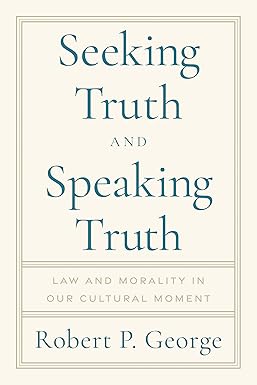
 Seeking Truth and Speaking Truth: Law and Morality in Our Cultural Moment
By Robert P. George.
Encounter Books, 2025.
Hardcover, 414 pages, $34.99.
Reviewed by R. McKay Stangler.
The first question, and perhaps the most pressing one when reviewing a book by Robert P. George, is this: Even in the comparatively small world of intellectual conservatism, is there anything George isn’t doing? He seems to be on every advisory board, every conversational roundtable, every conference panel. There he is at each significant conservative event, there he is quoted in every article about campus speech issues, and of course—most delightfully—there he is in an Odd Couple-ish embrace with his famously good pal Cornel West, as they run their perpetual Friendship Despite Divisions road show.
And by the way, in case all these things don’t make you look at your own weekly schedule and wonder where the time goes, he’s still running the James Madison Program at Princeton—the highly regarded program that essentially created the “civics center” template now sweeping academia—where he is also McCormick Professor of Jurisprudence. In the midst of all that, he still finds time to be the Best Dressed Man in academia: sporting a three-piece suit in nearly every appearance and setting the sartorial standard for scholars across the land.
Now a new volume comes our way from the busy desk of Robert P. George: Seeking Truth and Speaking Truth, an essay collection spanning subjects from Catholicism and civic order to “gnostic liberalism” to the interplay of markets and civil society. Despite the broad subject matter, George’s overarching aim in this new collection is to discern how it is that civilization evolved from the “Age of Faith” in the medieval period to the “Age of Reason” of the Enlightenment and its aftermath, only to now arrive at what he calls the “Age of Feelings.”
Echoing Alasdair MacIntyre, Philip Rieff, and Christopher Lasch, George sets out to explore across these essays how and why we all seem to feel that our “values and convictions are, in some sense, objectively true,” and how people “treat their beliefs as infallibly true and thus treat their feelings as if they are infallible sources of truth.” This likely reads as reflexively obvious to us moderns here in 2026. Note that the reigning dictum of high culture this past decade or so is not speak the truth but speak your truth. Perhaps we haven’t sufficiently explored why, when, or even how this happened. The work of Charles Taylor and even Carl Trueman has helped, certainly, but still: How is it that our own felt preferences, from religion to gender, not only conquered all ontologies but continue their dismal reign of uncontestable assertion?
Of special relevance to answering this question is Part Three of the collection, “Culture and Education.” Here George explores “the unwillingness of so many members of college and university communities to entertain, or even listen to, arguments that challenge the opinions they hold.” He laments the tendency to “permit prevailing opinions on campus to harden into dogmas, dogmas that go largely unchallenged, leaving students with the false belief that there are in fact no disputes on these matters among reasonable people of goodwill.” He finally concludes that the “phenomenon of groupthink” is “at the problem’s core.”
Groupthink is part of it, certainly, but is it at the core? I have served on humanities faculties at several schools, and it was always remarkable to me that even with admirable racial and ethnic diversity among the members, my colleagues held nearly uniform beliefs on virtually every notable public topic. But is “groupthink” the right word for that? For what has happened in academia, where deviation from the prevailing orthodoxy is not just discouraged but openly punished? (Punishments, by the way, don’t have to be official “cancellations” of professors; perhaps even worse is the chilling effect that results in quiet, go-along-to-get-along self-censorship.)
Groupthink there may be, but my concern is that George is treating the problem too lightly. It seems to me that the problem is something more like Orwell’s thoughtcrime: the notion that even thinking the “wrong” thing, much less vocalizing it to students or colleagues, can—or, worse, should—result in expulsion from polite society. George, in trying to make his argument palatable to his progressive colleagues, perhaps misses the precise (and undoubtedly more grim) diagnosis: that when we feel a belief to be true, when it is part of our core identity, then any affront to that belief is not just an affront to Self but a crime worth punishing.
We might also quibble with the prescription: “diversity of views, approaches, arguments and the like is the cure for campus illiberalism… people who want to be challenged because they know that challenging and being challenged are integral and indispensable to the process of knowledge-seeking (whatever their own personal views) will want intellectual diversity on campus in order for the institution to accomplish its mission.”
Well, maybe. But when the crux of the problem is that decreasing numbers of people “want to be challenged” and increasing numbers of people believe that challenges to their beliefs are challenges to their literal senses of self, this conclusion seems less than helpful. The question seems more profoundly, and more depressingly, epistemological in nature: How do we come to know both our beliefs and ourselves? And how can we separate legitimate challenges to the former from perceived challenges to the latter?
Elsewhere, George criticizes the recent proclivity of academic units and even entire universities to issue statements taking a position on controversial issues (the Dobbs decision is his focus, but we could also include Gaza, immigration, et al.) and the implication that there is consensus on an opinion within a university. For George, the key point is that such statements “raise the question of why there is a consensus on difficult moral or other normative issues on which, broadly in our society, reasonable people of goodwill disagree. Where are the dissenting voices? Has groupthink set in—in a unit, or perhaps an entire field?”
There’s that g-word again, and again George is a touch light-handed in his critique. I might suggest to George that the true problem rather precedes the phenomenon of groupthink and in fact lies in the great cultural erasure that has taken place in the last half-century or so. We no longer teach students that there is any civilizational knowledge or wisdom that is shared among them, and so we both create the conditions for social atomism and for the reign of preferences that takes hold within it.
If students were truly being formed in a culture that values what has come before—not just the power of debate and dissent, but a shared sense of what is worth valuing to begin with—then we might not have the all-powerful but bleakly nihilistic campus orthodoxies that we see today. Campus orthodoxies are powerful, in part, because students are arriving without a shared worldview that would enable them to have beliefs, be open to changing beliefs, and understand the intrinsic worth of shared beliefs themselves.
The best forms of education, and thereby the best ways to learn the seeking and speaking of George’s title, lie in a firm grounding in shared beliefs that also allows for flexibility and adaptation as the cultural moment demands. “Traditions are inheritances that must continue to be inheritances,” the critic Leon Wieseltier wrote recently in his journal Liberties. “And this is not possible without a capacity for honorable adaptation.”
The problem with campus illiberalism doesn’t seem to me to be groupthink; it’s that we teach students that the past is not just irrelevant but in fact oppressive, that all things are created ex nihilo, that all knowledge is suspect and all claims to truth subjective, that what I feel to be true is not just irrefutable but in fact all that matters. It’s as if we’ve amended Wittgenstein’s famous statement—“The world is all that is the case”—and given ourselves the much darker version: My world is all that is the case. This creates a tyranny of the felt, a dominance of the personal rather than the traditional, which inevitably forms and perpetuates a self-reinforcing orthodoxy.
George’s arguments can, at times, sound like so much pearl-clasping. He doesn’t want to alienate his progressive colleagues (an understandable position; no one likes being isolated at work), but this can result in milquetoast critiques (groupthink!) and unsatisfying recommendations (more diversity!). The better course is to resurrect what Wieseltier calls “the universe of previousness” and return education to formation within the core traditions that we can, do, and must share. Only when we understand the permanent things that unite us can we begin to understand how we might seek and speak truth together.
R. McKay Stangler is Director of Advancement at Heterodox Academy and a former professor of English and communication. He has published reviews and criticism in The New Atlantis, The American Conservative, Modern Age, Crisis, and many other publications. He lives in Prairie Village, KS, with his wife and three children.
Support the University Bookman
The Bookman is provided free of charge and without ads to all readers. Would you please consider supporting the work of the Bookman with a gift of $5? Contributions of any amount are needed and appreciated!


