
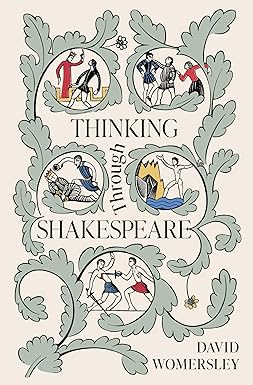
 Thinking Through Shakespeare
By David Womersley.
Princeton University Press, 2026.
Hardcover, 432 pages, $35.
Reviewed by Jesse Russell.
In England ideas run wild and pasture on emotions; instead of thinking with our feelings (a very different thing) we corrupt our feelings with ideas; we produce the political, the emotional idea, evading sensation and thought.”
– T.S. Eliot
Beginning in the 2010s, the phenomenon of cancel culture creeped into global consciousness. Initially, it was focused on tarring and feathering currently living individuals who had either transgressed a shibboleth of political correctness and/or had committed some alleged crime. The latter group, especially during the #metoo movement, was criticized not without some justification and merit. Indeed, the exploitation of women (and men) by the entertainment industry is something that still needs addressing. However, after the 2020 death of George Floyd, cancel culture accelerated to include historical figures who had somehow been involved in the transatlantic slave trade or who had allegedly voiced racist or sexist sentiments either publicly or in private. In addition to toppling statues and changing the names of buildings, some radicals attempted to remove authors from curricula or entertainment venues. While there were attempts to cancel many figures, one author seemed immune to canceling: William Shakespeare. It is generally assumed that Shakespeare is too big to be canceled, or Shakespeare’s ideas are so ambidextrous and seemingly contradictory that the bard seems immune to charges of racism. Indeed, Shakespeare’s “negative capability” is what makes the English poet’s work so enduring to people of a host of political viewpoints. Shakespeare’s philosophical ideas are the subject of Oxford University English Professor David Womersley’s recent work, Thinking through Shakespeare.
Womersley begins his work with a quote from Samuel Johnson explaining exactly why Shakespeare has proven to be so enduring: it is because Shakespeare depicts the “general nature” of humans and the wider universe. Clearly, although Shakespeare scholars tend to strangely bristle at the suggestion, the bard was addressing religious, political, and cultural issues pertinent to his era, but he was also questioning what it means to be human. Womersley notes that despite attempts by twentieth-century formalists to focus on the coherence of Shakespeare’s poems, what critics have been most attracted to in Shakespeare is his thinking. Womersley, however, does not see Shakespeare as someone who transmitted idées fixes through his art, as thinkers such as John Milton did. Rather, Shakespeare was someone who presented various and often contradictory views in his plays, which remain in often unresolved tension. Womersley places his work in dialogue with a longer Anglo-American literary tradition, conversing with T.S. Eliot’s attack on literature as a vehicle for a coherent system of ideas in Eliot’s essay on Henry James, “In Memory,” and his later work, “Shakespeare and the Stoicism of Seneca.” With chapters such as “Selves and Others,” “Barbarism and Civilization,” and “Means and Ends,” in Thinking Through Shakespeare, Womersley explores deep and fundamental questions of human identity and community, utilizing Shakespeare as well as a host of other thinkers.
Identity is one of the biggest questions in Shakespeare. In his ruminations, Womersley notes that identity is something we are routinely forced to compose and present to meet the demands of the security state. At the same time, identity can be very slippery. The idea, as Womersley notes, was especially important for David Hume, who (in)famously labeled the human being as a “bundle or collection of different perceptions.” It was further a topic of conversation for Aristotle, who tied human identity to bodily continuity, as well as Sophocles, who similarly rooted identity in the body in his Oedipus cycle. John Locke would later differentiate between man and person. The notion of man is essentially tied to the body, while the person denotes intelligence and reason. Ultimately, for Locke, the body might change, but the personal identity, which is intellectual, can remain the same.
Shakespeare’s Othello is, quite obviously, a play about ethnicity and cultural identity, but it is also a much deeper exploration of profound questions of human identity. Iago is the infamous diabolical manipulator of language in the play, but, as Womersley explains, Iago’s manipulation of language further reveals the porousness of identity in the play. Iago’s manipulation of Othello leads to what Womersley sees as a fusion of their two identities. Othello is fundamentally a play about relationships—not just marriage, but also friendship and the social structure of the military. Womersley further notes the importance of the setting of Venice, which was among the most “liberal” and fiercely independent Italian cities. Othello is an outsider in Venice, not simply because of his ethnicity, but also because he is a mercenary. From the first act of the play, as Womersley further illustrates, the Venetians are a people who interpret and probe the behavior of others. They can burrow through those who put up a pageant of appearance to hide their identity.
While in the twenty-first century Othello is frequently played by a historic, black American actor, Shakespeare very likely was thinking of someone from North Africa, and the physical appearance of the Moor would not be that different from some of the Venetians. What is most important is that Othello’s personal identity is different from the Venetians. His mind, rooted in the enchanted world of North Africa and then regimented by his military service, is even more exotic than his body. Thus, the core of the person is the soul more than the body.
Womersley’s final chapter, “Means and Ends: King Lear,” is an exploration of the moral distinction between the good (honestum) and the useful (utile), which is ultimately rooted in Cicero’s De Officiis, although it can be found in Plato and even Homer. Machiavelli famously overturned (at least for some) the view of the superiority of the honestum over the utile, while Kant (at least for some) righted the ship, placing goodness over utility. Womersley sees a struggle between these moral hinges in King Lear. Lear’s infamous questioning of his daughters’ love, which precipitates the action of the play, is grossly utilitarian. Goneril and Regan, fellow utilitarians, attempt to quantify their love and outdo each other, while Cordelia and Kent remain firmly grounded in (proto-)Kantianism. Womersley does not see a clear moral order in Lear; nonetheless, Shakespeare does seem to present positively those characters who take moral stands, and these characters undergo agonizing moral trials. Womersley sees King Lear as “a Kantian tragedy” and Measure for Measure as a “utilitarian comedy,” which critiques moral absolutes. Ultimately, for better or worse, in Womersley’s reading, Shakespeare explores critical philosophical ideas without necessarily committing to them.
One of the biggest questions in contemporary higher education is the solvency of the liberal arts. It is generally assumed by many that higher education no longer serves any real purpose. It is, in effect, a platform for indoctrinating students, not even necessarily with Marxist or even post-Marxist New Left thought. Rather, it is a venue for whatever “woke” ideology of the day might present, that is, talking points or emotional registers without any philosophical reflection—in fairness, there are some on the right who act in the same manner. However, in his rich and thorough exploration of not only Shakespeare’s thoughts but also the course of Western thinking, David Womersley demonstrates that ideas do matter, and that Shakespeare is bigger than the harsh but ultimately timid emotions of our age.
Jesse Russell has written for publications such as Catholic World Report, The Claremont Review of Books Digital, and Front Porch Republic.
Support the University Bookman
The Bookman is provided free of charge and without ads to all readers. Would you please consider supporting the work of the Bookman with a gift of $5? Contributions of any amount are needed and appreciated!

