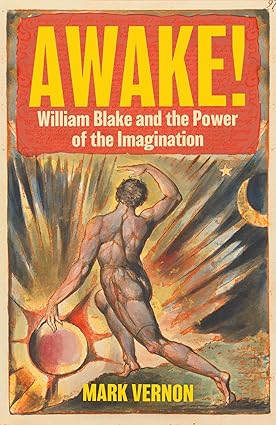
 Awake! William Blake and the Power of the Imagination
By Mark Vernon
Hurst, 2025.
Hardcover, 312 pages, $37.99.
Reviewed by Paul Krause.
William Blake’s name is synonymous with mad genius. In his time, as in ours, he had a reputation for being a crazy artist—incredible, yes, but not someone with which to get too cozy. In a world that was rapidly transforming, Blake attempted to chart another course. Can our world, equally in the throes of rapid change, find a friend in Blake? Mark Vernon positively answers Yes! in his new book, Awake! William Blake and the Power of the Imagination.
As in Blake’s lifetime, our world is the subject of intense conversation of what is “going right” and what is “coming undone.” Being born into a world not all dissimilar to ours gives Blake a unique and important voice for continued relevancy since he too was concerned with what was right and what was going wrong in the world. Intellectually, his world was one of innovation and transformation. Skepticism, moral sentimentality, feminism, and evangelical revivalism were all in the air as the infant Blake entered the world.
Mark Vernon’s unorthodox but excitingly gripping retelling of Blake’s life appropriately begins in infancy. And it is in Blake’s infant innocence where we encounter the first signs of his continued relevance for us. Modernity likes to shun innocence and imagination for the seriousness of the mundane. “Wake up, you need to make money” as the lyrics of a famous Twenty One Pilots song says. Birth itself is targeted as an evil by the anti-natalist movement which conceives existence as a tragedy, a mistake, something horrid and needing to be undone.
In the beginning, Blake’s poetry reflecting on the joy and goodness of infancy stands as an antidote to those who see childhood as something to escape and mature out of. As Vernon writes in assessing “Infant Joy,” one of Blake’s poems dealing with infancy, “Birth itself always carried positive connotations for Blake…These are tender lines, brief but conveying an unrestrained love of life before, even, anything has been named.” Amen!
The theme of innocence is subject to much discussion in this book, but what is innocence? For Blake, innocence is not ignorance of the world. It is much deeper and much more profound. It is openness, per Vernon, “to the love and presence of unexpected others,” whether the other is nature or other humans. In short, the innocence that Blake’s poetry sings of is the awe, wonder, and imagination of a child who can conceive of boundless relationships with everything from a flower or butterfly to sister, brother, mother, and father. “Growing up,” Vernon writes in addressing Blake’s poetic philosophy of innocence and imagination, “need not mean losing innocence and wonder.” In fact, a mature innocence that can blend realism with imaginative creativity is key to a good and joyful life.
Blake’s imagination, seen so beautifully in his art and poetry, offers the modern world a defense of interiority with the acknowledgement of the reality of physical things. Our imaginations are oftentimes stimulated and enhanced by the things of this world—waterfalls, prancing animals, storm clouds, the sun, the moon, or the stars. Maturing is about acknowledging these realities while retaining that sense of splendid joy of seeing dragons in the clouds. After all, what would our life be if we squandered the gift of imagination planted so firmly and richly in our minds? We would undoubtedly live far more impoverished lives despite the material wealth that now surrounds us.
This leads Vernon to defend Blake’s ecstatic visions. The reductionist likes to belittle visionary experiences as nothing but the firing of neurons and atoms in the brain to create a sense of ecstasy for a short period of time. But visions are what fuel the imagination and inspire us to live enchanted lives. “[Blake] offers both an invitation and a challenge. Can you too see more?”
Here, Blake’s poetry also invites us into the world of imagistic experience, awe, and wonder. From his “iambic beat[s]” to the musical “harmony” of his words, reading Blake’s poems can help readers enter a “symphony…of the imagination” wherein we find all things are related and connected to each other. When you hear a bird singing in the swaying trees that are dancing in the gentle breeze, do you find yourself part of that relational cosmos uniting human, animal, and plant as one under the life-giving sun? You should! And we shouldn’t let the killjoys dissuade us.
Blake, then, is also prescient and relevant to environmental concerns. This, too, is a gift that he gives us. Those who would destroy the countryside of trees and birds in the name of urban progress with its brutalist architecture destroy our perceptual imaginations. Our imagination is nurtured by the beauty of relationships that can be discovered by hearing the sparrow sing in the trees. Our world and our lives are enriched by the little Edens we preserve that give us a glimpse of that once and future paradise.
From imagination and environment to religion, Blake’s Christianity invites us to live by the central teaching of Jesus of Nazareth, “forgiveness.” Our world is starved for fellowship, and that is precisely what Blake finds salvific in the life and teachings of Jesus, “Jesus’s greatest innovation was advocating an almost reckless belief in the forgiveness of sins…Forgiveness is central because to forgive and be forgiven frees us from guilt and the quest for revenge.” Some of the best art of the twenty-first century speaks to this truth whereas so much art that is nothing more than a glib and glamorous spirit of the times preaches revenge.
For those who consider religiosity a natural impulse in the nature of humanity, Blake is a friend, for he keeps us from the constricting chains of dogmatism with his “felt” experience. This is undeniably true of religious sentiment. Ask most believers why they believe and they will speak in the language of feeling, fellowship, and experience. Blake craves a relationship with the divine in this world as so many of us in the modern world also desire.
Not only does Vernon help us navigate Blake’s relevance in our modern world, but he also plays splendid critic in analyzing the poet’s greatest works. In reading Vernon’s assessments of Blake’s writings, I found myself returning to reading Blake’s poetry and it was a treat that brought the awe and joy that this book proclaims we need and can find in Blake’s imaginative creativity and prowess. This is another gift to the reader: returning to Blake after reading Vernon to find a deeper love that was there but needed to be reawakened.
It is time to safeguard the importance of imagination in a world so hostile to it. Blake, in his art and poetry, as well as his life, stands as a testimony to the “perceptual openness” that enriches our existence. The need for artistic creativity and imagination, the importance of preserving green spaces in our world, and the never-ending desire for the divine are discovered in the life and work of William Blake.
Paul Krause is the editor-in-chief of VoegelinView and the author of, most recently, The Incredible Adventure of Passer the Sparrow (Resource Publications, 2025) and Dante’s Footsteps: Poems and Reflections on Poetry (Stone Tower Press, 2025).
Support the University Bookman
The Bookman is provided free of charge and without ads to all readers. Would you please consider supporting the work of the Bookman with a gift of $5? Contributions of any amount are needed and appreciated!

