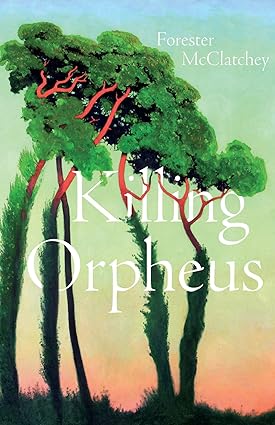
 Killing Orpheus
By Forester McClatchey.
Carnegie Mellon University Press, 2026.
Paperback, 88 pages, $20.
Reviewed by Camilo Peralta.
Might a revival of our degraded culture, or at least its verse, be possible? A recent collection titled Killing Orpheus from Forester McClatchey, a graduate of Hillsdale College, inspires hope that the times may yet be redeemed. Eschewing the confessional approach preferred by so many of his peers, he offers, instead, a series of short, reflective meditations on the “permanent things” favored by all great poets since the time of Homer. That is not to say that his poetry is impersonal, or that we should want it to be. Yet individual and universal experience is deftly blended, so that, e. g., even readers without children will be able to appreciate the poems in which he grapples with the anxieties of parenthood, such as “Waiting for Breath,” “Not Knowing How to Breath,” and “Turning One.” In each, he succeeds in drawing timeless lessons from the unique bond enjoyed between fathers and their daughters. “Not knowing how to breathe is a song,” he writes in the second, “soon you’ll know, and this balky song will die.” It is a lesson the girl has yet to learn, of course, and who among us cannot envy her blissful ignorance of death?
In other poems, we learn of the poet’s lack of gardening skills (“In a Green Shade”) and meet his wife (“Ringneck”). In the latter, the couple argues over the distinctive appearance of the titular snake, which has a colorful underside that it tends to reveal when threatened. How can modern, Darwinian science possibly explain the ring of gold around the departing serpent’s neck? She has one answer, the poet suspects another may be true, but there is no doubt that such a conversation actually occurred between the two. When he describes her baking bread in “Come to Grief,” likewise, one suspects that he has witnessed the real Mrs. McClatchey perform that very act countless times. The worry he feels about her is both highly personal and easily relatable: she is “Young for now, almost wholly well,” but someday she will not be either. Only in “Stanzas for Dwoskin,” named after a former colleague, does the poet veer too much into self-absorption and obscurity. It is followed, fittingly, by an excellent poem on the “unmasterly masters,” the workmanlike mediocrities who compose the vast majority of art in every era (“The Painters Who Were Not Masters”). McClatchey, a talented and promising poet, is nonetheless humble enough to recognize an affinity with them.
In “Tradition and the Individual Talent,” T. S. Eliot argues that “Poetry is not a turning loose of emotion, but an escape from emotion; it is not the expression of personality, but an escape from personality.” True genius is not demonstrated, he adds, by one who attempts to effect a complete break from the past, which is impossible anyway, but by those willing to embrace the long tradition of humane letters to which every artist owes a debt. McClatchey is certainly aware of that, which he repays in part by recycling old verse forms (sonnets) and, more frequently, through Biblical and classical allusions. The eponymous lyric (“Killing Orpheus”) is named after one of the most famous artists in all of literature, who descended into hell and saved his wife from death—at least temporarily, depending on which version of the myth you consult. Almost all of them end unhappily for Orpheus, who in some versions is torn apart by Maenads, female followers of Dionysus. The link between art and power, romance and violence is highlighted by McClatchey, who sets his poem in a Roman colosseum, with a convicted criminal playing the doomed, central role. The crowd cheers as he is beheaded. Nor are these antiquated themes, as the media circus surrounding the 2024 murder of healthcare CEO Brian Thompson suggests.
One conceit of this collection is that many of the poems are written from the point of view of an historical, religious, or fictional character. These include a Roman soldier, Frankenstein’s monster, and an elephant in Hannibal’s army, who may be even less deserving of his brutal fate than the pseudo-Orpheus. “Isaac’s Memory,” “After Abel,” and “Adam’s Task” all explore the psyches of Old Testament figures, and reflect well the pessimism and doubt of the Hebrew Bible. Without Christ, there can be only partial and unsatisfying answers to their questions. More interesting are the poet’s take on some of Shakespeare and Homer’s best-known heroines. In the sonnet “Ophelia,” inspired by a famous portrait by John Everett Millais, McClatchey notes that our enjoyment of the play is predicated upon the dismissal of her suffering, that we can be as callous and complicit in her death as Hamlet. In “Penelope, Growing Old,” he depicts Odysseus and his wife as an elderly couple. She resents having to care for him in his doddering, drooling senility—a far cry from the shrewd, vigorous hero known to us from Homer, Vergil, and Tennyson.
In an essay written shortly before his death, Russell Kirk observed that
Time was when nearly all men and women, believing in some transcendent religion, had taken it that their little lives were bound up with some divine design, which they could not hope to comprehend wholly, but which gave meaning to their existence as persons. Such, at any rate, had been the doctrine imparted to them, and most of them had tried to conform their lives to that eternal purpose.
That time had already begun to pass by 1918, the year of Kirk’s birth. Despite his and others’ efforts to prevent further decline in transcendent beliefs, more than a century later, it is clear that those Americans who adhere to them represent a small and frequently marginalized minority. McClatchey must be counted among their number, for he frequently touches upon transcendent themes, though often in a naturalistic or vaguely spiritual manner (“Wreath-Making,” “Clew,” “Eating in a State of Flowers”). If the creatures who outlive us must be “ignorant of America, outliving God,” as the poet asserts, what then is the point of it all? “A Carcass” knowingly borrows its title and theme from one of Baudelaire’s “Flowers of Evil.” Whereas the French poet is able to wring out some kind of moral from the sight of a bloated corpse, McClatchey, half-heartedly, declaims the possibility of doing so:
We stared, tight-lipped. What were we to say? Impossible to milk a moral from
that corpse. The fiercest facts preclude a Why.
Our helpless silence seemed the only way
to pray. The bones were eaten. Every crumb.
But there is proof of a moral order even in the decomposition of a dead dog’s body, and the emphasis on transcendence throughout the collection suggests an awareness of such.
A related, and most welcome, theme in Killing Orpheus is memento mori, a reminder of the inevitability of death. Our lives have become so long, easy, and comfortable that death has become something of an inconvenient truth, which many prefer to ignore or forget. McClatchey is not one of them, thankfully: the collection abounds with reminders of our mortality. He even offers a mock “Threnody,” or mourning song, in honor of a tragic incident that ends up being something very different. But the mistaken near-brush with death lingers: “For a long time I stood / in dapples. An odd ache said she was there. / Somehow inside the sound. Somehow aware,” as it does for the man who inadvertently kills a bug while gardening (“The Rival”). Whether it frightens, emboldens, or shames us, the poet reminds us that death is an inescapable fact of the human condition, with which one must reckon eventually. This is true even of the great (“The Albert Memorial”). “Did you ever hear,” he wonders of the immortalized Prince Albert, “tapping on your shelf, / the long white stick of unmalicious time?” Our souls may be transcendent, but “This present life here below,” as Kirk observed, “is an ephemeral existence, precarious.” Even the monuments we build will not outlast the alligators.
Kirk was also fond of quoting a few lines from Eliot’s “Little Gidding,” one of the Four Quartets published late in the poet’s career:
And what the dead had no speech for, when living,
They can tell you, being dead: the communication
Of the dead is tongued with fire beyond the language of the living.
Indeed, the words are inscribed on his tombstone. They reflect a belief that death is not the end of life, though what exactly our existence will be like in Heaven or Hell is not something we can ever know until we go there. In several poems (“Root Words” and “Question for the Dead”), McClatchey echoes this idea. His characters do not seem to be particularly religious, though their openness to the transcendent would seem to preclude the possibility that they are outright atheists. Then again, such confusion only reflects wider social trends, as the longing for truth that is endemic to all humans throughout history conflicts with the fragmentation of society that has been rapidly increasing since the turn of the last century. This has made it difficult, if not impossible, for most of us to recognize and discover the genuine sources of truth.
There are many like the couple depicted in “Smoke Jumper,” one of the final poems in the collection, and easily the longest. It consists of eight sonnets, which tell the story of a firefighter whose half-informed pursuit of transcendence causes him to neglect those he loves. One day, while battling a wildfire, he encounters the body of a cougar that had been burned to death. Its frozen visage provokes in him a jumble of thoughts, which he lacks the imagination or religious framework to understand. Like most Westerners, he has a basic familiarity with Christianity and associates the experience with various incidents from the Bible. But when he gets home, he finds himself unable to explain what has happened to his wife: “but some mute thief / stole the substance from his words … She cannot hear, he fumed.” She resents him for ignoring her, and the two separate with much bitterness and hostility. Perhaps there is a deliberate echo here of The Waste Land. Like the couples in Eliot’s poem, like so many other modern lovers, the smoke jumper and his wife don’t really understand or know how to communicate with each other.
Both are to blame. The final stanzas of McClatchey’s poem reflect her perspective. It is good to seek transcendence, as her husband has always done. Indeed, it is perhaps the most important thing one can do. There is a fine line, however, between holiness and religious mania, between the selfish pursuit of gnostic secrets, upon which her husband seems to be engaged, and the Truth represented by that dead cougar, which neither is in a position to understand fully. Yet all that is really asked of them in these decadent days is to treat each other with the love and respect owed by spouses to their partners. And in that sense, it is clear that he has failed:
He could not see the wife, alive and real
before him, who did not ask for God or light,
but only craved an hour of words, a night
of true and chiming talk, to make her feel
like she existed …
At the end of the poem, despite her lack of interest in such things, the wife experiences a brush with transcendence, exactly like that experienced by her husband, and just as ineffable. Only the dead know what they want to say to each other. For those without faith, like these two, that is cold comfort. For the open-minded, and for the kind of reader who would enjoy the poems in this collection, it doesn’t have to be.
Camilo Peralta is an Associate Professor of English at Joliet Junior College. He has written one book, The Wizard of Mecosta: Russell Kirk, Gothic Fiction, and the Moral Imagination, and is editing a forthcoming collection on conservative cultural criticism. He lives in the Chicagoland area with his wife, daughter, and cat.
Support the University Bookman
The Bookman is provided free of charge and without ads to all readers. Would you please consider supporting the work of the Bookman with a gift of $5? Contributions of any amount are needed and appreciated!

