
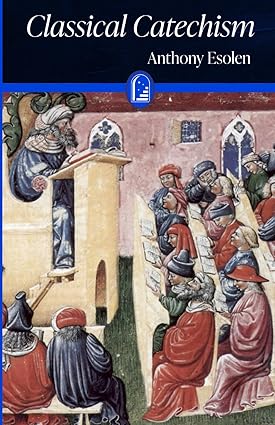
 Classical Catechism
Anthony Esolen.
Thales Press, 2025.
Paperback, 109 pages, $9.99.
Reviewed by Sean Hadley.
It would be a rather run-of-the-mill comment amongst any group of Christians to state that catechisms play an important role in the life of the Church. While certain denominations may be suspicious of such practices, the influence of this practice on American life is tangible even upon the less traditional churches. Were someone to wander into a room in any office building and ask aloud, “What is the chief end of man?”, it is likely at least one person could respond, “to glorify God and enjoy him forever.” Similarly, queries like “What happens at confirmation?” and “What is the Gospel?” would be easily recognizable questions with responses readily supplied, often regardless of one’s specific Christian tribe. This is one of the strengths of a catechism, namely its power to provide a common language amongst groups and to pass on essential beliefs that can be easily recalled when needed.
What might be surprising, by contrast, is the recent surge in Classical Christian schools adapting this practice to their classrooms. I first encountered this idea as a teacher in 2018, just before Josh Gibbs published Something They Will Not Forget, which outlines his views on deploying catechisms as a pedagogical tool in the classroom. This practice has gained steam since then, but continues to be largely an individualized approach. Some schools have developed catechisms unique to their community, while some teachers have built their catechisms. And this latter category might be the same from class to class, or might change based on subject, time period, or even the age of the students. Obviously, this is a different approach than the unifying method of Lutheran churches in the U. S. or the Greek Orthodox Archdiocese of America. Rather, these attempts at catechesis tend to take the general concept and translate it into something of educational effect in a class on Biology, Calculus, or Medieval History. Questions remain about the efficacy of this practice, though anecdotal evidence suggests that there is something here to consider further.
That is why Anthony Esolen’s Classical Catechism is such a welcome entry into this conversation. Esolen’s prolific career as a writer, translator, and teacher informs this little book and what it means to take part in a classical education. Esolen was one of the earliest casualties of the D.E.I. movement that continues to wreak havoc on college campuses, departing Providence College in 2017 after publicly criticizing the school for becoming too secular. He currently serves as the Distinguished Professor of Humanities at Thales College in Wake Forest, North Carolina, which is where his Classical Catechism came to life.
The book is itself difficult to summarize despite its small size. It is an introduction to the pedagogical life of a classical school. It is a philosophical argument for a particular approach to being a classical teacher. It is a work of cumulative experiences which manifest in teacherly wisdom. And it is a treatise aimed at critiquing the Modern Industrial Model of Education which has characterized the last several decades of American schooling. It is each of those things and more. The ability to say so much in such a small space is indeed itself a testimony to the rhetorical skills which result from being educated into the Classical Tradition, giving a weight to Esolen’s argument that would not be accomplished in a 600-page tome littered with footnotes and lengthy digressions.
Teachers who see their vocation in the light of transformation, regardless of their training, will find inspiration in Esolen’s catechetical approach. Q1.1 states the most essential question, “What is the organizing principle of a classical education?”, and the response is richer than anything one would encounter in a modern textbook on educational theory. Esolen reasserts the importance of “memorization, . . . memorial, and . . . music,” noting how these practices shaped the ancient world and how they aid the life of the mind in the twenty-first century. This retrieval effort characterizes the book, as does the constant reminder that terms must be defined in order to have a reasonable discussion. When Esolen addresses sports in Q3.6, he notes that “we must take care to distinguish between a classical and humane approach to sport,” repudiating the “sport-as-work and post-as-ambition” approach which is dominant in the secondary and post-secondary educational landscape. This example is helpful in recognizing that Esolen is not merely offering a helpful summary of current trends but taking aim at cultural shibboleths which threaten the soul of education in a society sorely in need of renewal.
Consider his requirements for teachers. English teachers, for instance, need a “knowledge of Greek and Roman epics” to teach the works of Milton, because literature is constantly conversing with the past. The science teacher “will not see his field as either superior to others or as unrelated to them,” avoiding siloed claims like “that isn’t my field.” And the art teacher should “be like a doctor prescribing a slow and gradual cure for blindness and deafness.” These are not the specialized, training center outcomes common in education departments across U.S. colleges, but rather these standards indicate that the education a student receives should in some way already exist within their instructor. This is not to say that every teacher will be the same; for even a math teacher should be allowed to “be guided by their inclinations” when determining special topics in arithmetic or geometry. Esolen’s Catechism draws the school administrator, teacher, and parent back to the roots of learning, never taking the shallow or easy route but rather noting the importance of the work that accompanies the journey.
Esolen’s concluding remarks on the classical school’s relationship to the surrounding culture brings the reader back to the introductory portion. And Q1.13 along with Q10.1 represent some of the practical rifts which exist amongst classical educators. “Must a classical education be religious?” is answered in the affirmative, but Esolen’s qualification and nuance would raise a few eyebrows in the Classical Christian world. Likewise, Esolen explains that if the question is “must the school include religious instruction,” his own answer is emphatically “no.” To such claims there are many within the classical school movement who would consider this a non-starter in working together. But Esolen’s point is not an invitation into theological squishiness; rather he reveals an important shift in the larger discussion of classical education. For the first three decades of the classical education renewal, this was predominantly a Protestant private school endeavor with a parallel interest in many Catholic circles. However, in the last ten years, the explosion of classical charter schools and the growth of networks like the Thales schools have proven that there is a hunger for the classical model of education outside of the Church. Yet as Esolen notes, “The classically educated person enters the cathedral at Chartres with wonder and gratitude, not contempt or indifference.” This will be insufficient for some, yet I for one am persuaded by Esolen’s charity.
If classical teachers believe that truth, beauty, and goodness can indeed change the world, then the sort of student (and teacher and school) described by Esolen is a net gain for this world. And his Classical Catechism serves as a helpful tool in building the necessary common language that can only strengthen what is already being done. It is my hope that more people who are involved with classical schools will take up Esolen’s book and consider it. For there is much work still to be done.
Sean C. Hadley is the Upper School Principal at Trinitas Christian School in Pensacola, FL. He earned his PhD from Faulkner University and spent two years conducting post-doctoral research at the University of Arkansas. His writing has appeared in Touchstone magazine, The Hemingway Review, and Classis journal. His wife Sarah graciously tolerates his eccentricities, and his four children have learned to laugh at his jokes.
Support the University Bookman
The Bookman is provided free of charge and without ads to all readers. Would you please consider supporting the work of the Bookman with a gift of $5? Contributions of any amount are needed and appreciated!

