
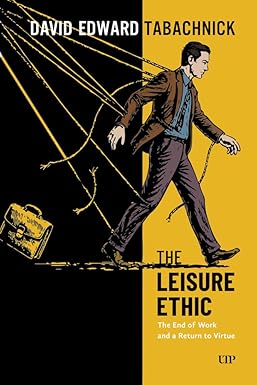
 The Leisure Ethic: The End of Work and a Return to Virtue
By David Edward Tabachnick.
Toronto University Press, 2026.
Paperback, 288 pages, $39.95.
Reviewed by Robert Rich.
In August of 2014, the science educator and YouTuber CGP Grey made the case, in a video titled “Humans Need Not Apply,” that robots would soon have the ability to do the majority of human labor. According to this video, the robots are coming not only for the truckers, baristas, and white collar workers, but for the programmers, doctors, lawyers, and potentially even the artists. This coming economic revolution, Grey warns, “is going to be a big problem if we’re not prepared. And, we’re not prepared.”
The argument has aged reasonably well; autonomous taxis now operate in a handful of US cities, robot waiters are taking orders at restaurants, and millions of people are venting about their problems to their chatbot therapists. While the AI boom has not yet led to the kind of mass unemployment that Grey warned of, and there are still debates over whether it ever will, his assertion that we are not prepared is worth contemplating.
What would it mean to be prepared?
On one level, this is an economic question. Former Labor Secretary Robert Reich’s hypothetical iEverything comes to mind; if the iEverything does everything that you would otherwise have to pay a human to do, how will anybody afford one? But the question also has a psychological (and philosophical) component: Would humans be able to adapt psychologically, if necessary, to a society where they no longer needed to work? And what might that adaptation look like? David Tabachnick’s The Leisure Ethic: The End of Work and a Return to Virtue attempts to answer this last question.
For Aristotle, the need to labor is a necessity man shares with every other animal. Leisure (or scholé) is what makes us human and is essential to the process of learning how to live virtuously. Tabachnick argues that within the last five hundred years this ancient ideal has been lost. In its place, we have been indoctrinated into accepting a misguided “work ethic” that still dominates our culture, morality, and politics.
If modern technology is making it increasingly possible to have the opportunities for leisure that Athenian citizens had, then there has never been a better time to rediscover this forgotten ideal.
Interestingly, as Tabachnick shows, this is not the first time in history that there have been grounds for concern that peace, prosperity, and technological progress would lead to boredom and restlessness. Most concerningly, he recalls Nietzsche’s warning about the “magnificent tension” that will inevitably build up when men lack an appropriate outlet for their most intense energies and ambitions, a theory that found no lack of adherents in early twentieth-century Germany. Concerns about how we will occupy our minds and bodies in a tranquil and prosperous world are far from trivial.
The opening chapter provides a skeptical exploration of the ideological roots of our modern day work ethic. Following Max Weber, Tabachnick explains how the Protestant notion that worldly success was a sign of salvation led to a decisive turn in western culture toward a busy and acquisitive ethic and away from the earlier, more ascetic Christian ideal exemplified by the Desert Fathers. He suggests that in addition to this Protestant influence, our work ethic also owes something to the Lockean idea that to create property by applying our labor to the natural world is the essence of freedom as well as the idea, inherited from Benjamin Franklin, that hard work is conducive to good moral character.
The second chapter contends that the natural corollary of this work ethic was a corresponding stigmatization of idleness and that this stigmatization has influenced our treatment of the poor from the time of the Reformation to the present day. He goes as far as to argue that, “Eugenics and the Holocaust are the realization of the much older categorization of people as fit or unfit that began with attempts to address the ethical crisis of laziness.” He even criticizes New Deal Era and modern anti-poverty measures along similar lines, arguing that contemporary discourse on welfare reform is still poisoned by this same moralism, as implied by expressions like “the dignity of work.”
Chapter three offers a thorough and trenchant critique of various arguments about how to prepare for the coming technological revolution. Tabachnick divides the people whose arguments he addresses into three groups: neo-luddites, technophiles, and reformers. IIs discussing this third group, he provides one of the more interesting observations in the book: the fact that concerns about an impending reduction in the need for human labor, accompanied by calls for “upskilling” and proposals for a shorter workweek, were quite common in the pre-Great Depression years. Yet, in spite of these concerns and proposals, it was during the post-war years that the forty-hour workweek first became the standard. What we truly need, Tabachnick argues, is not more policy proposals, but an altogether new ethic.
It is in the fourth and final chapter that he delivers on the promise of the book’s title by constructing a “leisure ethic” for the twenty-first century. This requires first and foremost an expansion of our understanding of “leisure” beyond its typical English connotations. As Tabachnick points out, “leisure,” which actually comes from the pejorative Latin term “licentia,” is a less than perfect equivalent of the Greek term “scholé.” What he means by “Leisure” does not describe a fixed category of activities so much as the spirit or attitude in which an activity is pursued. As such, the argument of this chapter is not merely an argument about how we should spend our spare time. The ethic for which Tabachnick advocates would inform our approach to parenting, school, business, and politics. We undertake these things in accordance with the leisure ethic when we pursue them as ends in themselves, rather than as means to other ends, when we pursue them voluntarily and actively, and when we pursue them with a view to excellence and the fulfillment of human potential. Such an ethic makes it possible for us to think beyond the traditional dichotomy between “work” and “idleness.”
One need not agree with Tabachnick’s wholesale rejection of the modern work ethic to find this proposed leisure ethic compelling. This is worth emphasizing, because his attempt to discredit the work ethic is not necessarily the most convincing part of his argument. As well-researched and illuminating as his deep dive into the history of relief for the poor is, his attempt to read that entire history as a moralistic and morally misguided crusade against “idleness” is something of an oversimplification; only rarely and indirectly does he seem to acknowledge that administering poor relief effectively on a large scale is an extraordinarily daunting and complicated bureaucratic and ethical task. He makes little to no allowance for the fact that such systems did (and do) need to be carefully designed in order to mitigate perverse incentives and opportunities for abuse. Moreover, much of his criticism of modern anti-poverty discourse is premised on an explicit rejection of the possibility that “the dignity of work” could have any kind of legitimate psychological or moral basis.
Tabachnick does not take a strong stance one way or the other on the question of whether we are destined for the kind of mass unemployment that CGP Grey predicts. His argument for the need to develop a “leisure ethic” rests largely on the premise that people currently work far more than they need to. And for this he blames “overconsumption,” contending that so long as people are propagandized to buy things that they do not need, overwork (and the profusion of “bullshit” jobs) will be the inevitable result. He does not seem to consider the possibility that rational and thoughtful adults purchase things like kitchen appliances, exercise equipment, and Netflix subscriptions because they believe (sometimes accurately) that these things will have a positive impact on their quality of life.
Rediscovering the lost ideal of leisure is highly worthwhile regardless of whether we are headed for a world in which humans need not apply for most jobs. Tabachnick’s book is a fruitful and thought-provoking exploration of how we might realize this ideal.
Robert Rich is a Writing Instructor at the University of Rochester with an academic background in nineteenth-century British literature and the history of economic thought. His writings have appeared in The Montreal Review, Merion West, and VoegelinView.
Support the University Bookman
The Bookman is provided free of charge and without ads to all readers. Would you please consider supporting the work of the Bookman with a gift of $5? Contributions of any amount are needed and appreciated!

