
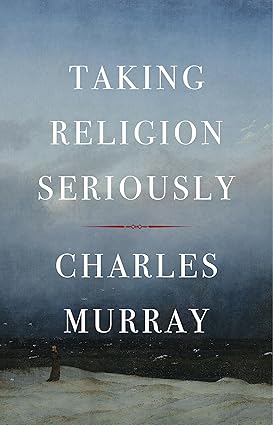
 Taking Religion Seriously
By Charles Murray.
Encounter Books, 2025.
Hardcover, 200 pages, $29.99.
Reviewed by Jeffrey Folks.
Taking Religion Seriously is a thoughtful, moving, and entertaining account of the author’s decades-long journey toward acceptance of religious faith, though the faith at which Murray arrives is decidedly not of the evangelical sort. As he notes several times, his “way of taking religion seriously” is “more arid than [he] would prefer,” and clearly more so than that of his wife, whose religious devotion originally led him to reconsider religious faith. Although Murray does affirm his belief in God, an afterlife of some sort, and Christ as a figure he reveres, like so many of his contemporaries he has doubts concerning many conventional elements of Christianity. The difference is that Murray is as willing to be as open-minded toward religion as he is toward science and human psychology. The result is a fascinating dive into the mind of a highly intelligent man who, though raised a Christian, had lived as an agnostic for decades before reconsidering the biblical claims of God’s existence, the creation of the universe, the teachings of the Gospels, and the divinity or at least “unique” relationship of Christ to God.
Murray is aware that, as an intellectual and academic, the publication of a book about the rediscovery of religious faith will expose him to ridicule among many members of the “tribe of smart people,” those intellectuals for whom an open discussion of religious faith is considered embarrassing at best. His answer to his readers: “If you find yourself reluctant to give up strict materialism…, try to get over it.” In Taking Religion Seriously Murray displays the same intellectual courage as evident in The Bell Curve, Coming Apart, and Losing Ground, among other titles: he writes with fierce honesty and follows the argument wherever it may lead, and he is willing to offend either side of the debate. To take one example, while he “suspects” Jesus had a unique relationship to God, more so than that of any other religious leader, he also “believe[s] that getting much more specific in describing Jesus’s relationship to God is impossible.” Similarly, while he believes in life after death and the continuing presence of God in the universe, he finds it difficult to be overly specific concerning the form these take.
One hint of an afterlife that Murray takes seriously is the vast literature regarding after-death experiences. Those who have slipped into death but miraculously returned—a large number of cases, as it turns out—report rather similar images: initial darkness, followed by bright light and tunnel-like surroundings. Even among those with no familiarity with the reports of others, these elements are common features. Murray admits to having once dismissed these accounts out of hand, but the accumulation of evidence, which he cites in some detail, is difficult to deny.
At one point Murray quotes a famous passage in Mere Christianity in which C.S. Lewis states that, given the words and actions of Jesus recorded in the New Testament, one must conclude that Jesus was either a fool, a liar, or indeed the Son of God. According to Lewis, these are the only three alternatives, and Murray appears to accept this argument. One must, however, as many skeptics have, question whether these are actually the only three alternatives. It could be, as revisionists have maintained since the eighteenth century, that the Gospels were written long after the death of Christ and that the events of his life (if he actually lived)—the divine incarnation, the miracles, the Crucifixion and Resurrection—were the invention of his disciples and other followers and were repeated by later historians. Or it could be that Christ claimed to be and actually believed himself to be the Son of God, but that the evidence for his divinity, the resurrection in particular, was the invention of later writers. In fact, although Christian tradition associates Matthew and John with eyewitness testimony, the authorship and dating of the Gospels remain disputed, and many place their composition decades after the Crucifixion, long enough, skeptics argue, for elements of the story to have been altered.
Murray goes to some length to refute these arguments, and his refutation is supported by extensive reading of recent biblical scholars who essentially side with Lewis, but extensive reading does not mean that the arguments are true. Similarly, Murray’s recitation of the “proofs” of the existence of God is fascinating and deftly presented, as is the entire narrative or “memoir” of how he came to accept belief in God and in Christ. The truly extraordinary timeline of the split second in time immediately following the Big Bang that allowed for the creation of the stars and planets and eventually of life should be especially troubling to any skeptic, since the statistical possibility of an accidental creation of the universe we inhabit is one to a digit followed by a near infinite number of zeros. One refutation of this argument from creation is that in the course of an infinite number of creation events, at least one is likely to have resulted in a universe resembling ours, but that argument stretches credulity even further. The current estimate dates our own Big Bang to some 14 billion years ago: those who suppose that many trillions of Big Bang events have taken place before our own—the number necessary to make creation even a possibility—are engaging in their own act of faith, and one that is perhaps more improbable than the existence of a divine force responsible for Creation.
It should be noted that Murray records several caveats regarding his religious beliefs. God most certainly is not the anthropomorphic bearded old man sitting atop his throne in Heaven. If anything, he is closer to the deistic Primal Mover who created the universe knowing how it would evolve, even down to our present-day condition. Likewise, Murray is skeptical of most elements of the traditional story of Christ: the Virgin Birth, the Wise Men traveling from afar to a manger in Bethlehem, the series of miracles performed during Christ’s brief life, and possibly even the resurrection. Given these doubts, many believers would not label Murray a Christian at all: as he admits at one point, he is closer to a Unitarian than an evangelical Christian, but, as he also insists, his faith is still evolving. Like C.S. Lewis, Murray was once a confirmed agnostic if not an atheist: now he is one who cannot find a logical explanation for the existence of the universe as we know it without “the entity that I might as well call God,” and he finds in Christ a unique human being among the billions who have ever lived, in terms of his relationship to God.
Murray also believes that modern existence has been greatly impoverished by the widespread loss of religious faith among intellectuals in the West. A simple review of contemporary art and literature reveals this to be the case: beginning in the late 1800s, most artists and writers abandoned the idea that the function of art was to embody Beauty, Truth, and the Good, all of which are qualities dependent on faith in a purposeful universe and, in effect, on the existence of God. As Murray characterizes it, modern art and literature have become nihilistic, antagonistic, and incomprehensible: “the high culture of the twentieth century seems so pallid in comparison with the high culture of the preceding five centuries.”
According to Murray, there also exists an innate Moral Sense that is universal, though the “wording” and emphasis vary across cultures. Absent these moral instincts, we decline into a state of moral anarchy in which there is no defense against any number of “sins” (and, yes, Murray uses the word) with the most horrific consequences, but to believe, as many do, that one can follow a moral code that derives from Christianity without believing in Christ himself is not good enough. In the end and over time, that softening influence is lost, and we are thrown into the condition of violence and blindness that Yeats describes so powerfully in “The Second Coming.” Religious belief provides the necessary foundation for moral certainty. It is impossible to live a moral life without a grounding in moral absolutes, and those absolutes cannot just be a list of what some wise person said or what we decide for ourselves: they must be experienced as universal commandments, such as the prohibition of murder, adultery, theft, and dishonoring of one’s parents, that are themselves a codification of innate virtues. These moral instincts existed before any philosopher came along to weigh their value and effect on society. Indeed, psychologists have found that an innate moral sense, including a pronounced belief in fairness, is present in very young children who are too young to have been taught right and wrong.
Regardless of one’s beliefs, Charles Murray’s Taking Religion Seriously must be acknowledged as a notable work. It is a heartfelt account of one man’s (actually, one couple’s) acceptance of religious faith and of Christianity in particular, and while not a work of scholarship, it is informed by extensive reading and decades of thought. Like the work of C.S. Lewis, which inspired Murray’s turn toward Christianity, it is written in an admirably direct and accessible style. Taking Religion Seriously is a book that I would recommend to practically any reader and certainly to those like Murray himself who are struggling to make sense of a world that is greatly influenced by unexamined agnostic and atheistic beliefs.
As Murray stresses, he is not in any way attempting to proselytize: he is merely telling the story of what led to his acceptance of religious faith, a process that began with his observation of his wife’s extraordinary devotion to their newborn daughter (a degree of love inexplicable by evolutionary models). One must admire Murray’s courage and honesty in sharing his conversion experience with a public of intellectuals that will probably respond with attitudes ranging from indifference to hostility. For some readers, however, Murray’s memoir may offer an earnest and accessible account of one man’s journey toward religious faith.
Jeffrey Folks is the author of many books and articles on American culture, including Heartland of the Imagination (2011).
Support the University Bookman
The Bookman is provided free of charge and without ads to all readers. Would you please consider supporting the work of the Bookman with a gift of $5? Contributions of any amount are needed and appreciated!

