
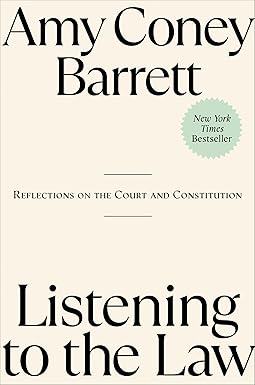
 Listening to the Law: Reflections on the Court and Constitution
By Amy Coney Barrett.
Sentinel, 2025.
Hardcover, 336 pages, $32.00.
Reviewed by James V. F. Dickey.
Listening to the Law reveals the personal and public-facing perspectives of Supreme Court Justice Amy Coney Barrett on her own life in the law, the workings of our Supreme Court, the history behind our American government, and the interpretive methods that mark Justice Barrett’s life’s work.
A book of stories about Justice Barrett growing up in Louisiana, her clerkships and law practice, professorship, and years as a federal judge will make for an excellent biography someday. But this is not that book. Instead, Listening to the Law works its way from a glimpse of Justice Barrett’s personal life and upbringing, to descriptions of the Supreme Court’s inner workings, to the compromises that built our nation’s legal structure, to how Justice Barrett views the Court’s role and how she goes about interpreting the law.
The book begins with the author’s roots and personal story, through which she establishes credibility not only as an accomplished jurist but also as a daughter, wife, and mother. Justice Barrett is relatable and down-to-earth, and her willingness to share her personal story makes the book more readable and interesting for those who want to know more about her as a person. The personal story she tells is also essential to understanding her as a judge, and it’s an uplifting and truly American tale. Justice Barrett briskly marches the reader from her upbringing in New Orleans, to her time clerking for Judge Silberman and Justice Scalia, to BigLaw and her professorship at Notre Dame, to her judgeship on the Seventh Circuit, to her current gig as Supreme Court Justice—all while raising a family of seven children. Those less inclined to be interested in discussions of constitutional doctrine will still be interested in and uplifted by reading about Justice Barrett’s journey, marked by her humility and personal sacrifice.
Justice Barrett also gives the reader a glimpse into life at the Court and its work. This glimpse includes the life and work of judicial clerks, the process by which cases are selected, how and why the cases are heard by the Court, and how they are ultimately decided. And the reader comes away understanding not just how these processes work, but also why and how they were established and developed into what they are today. This structural and historical discussion will be fascinating to a student of American civics—after all, the workings of the Supreme Court can feel opaque to many Americans. But it is also useful to practitioners of constitutional and other federal law, who will glean insight into how and whether to present petitions for certiorari and amicus briefs to the Court, how to present merits arguments, and how to interpret questions from the justices at oral argument.
Justice Barrett also discusses here the Court’s power and limitations, with emphasis on the example of and fallout from the dispute between William Marbury and James Madison that led to Chief Justice John Marshall’s essential declaration that it is “the province and duty of the judicial department to say what the law is.” Justice Barrett emphasizes the dual nature of this declaration: while the Court identified its power of judicial review, it also identified its limitations to “Cases” and “Controversies” under Article III of the United States Constitution.
Justice Barrett then provides a brief historical survey of the framing of the Constitution and discusses the nature and consequences of its design. While one might be tempted to assume that such a review merely re-treads ground that is well trod, it doesn’t.
In this part, Justice Barrett goes beyond the nuts and bolts of a chronology and showcases the difficulty and conflict that marked the 1787 Constitutional Convention. Reading about the months spent by delegates over a sweltering Philadelphia summer with sharp disagreements about national power and representation gives the reader appreciation for the compromises that formed our national government. This backdrop helps the reader understand why, a few months later, Washington called the Constitution’s ratification a miracle to the Marquis de Lafayette.
Justice Barrett notes, however, that the miracle was neither complete nor perfect. She discusses the process for constitutional amendment and a history of our amendments, from the Bill of Rights, to the Eleventh Amendment as a response to the Supreme Court’s decision denying sovereign immunity to Georgia in Chisholm v. Georgia, to our national failure to eradicate slavery without a bloody civil war, leading to the postwar Reconstruction Amendments, and then into the modern era.
She describes the result of the Miracle at Philadelphia as a document that is hard to change but changeable, and one that tries to restrain the federal government to truly national issues. This “federalism” means the national government sets national norms on a discrete and limited set of national matters, and the states and the people retain all powers not so entrusted to the federal government. But neither the federal government nor the states can infringe those liberties entrenched in our national history and tradition and in the concept of ordered liberty.
That is, when the system works right. Justice Barrett walks the reader through “constitutional moments” that have challenged the system, in which judges have had to interpret the Constitution’s flexible standards rather than its fixed rules. Put broadly, Justice Barrett identifies two types of attempts to “overconstitutionalize” and upset 1788’s careful balance: on one hand, broadly interpreting clauses like the Commerce Clause (Wickard v. Filburn) and the Necessary and Proper Clause (McCulloch v. Maryland), and on the other hand (and later in the book) by finding unenumerated rights against state regulation (Lochner v. New York).
Justice Barrett’s analysis shows a philosophy of deference to the people’s representatives and the President in the lawmaking process. She speaks only with reservation about the broad reading of the Commerce Clause that has arguably expanded Congress’s power beyond its proper place. But she fully rejects Lochner’s protection of an unenumerated right to contract and other economic liberties. While her view appears deferential to national legislators, however, she also calls them to meet a high standard to fulfill the Constitution’s promise, especially related to the Reconstruction Amendments and their Civil War-earned promise of equal protection and due process of law.
This presentation becomes practically relevant when Justice Barrett turns to the crescendo of her work: her thoughts on how to judge, based on this body of history and precedent. Justice Barrett elegantly makes this transition and makes a subtle and persuasive case for originalism and textualism as the proper methods for interpreting legal texts.
If one had to choose a single takeaway from this part of the book (and perhaps the whole thing), it could easily be Justice Barrett’s emphasis on our Constitution as a written document: “it is no exaggeration to say that the defining feature of American constitutional law is its basis in a concrete document.” Springing from that keystone declaration, Justice Barrett defends originalism and textualism as the only interpretive methods appropriate to written legal texts.
Justice Barrett thus roots an originalist mode of judging in history and tradition. Judging rightly is an inherently conservative endeavor: the judiciary’s very claim to review the work of the political branches draws each political act back to past writing, either in the Constitution or the United States Code. Keeping our politics within the scope of ordered liberty—and most importantly a written text—makes the judiciary the branch that preserves and tempers us in the face of the revolutionary instinct to throw off the so-called “dead hand of the past.”
Probably because originalism has so many critics but not so many clear alternatives, Justice Barrett uses some contrast to show the follies of poor alternatives and assures would-be critics that originalism (and its cousin, textualism) is not a wooden and impractical doctrine. Justice Barrett accordingly rips Thomas Jefferson’s “unstable and impractical” suggestion that all laws and constitutions should expire every nineteen years. (Yes, he suggested that.) And she assures the reader that originalists and textualists “are not literalists, and neither are good judges.”
Likewise, Justice Barrett does not claim to be a historian by profession—but explains that originalist judges are “well equipped” to be legal historians because “how history bears on a constitutional issue has scholarly elements (as all judging does) . . . [yet] occurs in the context of a practical enterprise (as all judging is).”
Justice Barrett’s most critical point for originalism may be her debunking of the premise that originalism means that dead people who ruled long ago still rule us now. That is because dead men’s intent, or purpose, does not matter to the faithful originalist judge so much as the text’s meaning, which comes from what’s on paper, not in a dead man’s head. That original meaning can apply as easily to an unconstitutional search using heat-sensing technology as it could to a colonial constable breaking a window to get into a suspect’s house. Originalism recognizes the enduring past and is prepared for the present and future.
Finally, Justice Barrett explains how to interpret the unspoken meaning of key words in legal texts, in their proper context.
Justice Barrett is a textualist, again rooting her interpretive theory in what the law says, in writing. This “textualism” chiefly conflicts with “purposivism,” in which courts try to divine what lawmakers meant to do when passing a law. But as Justice Barrett writes, purposivism has a fatal flaw: it’s impossible to “discern the intent of a majority of 435 members of the House, a majority of 100 members of the Senate, and a single president with veto power.” Tools like legislative history fall short because they do not reflect the full legislative compromise. She summarizes the point of textualism: “Rather than trying to get into Congress’s mind, an interpreter should take Congress at its word.”
Justice Barrett concludes by addressing the criticism that originalism and textualism are not really neutral or fair because conservative jurists use “strong-form substantive canons” to achieve a desired result contrary to the text’s best reading. One such recent criticism is the Court’s reliance on the “major questions doctrine” to limit Congress’s delegations to federal agencies. Justice Barrett is at her strongest here, as a widely recognized author of important scholarship on the canons of construction. She invokes her concurrence in Biden v. Nebraska (the student loan cancellation case) to point out that the major questions doctrine is merely a “linguistic canon” that places text in historical context to better understand Congress’s original public meaning.
The reader comes away from reading Listening to the Law wanting “the rest of the story.” But for now, Justice Amy Coney Barrett has given the reader a window into the life and philosophy of the author, who is already making her mark as a justice on our Supreme Court in less than a decade in that role.
Justice Barrett’s philosophy places her athwart the temporary majorities of our time. That place will often seem thankless, regardless of which politician she irks with her decisions. Yet she seems willing to take up that mantle to conserve our constitutional republic. As Russell Kirk wrote in The Conservative Mind, “In every period, some will endeavor to pull down the permanent things, and others will defend them manfully.” As Listening to the Law reveals, Barrett artfully defends the permanent things with the “astonishment that this system has attained so much,” and an optimism for the future.
James V. F. Dickey is Vice President of Litigation for the Southeastern Legal Foundation. He actively litigates on behalf of SLF’s clients in the freedom-based law movement and has argued more than a dozen times before the federal appeals courts and the Minnesota Supreme Court. He lives in Minnesota with his wife and three children.
Support the University Bookman
The Bookman is provided free of charge and without ads to all readers. Would you please consider supporting the work of the Bookman with a gift of $5? Contributions of any amount are needed and appreciated!

