
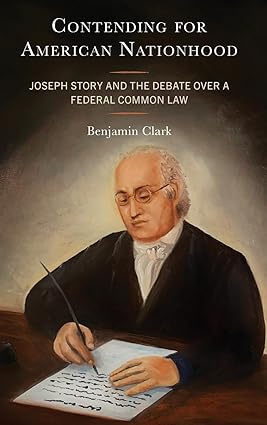
 Contending for American Nationhood: Joseph Story and the Debate Over a Federal Common Law
By Benjamin Clark.
Lexington Books, 2024.
Hardcover, 252 pages, $120.00.
Reviewed by John G. Grove.
The debate over federal common law does not generally fire the imaginations of those interested in the broad sweep of American history and politics. The issue doesn’t have the same intensity as other early-Republic controversies like the national bank or interposition and the Alien and Sedition Acts. A recent book, however, shows that the student of early America cannot pass the issue over.
In Contending for American Nationhood, Benjamin Clark offers a careful analysis of the ideas of the federal common law’s most strident supporter, Supreme Court Justice Joseph Story. He also situates the debate over the common law within the context of the broader question of the nature of the American union.
Clark offers an overview of Story’s attempts as a justice to establish a federal common law, as well as his wider writing in which he sought to develop a theoretical justification for it. The former includes a failed attempt to have the Supreme Court reconsider the 1812 case United States v. Hudson and Goodwin, which held that federal courts could not enforce a common law of crimes. His attention then turned to more modest goals, finding ways to establish the federal courts’ authority to determine and apply common law rules in cases in limited circumstances: related to Washington, DC, cases in which there was federal jurisdiction but some uncertainty about the status of a common law rule under state law, and in cases of diversity jurisdiction. His efforts toward the latter culminated in Swift v. Tyson in 1842, a significant victory, albeit one that fell short of his ultimate ambitions.
At the theoretical level, Story’s Commentaries on the Constitution sought, among other things, to establish a particular understanding of the American founding and union that would serve as a foundation for the common law. This argument fleshed out more fully his famous opinion in Martin v. Hunter’s Lessee to the same effect. Eventually, America wound up embracing his theory, but not his view of the common law, as even his signature achievement in that regard would be overturned in 1938’s Erie Railroad v. Tompkins.
Though Story is undoubtedly the main character, Clark’s is not a particularly sympathetic account of the justice’s endeavors. He gives ample attention to the opponents of a federal common law, most notably St. George Tucker, and the reader is often left with the impression that they had the better argument. The result is an excellent, balanced introduction to the debate from its origins in the early republic to its culmination in Swift.
Clark stresses repeatedly that the early debate over the federal common law was not a debate over the merits of common law per se. Both sides generally agreed on the value of the English common law, and universally agreed that Americans had, indeed, adopted it (at least in part) after they gained independence. The relevant questions were “Where?” “How?” and “To what extent?”
“Where?” was the crux of the issue. Common law, of course, is neither universal nor static. It is, rather, context-bound and evolving. It must therefore have a venue in which it lives and moves and has its being. So in America, the question was essential: which context, and what changes over time?
The explicit adoptions of the common law all came at the state level, and those adoptions had stipulated to what extent the English common law was being adopted, and what aspects of it were being left in the Old World, inappropriate to this new, republican context. To Jeffersonians, this indicated that each state was now the incubator of its own common law, clarified by state judges, and evolving within the context of the state.
To find a federal common law, Story and others had to rely on far more ambiguous evidence. His strongest case was a practical one, arguing that “There was a palpable need for a more comprehensive set of guides and rules [for federal judges] than the undeveloped corpus of congressional statutory law would allow for.” But as Clark notes, “Story would never offer a thorough and comprehensive account” of “when and how the national common law had been adopted.” He could rightly observe that the common law was almost universally accepted across the states; he would observe that it was “our birthright and inheritance” and that the Constitution and federal laws were “predicated upon the existence of the common law.” But all of those are evasions of the key questions: Where, how, and to what extent?
And as Clark rightly observes, vague assertions just wouldn’t do. The various states had adopted the common law at different times and thus had adopted a somewhat different body of law, each bringing it over “as it existed in England at that point in time,” the law having changed during the intervening years. Moreover, the bodies of law had also changed significantly within each state since their adoption, such that it “did not exist in the same form in any two states.” So it was a major leap to take the near-universal adoption of the common law by the states as evidence of a national adoption.
Moreover, opponents saw a federal common law as incompatible with the federal structure of the Constitution. The common law always went hand in hand with a parliamentary authority to overrule or modify judicial decisions. The absence of such oversight by a representative body would result in an unaccountable juristocracy. But if Congress’s powers were to be coterminous with a freestanding federal common law, it would destroy the cornerstone principle of the American Constitution—that it was one of limited, enumerated legislative powers.
Story’s theoretical justification, such as it was, would rest on his hyper-nationalist interpretation of the American founding, which in turn relied on a historically suspect, quasi-spiritual narrative of national union.
The central theme of Clarke’s study is the extent to which the case for the federal common law rests on a thoroughly nationalist understanding of the American founding and union. At a basic level, a common law requires a common people. But even more importantly, Story needed a narrative of consolidated American nationhood to fill the yawning gap in his theory—that there was never any direct, national adoption of the common law.
The basic parameters of the rival Compact Theory essentially remained the same from Jefferson, Madison (who, of course, would later back away from his arguments), Tucker, John Randolph, Spencer Roane, John Calhoun, and Abel Upshur: the Revolution had established “free and independent states” which then formed a confederation in which states retained their sovereignty, but certain powers were delegated to a Confederation Congress. The Constitution replaced the Confederation Congress with a more complex, institutionally robust government and delegated certain additional powers to it, but the people of each state remained sovereign, and the union remained essentially a federation of states.
Nationalist theories, however, often lacked theoretical sophistication and were satisfied with making a pragmatic case for a strong central government. The theoretical justifications, moreover, were much more varied. Did the unified American nation emerge in 1789? 1776? Prior to that? The most viable option to serve as the origin of the nation is the adoption of the Constitution (although that is not without its significant problems, too). The federal common law issue, however, made that unworkable for Story’s purposes. The reception statutes of the then-extant states had all come before the Constitution. So if they were to be seen as evidence of a national common-law adoption, the American people must be understood as one united whole prior to those adoptions.
Thus, Story articulated a more thoroughgoing nationalism, albeit one with more historical question marks. The common action and common struggle undertaken by the colonies in the Revolution, by this account, forged a common identity. He also places a heavy load on the Continental Congress, seeing it as a “general government” acting on behalf of a common American people. Thus, as he argued, “from the moment of the declaration of independence, if not for most purposes at an antecedent period, the united colonies must be considered as being a nation de facto.”
This account of nationhood runs into several problems. It generally overlooks confederation as a model of governance, taking any sort of common action and common government as a sign of unitary nationhood, and thus begs the question. It also has to account for the Declaration’s establishment of “free and independent states,” those states retaining “their sovereignty” under the Articles of Confederation, and the fact that each state was free to accept or reject the Constitution, among other historical difficulties. Story attempted to address those by conceding a degree of political and legal separateness that had not yet caught up with the reality of American nationhood, but it is hard not to see that as a post hoc rationalization that downgrades the actual attitudes and decisions of founding-era Americans in favor of an unrecognized spiritual movement that aligns with Story’s preferences.
Despite the fact that all sides of the early debate embraced the notion that the British common law was generally desirable and certainly in force, Clark notes that Story attempted to frame the debate differently. Focusing on a contextless quote from Thomas Jefferson (and on the third president’s known predilection for natural rights), Story presented the debate as “philosophic” in character: a “dispute between the advocates of traditional common law ‘rights of Englishmen’ and the advocates of abstract Enlightenment ‘rights of men.’” In this account, Story was the conservative, favoring the inherited rights of the English common law, and his opponents were Enlightenment universalists.
This narrative continues to exert influence among more contemporary scholars, who often make use of a “Conservative-Federalist/Jacobin-Jeffersonian” framing for the early republic. But this view, which assumes that Jefferson’s philosophical fancies necessarily undergird the Jeffersonian tradition as a whole, is often misleading. The common law question is one such case.
While common law is ultimately context-bound and evolving, it was long understood as a grasping toward an inherent or natural law, which was universal. There can, thus, be a conceptual tension between those who value the common law because of its locality and those who see it as the establishment of universal law. And on the federal question, it was Story, rather than the Jeffersonians, pursuing a universalist and modernizing vision. As Clark summarizes it, “Story’s goal in Swift was to give birth to a national body of commercial law that might clear a way between the various competing common law rules in the state court systems and instead foster a national union of commercial codes that would encourage national economic growth.” The patchwork state common law systems baked in a kind of local variety that hindered Story’s desire for uniformity and could potentially stand in the way of economic modernization and commercial ease. The Jeffersonians, on the other hand, took their stand not on a universal model, but on the inherited legal orders of territorial republics.
Studies like Clark’s are essential windows into the complicated politics of the early republic—and can helpfully complicate the narratives around it.
John G. Grove is editor of Law & Liberty.
Support the University Bookman
The Bookman is provided free of charge and without ads to all readers. Would you please consider supporting the work of the Bookman with a gift of $5? Contributions of any amount are needed and appreciated!

