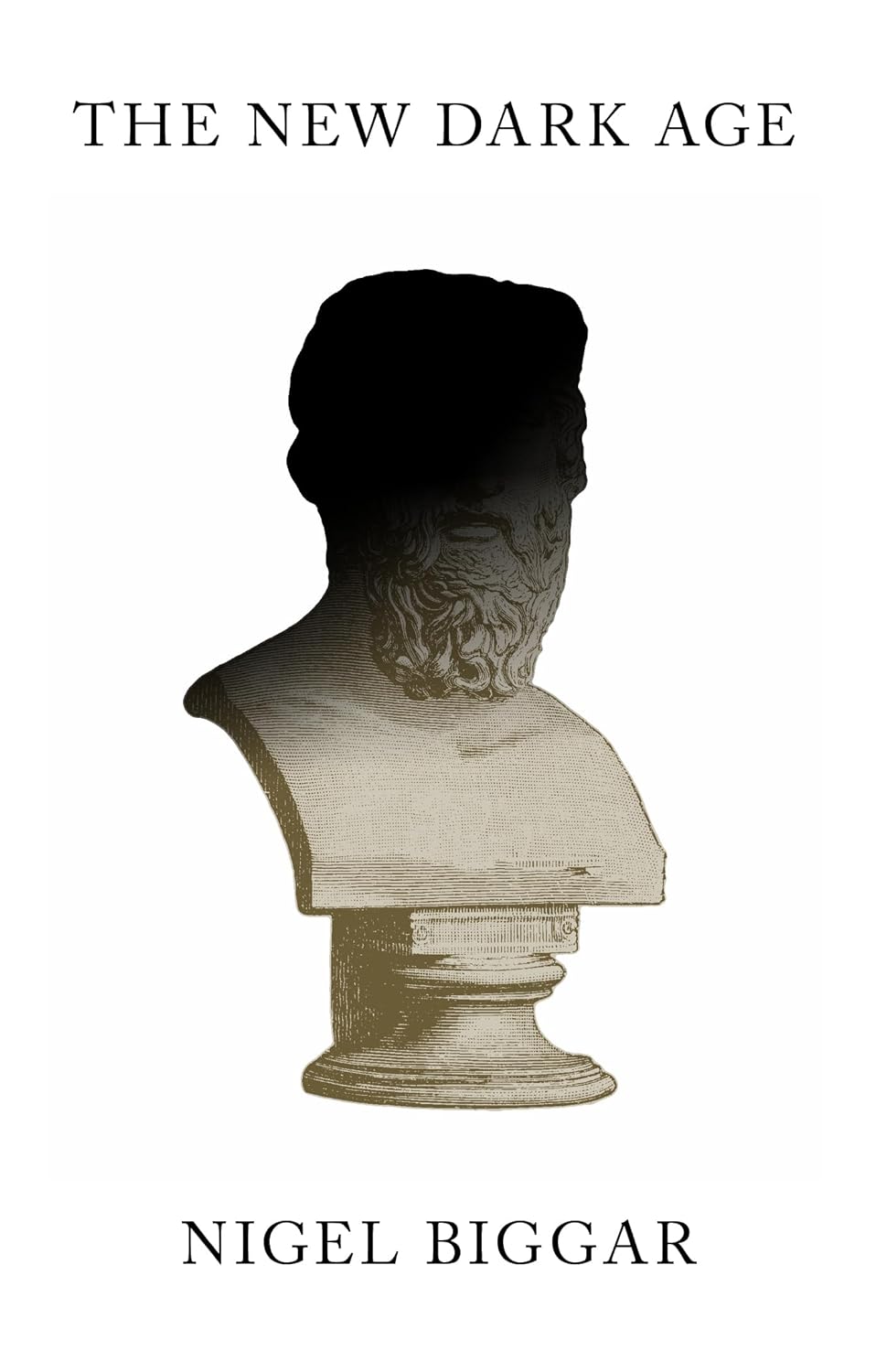
 The New Dark Age: Why Liberals Must Win the Culture Wars
By Nigel Biggar.
Polity Press, 2026.
Hardcover, 192 pages, $25.00.
Reviewed by Gene Callahan.
Nigel Biggar did not join the culture wars voluntarily: the culture wars came for him. He opens his new book with a description of how that happened: Biggar was working on an academic project called “Ethics and Empire” at Oxford University. When it was discovered that the project was attempting to highlight both the negative and the positive impacts of empires on their subjects, he found himself the target of a campaign by hundreds of academics and a host of students who wanted to, in the words of Cambridge professor Priyamvada Gopal, “SHUT THIS DOWN.” (The caps are hers.)
Apparently, the idea that empires have had good as well as bad aspects is so outrageous that no one should even be allowed to investigate the issue. As further evidence that the culture wars are not an invention of conservative politicians or something artificial and trivial, Biggar cites the gay feminist philosopher, Kathleen Stock, who was forced to resign from her post at the University of Sussex because of “a sustained campaign of harassment by students and some colleagues.” Her crime was that she had questioned transgender orthodoxy.
The species of postmodernism which had Biggar in its crosshairs is “postcolonialism.” Biggar never denies that colonial powers sometimes did terrible things; he only notes that they sometimes did good things as well. But that won’t do for hardcore postcolonialists: for them, the world is cleanly divided between wholly evil colonial powers (almost always European; post-colonialists have little interest in the history of colonialism on the part of non-white people), and wholly innocent subject populations. And to make that sharp cut, they must reject basic logic and sweep any contrary evidence under their PhD theses. Biggar here cites a founding postcolonialist, Frantz Fanon, who condemned the “tiresome reasoning [and] oppressive logic” characteristic of “European culture.” But, as Biggar notes, you can’t solve a problem unless you diagnose it correctly, and “Fanon’s view of the colonial problem… owe[s] more to blind hatred than to a disciplined observation of historical data and diagnosis of the problem.”
Another incident of postcolonialism gone mad that Biggar describes involves the claim that hundreds of American Indian students at residential schools in Canada were killed and dumped in unmarked graves. And this story continues to circulate as though it were true, despite the fact that “[n]ot a single set of remains of a murdered Indian child in an unmarked grave had been found in Kamloops or elsewhere in Canada. Indeed, not a single attempt to disinter an alleged grave has been made.”
The whole field of “postcolonial studies,” as Biggar sees it, only wears the skin of a scholarly enterprise, as its practitioners are not competent in philosophy or ethics or history, and so simply treat the evil of colonialism as “axiomatic” and “slavishly” repeat the work of a founder of the field, Edward Said, as “Holy Scripture.”
Biggar offers an example of the fatuousness of the field’s practitioners in their efforts to “decolonize” museums. For instance, the Kelvingrove Museum in Glasgow installed a permanent exhibition intended to show that Glasgow benefited greatly from the slave trade (with which it was barely involved) and failing to mention the city’s much more important role in ending the slave trade.
Next is the case of Frances Widdowson, who was fired from her professorship at Mount Royal University for questioning the notion of “indigenous science.” This is ironic because, while “indigenous” people certainly knew lots of interesting things, and it is foolish to dismiss them as ignorant savages, to insist that the knowledge they had was “science” is to demand it fit into a western framework.
Biggar sees this aversion to reason and evidence (at least when they interfere with a politically useful narrative) to contain “the springs of tyranny,” since once those are abandoned, the only means left to resolve disagreements is power. Thus, “postcolonialists and other ‘progressive’ zealots assume an aggressive, intimidating, repressive, tyrannical posture.”
As an example of this odious behavior, Biggar cites the “Rhodes Must Fall” movement at Oxford University, dedicated to bring down a statue of Cecil Rhodes at the university. Biggar notes that their outrage over the statue centered around a single quote fabricated by Adekeye Adebajo and falsely attributed to Rhodes. He notes the irony that the students preferred to protest Rhodes, a white man dead for over a century, to protesting about the present-day humanitarian crisis in South Africa due to government corruption.
What explains this gulf between the protesters’ self-proclaimed concern for the oppressed and their general lack of concern for the people actually suffering oppression? Biggar argues that “[Their] focus of concern was really not the poor and disadvantaged at all, but the righteous self.”
He notes that in Christian literature, the saints recognize that they themselves are terrible sinners. But in the literature of wokeness, sin lies entirely with the “oppressors,” from whom the woke person is sharply distinguished. Given that wokeness is about showing one’s own moral superiority, it follows that “it is a narcissistic relationship in which the African, the Indian, and Arab are brought in as extras.”
While Biggar was under attack by the postcolonialists, he was taken aback by the silence of his university colleagues, many of whom he had thought to be friends, in the face of his troubles. “It was as if I had become diseased and they were terrified of contagion,” he writes. Only four colleagues reached out to offer support. And he had to meet one of his “supportive” colleagues in a deserted café, behind a screen where no one could see them. Given his colleagues’ fear of publicly supporting Biggar, we can surmise that they would also be afraid to express their true views where they differ from the elite consensus. As Biggar points out, “a single visible cancellation causes multiple invisible self-cancellations.” In explanation, Biggar posits that “[a]cademics are as protective of their reputations as anyone else… They are generally not made for battle.”
This propensity of academics to bend in whatever direction the political winds seem to be blowing is not new: Biggar notes that “the Nazi party enjoyed ‘almost twice as much’ support among students as in the country as a whole.” Three hundred professors signed a manifesto urging support for Hitler.
Much like today’s woke academics, the academics of 1933 Germany held that “research and teaching must serve…the national community…and not some abstract notion of ‘objective truth.’” The difference is that in the latter case, it was the Nazi party they believed research and teaching ought to serve.
While discussing these problems, Biggar complains that the medieval university lacked faculties of subjects like architecture and agriculture, “[p]erhaps because of the infection of medieval Christendom by an Aristotelian disdain for the servile arts.” But this suggestion ignores the fact that manual labor was an important and respected part of monastic discipline. Could it be instead that no one thought that universities needed a faculty of architecture or faculty of agriculture because education in such disciplines was done better under an apprenticeship system?
Biggar proceeds to list the intellectual vices he sees corrupting today’s universities and contrasts them with the intellectual virtues he believes are necessary for the university to fulfill its telos. The vices he catalogues are “smearing by association, the authoritarian pulling of professional rank, misrepresentation, the setting up of straw men, unjust bias, false assertion, dogmatic ideological abstraction and evasive omission.” Biggar offers several stunning examples of the first vice from one Richard Drayton, who in an essay on Biggar brings up such irrelevant facts such as Biggar’s great-great-grandfather having had a manure business, and Biggar having been born some few miles from long-dead people who were known to be racists.
(I do have one complaint about this section: the rhetorical device Biggar uses in referring to himself in the third person throughout this chapter does not work for me: it merely makes me think someone else wrote the chapter.)
The virtues Biggar opposes to these vices are temperance, respect, carefulness, patience, charity, humility, docility (openness to being taught), thoughtfulness, and courage. Of particular note for our online world is that, for Biggar, respect means that our initial position should be that others are acting in good faith. (Of course, we may later discover that they are not doing so, but that should be a discovery, not an assumption.) And Biggar makes the important point that professors should not just teach these virtues, but also model them.
While of minor importance to the central thesis of this book, it is worth mentioning that Biggar seems to have a misapprehension about the nature of historical research. He writes:
It is true that only those who have dug deep into archives or archaeological sites can tell us what the hard, empirical data are. But when it comes to making sense of that data, all manner of… assumptions come into play.
To explain what is wrong in the above, I will begin with an example. In one of his lectures, Egyptologist Bob Brier described how the pharaoh Ramesses II, every few years, had an inscription made up that boasted of how he had recently ventured out and crushed the Hittites. Brier points out that if Ramesses had really thoroughly defeated the Hittites the first time, there would not have been a second time, and if he had done so the second time, there wouldn’t have been a third time, etc. As a result of this historical reasoning, scholars have concluded that Ramesses never crushed the Hittites at all, but merely battled them to a series of draws.
Thus, these inscriptions are not the data of history that an historian discovers by observation, the way that an astronomer determines where a planet is on some particular night. Instead, they are evidence as to what the data is. So it is not the case that there is first historical data, followed by historians’ “making sense” of that data. The data of history only emerges as a result of historians making sense of the evidence.
A more important concern I have with the book is the tension running throughout this work between Biggar’s repeated invocation of liberalism as the solution to the woes he describes, and his recognition that (quoting Charles Renouvier), “The world suffers from its lack of faith in a transcendent truth.”
But that need for a transcendental grounding for social order is something liberalism has tried to reject. Liberalism declares, “No, we can ground social order in purely immanent reasoning.” There’s no appeal to transcendent reality in Hobbes’s case for the Leviathan, or, three centuries later, in the reasoning of Rawls or Nozick.
Furthermore, contra the liberal conceit of neutrality between different “comprehensive doctrines,” Biggar seems to understand that, as he puts it, “There is no neutral position available.” But given Biggar sees this truth, then why does he argue that it is academics’ “civic duty to defend liberal culture on campus”?
Of course, with this statement, Biggar may not actually be denoting ideological liberalism. He might mean “liberality” as a personal virtue, so that academics have a duty to carefully consider others’ ideas, and respond to them rationally. But Plato was teaching us that 2400 years ago, and certainly not under the guise of liberalism. So this is another place where Biggar’s invocation of liberalism is a puzzle.
I agree with Biggar that academics should teach and practice the virtues he lists. But why aren’t they enough? Why tie them to the ideological baggage of liberalism?
In any case, Biggar’s short but important book gives us a new twist on the old aphorism, “A conservative is a liberal who has been mugged.” The updated version is: “A conservative is a liberal who has met a cancel mob.”
Gene Callahan is the author of Economics for Real People and Oakeshott on Rome and America, and co-editor of the books Tradition vs. Rationalism, Critics of Enlightenment Rationalism, and Critics of Enlightenment Rationalism Revisited. He has a PhD in political theory from Cardiff University and teaches at NYU.
Support the University Bookman
The Bookman is provided free of charge and without ads to all readers. Would you please consider supporting the work of the Bookman with a gift of $5? Contributions of any amount are needed and appreciated!

