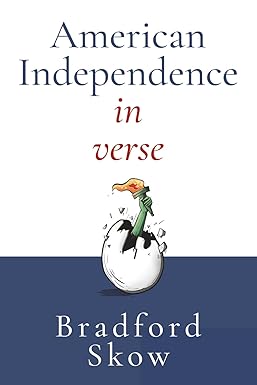
 American Independence in Verse
By Bradford Skow.
Pentameter Press, 2025.
Paperback, 94 pages, $9.99.
Reviewed by Thomas Philbrick.
In Book III of the Aeneid, Aeneas lands with his men on the shores of Carthage after fleeing Troy and surviving a string of harrowing storms at sea. After they gather food and cobble together some rudimentary shelters, Aeneas does something surprising. Rather than present plans for a continued voyage or the building of a temporary settlement, Aeneas tells them a story. Their story, in fact. He tells them of their ancestors, the battles fought and the victories won, the many silent labors undertaken by those who came before them. And he reminds them of their destiny, the calling that illuminates the horizon ahead of them and points the way toward what will eventually become the great civilization of Rome. It is a brilliant piece of statesmanship. By reminding his men of their collective heritage, Aeneas galvanizes them toward a single, higher end at a time when, under a lesser leader, they might otherwise have disintegrated under the stress and exhaustion of their situation.
A recent poetry collection from Pentameter Press seeks to do something similar. American Independence in Verse, penned by the poet Bradford Skow, retells the story of the American Revolution in poetic form. The collection takes as its focus the events that occurred between the Stamp Act (1765) and the Declaration of Independence (1776). This twenty-two year period Skow divides into three parts that are separated by what he calls “Interludes”: pauses in the action that presage a flurry of political or military activity. I found this organizational scheme tremendously helpful for readers who might not otherwise know where to place a given poem in the progression of events. Those three parts are (1) the Stamp Act, (2) the Townshend Acts and subsequent resistance (including the Boston Massacre), and (3) the young nation preparing for war.
Skow is a philosophy professor at MIT—a formidable achievement in its own right—but he is equally proficient as a poet. How did he become a poet? “I read Paradise Lost,” he says. From there he began writing his own poems, experimenting with different verse forms and eventually gravitating toward metric poetry along the lines of Milton’s masterpiece.
Now, for the poems themselves. While the poems are organized into three historical segments, none of the poems are as simple as the segment into which they fall. Skow is unafraid to show us the complex, nuanced perspectives of the Americans who sympathized with the Crown and Brits who understood the frustrations of the colonists. For instance, in I’m charged with giving birth to sedition in America, Skow presents various speeches by members of the House of Commons, including one by William Pitt in which he calls the Stamp Act a “gross injustice.” And in the first “Interlude,” Skow offers us a view at the surprising pre-war sentiments of no less a patriot than George Washington himself:
I find I must be candid, and confess
That your opinions have been led astray
By venal men, who falsely counsel you
That Massachusetts is rebellious,
And that it aims for independency.
Give me leave, my good friend, to say to you,
You are abused. I am as satisfied,
As I am of my own existence, that
No such thing is intended or desired,
By any thinking man in North America.
Skow also shows us the many Americans who sought to request the Crown’s favor with humble and patient entreaties, first in Declarations and Petitions of the Stamp Act Congress, and again in We’re stuck between the hawk and buzzard, which is Skow’s take on the somber 1775 Olive Branch Petition.
We aim to execute this office with
The utmost deference to your Majesty;
Fondly we cling to your great Person, with
All possible devotion and affection;
And ardently desire our former harmony.
The most effective example of Skow’s nuanced view of Revolutionary history, however, is the contrast he draws between John Dickinson’s 1767 Letters from a Farmer in Pennsylvania and Thomas Paine’s 1776 Common Sense. Dickinson, who famously refused to sign the Declaration of Independence, worries about the unforeseen consequences of complete separation from Great Britain.
And what then? If once we’re separated
From the mother country, torn from her
To whom we’re bound by laws and warm affection—
We must bleed at every vein.
As Dickinson sees it, any dissatisfaction with the Crown must be expressed in respectful and limited terms.
But our resistance must be that of dutiful
Children, who have received unmerited
Blows from a much-loved parent. Our complaints
Must speak the quiet tones of veneration.
Paine, on the other hand, has no such qualms. “Hark and listen,” he says, “’tis time to part.” Dickinson’s hoped-for reconciliation “[h]as passed away like an agreeable Dream.” Paine’s language is extreme, his imagery brutal:
[N]o more
Can you forgive the murders of Great Britain
Than can a man forgive the ravisher
Of his wife.
Through these two contrasting characters, Skow illustrates the wide range of opinions in the young country at the time of the Stamp Act. Even their placement in the collection is illustrative, with Dickinson’s Letters at the beginning of Part II—when reconciliation might still have been a viable option—and Paine’s Common Sense at the very end of the book—after war had become the only path forward.
Skow also illustrates the diverse range of perspectives on the other side of the pond. These views range from disgruntled financial concern—“Will the[ Americans] not grudge a tiny share To help relieve the debt we bear?” (These Sons of Liberty will but grow stronger)—to open disgust at the colonists’ “malice” and “false reports” (The Case of Captain Preston). One notable inclusion is Edmund Burke, the great statesman and author of Reflections on the Revolution in France (1790). Skow shows us one of his speeches to Parliament, titled Nobody will be argued into slavery, in which Burke tries to convey the practical consequences of the Crown’s actions.
For if you sophisticate
And poison our authority with subtle
Deductions, . . . all you’ll teach them is
To call our right to rule in question.
Skow does, however, allow himself the liberty of tipping the scales when it comes to Parliament. Each time Parliament appears in the collection, its words are presented in an obnoxious nursery-rhyme style that is, to put it simply, hilarious. Take, for instance, the 1766 Repeal of the Stamp Act:
We passed an Act of late
‘Cause protecting you is expensive
Developments since then
Have made us apprehensive.
But don’t get too excited
We noticed that you broke
Our laws with resolutions
Throwing off our yoke.
Or better yet, the opening of The Intolerable Acts:
We’re kind of mad
You dumped the tea
Since you’ve been bad
We now decree:
The center of the collection is not Parliament, though, nor is it Washington, Burke, or Franklin. It is Samuel Adams, that great publisher of freedom who disseminated the sentiments that ultimately spurred the nation to war. Skow sprinkles Samuel Adams’s writings throughout the collection, each one featuring a different pseudonym and each one drilling to the core of the country’s young identity. Speaking as “Alfred” in The consequences arriving from our independence, Adams writes:
For Britain is a haughty nation drunk with power
And acts the drunken man upon a precipice.
It is in this same passionate, pseudo-biblical (dare I say Whitman-esque?) free verse style that Adams, this time writing as “Determinatus,” later urges his fellow Americans to recognize the true nature of their situation:
I am no friend to riots, tumults, and unlawful assemblies.
But when the people are oppressed, their rights
Infringed, and their property invaded,
When taskmasters are set above them;
When ships with cannon execute unlawful acts
Before their eyes;
When royal governors dissolve their legislatures,
Sweeping aside the delegates they empowered
To guard their rights;
In such circumstances, the people will be discontented,
And they should not be blamed.
Simply put, Adams is the glue that binds the collection together. His voice is powerful and unique, incorporating and tying together the various strands of the American spirit into one unified cry for freedom.
Nonetheless, the collection ends with George Washington’s July 9, 1776 order to have the Declaration of Independence read aloud. Skow places this poem in a separate Coda, a move that nicely highlights the new territory that was entered once the delegates signed the Declaration. Washington tells the colonies that they are now “Free, and Independent States,” a “people joined in Freedom.” But this freedom, he warns, comes with responsibility:
This fresh
Incentive to Fidelity and Courage
Rewards us all with new realities:
The future peace and safety of this land
Depends alone on our success in arms.
As we approach our country’s 250th anniversary amidst the usual assortment of political and social controversies, Washington’s warning is prescient. Courage is needed, as is fidelity to the bond of ordered liberty that once spurred our forefathers to take up arms to secure the peace and safety we now enjoy. By illuminating and recasting these words from our collective past, Skow has offered us a timely reminder of our hard-won inheritance. And by presenting them in a poetic form traceable to ancient cultures—the very cultures out of which our American inheritance was molded—he has also connected us, across centuries, to timeless principles that transcend any particular polis.
Given the success of this collection, I couldn’t help but wonder if Skow has ambitions for a larger work, something akin to the Greeks’ Iliad or the Romans’ Aeneid, a colossal epic poem telling the story of the country’s birth, growth, and maturity. But Skow wasn’t dropping any hints. “Maybe,” he says. “Maybe down the road.”
Thomas Philbrick is an attorney, artist, composer, and literary critic living in Michigan. He is a former Wilbur Fellow at the Russell Kirk Center for Cultural Renewal.
Support the University Bookman
The Bookman is provided free of charge and without ads to all readers. Would you please consider supporting the work of the Bookman with a gift of $5? Contributions of any amount are needed and appreciated!