 Historical Consciousness: The Remembered Past
Harper & Row, 1968
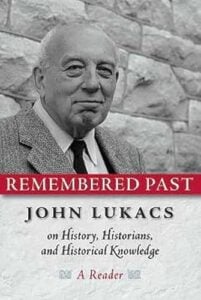
The Remembered Past
ISI Books (Intercollegiate Studies Institute), 2005
(922-page collected volume; distinct from the 1968 book)
The Hitler of History
Alfred A. Knopf, 1997
A Thread of Years
Yale University Press, 1998
1945: Year Zero
Doubleday, 1978
The End of the Twentieth Century and the End of the Modern Age
Ticknor & Fields, 1993
At the End of the Age
Yale University Press, 2002
The Future of History
Yale University Press, 2011
Reviewed by John Rodden.
The centennial anniversary of the birth of the man who was, until he passed away seven years ago, our nation’s greatest living European historian recently occurred with hardly a word. That disregard or sheer ignorance represents a damning commentary on the lack of historical consciousness in this nation. I refer to my late teacher and friend, the Hungarian-born John Lukács (1924 – 2019). Fittingly enough, Lukács was the proud author of the landmark volume of historiography, Historical Consciousness (1968)—who doubtless would have acridly added that our august republic suffers today not just a privation of historical consciousness but an affliction of gaping Orwellian memory holes.
Renewed attention to this pathbreaking, too-little-known classic will serve to fill at least partially one of these holes. Lukács’s Historical Consciousness: The Remembered Past (1968) is one of the most ambitious works in the philosophy of history written in the twentieth century. Rather than a conventional historical narrative focused on events, the book is a meditation on the nature of historical thinking itself—what it means to be a historical being, how we remember the past, and why historical knowledge matters. Put another way, Lukács offers an extended contemplation on what it means to think historically and how “historical consciousness”—the awareness of human existence in time—shapes all of human experience. The table of contents suggests the breathtaking scope of the inquiry, with sections devoted to the following topics:
- The growth of historical thought in the “democratic age”
- Problems of facts, causation, and interpretation
- The role and limits of memory, recognition, and narrative
- The relation of history to science and other forms of knowledge
- How historians think and what history has become
Lukács argues in Historical Consciousness that history is best understood as a shared phenomenological experience, which he terms the remembered past, as the subtitle formulates it. Contra the great nineteenth-century German historian Leopold von Ranke, “History” for Lukács is not merely a record of events based on a collection of facts. It is not the Rankean (and Comtean) positivist reconstruction of wie es eigentlich war (as it actually was). History is not what the historian believes “really happened,” but rather a conception of the historian himself as viewed from a certain historical and social perspective, notwithstanding the painstaking recovery and piecing together of evidence. Rather, “history” is an irreducibly human cognitive and moral activity that shapes identity, yields personal and collective meaning, and embodies how people understand their present and future. For Lukács, every person is a “historian” because all human persons live with memories and interpretations of their past.
Proceeding from this starting point, Lukács traces the evolution of historical consciousness—our awareness that humans and societies exist in time, shaped by past actions and choices—as a distinct intellectual phenomenon that emerged most fully with modern Western thought. Instead of treating history as a science of causal laws, Lukács emphasizes that every historian, amateur or professional, is inherently historical by virtue of being human. Historical knowledge is personal, moral, and participatory, not just an assembly and reconstruction of empirical data.
Historical Consciousness represents a sustained, unprecedented attempt to defend this humanistic claim in political, epistemological, ontological, and personalist terms. After an introduction diagnosing the “decay of scientific history” and the bureaucratization of the profession, Lukács surveys topics ranging from how history functions in democratic societies to the implications of modern physics for historical thought. Lukács insists that historical consciousness cannot be separated from our own standpoint as individuals in time, and that to understand the past, we must recognize how our present shapes our interpretation.
One of Lukács’s most original arguments is that historical understanding is not neutral or purely objective. Instead, he holds that understanding the past is a moral endeavor that requires imagination—what cultural critics such as Lionel Trilling memorably described as the moral imagination—because it demands empathy with historical agents and a sense of the unique contingencies that shaped events. This stands in contrast to the dispassionate objectivity championed by Ranke.
However, Lukács’s originality may also account for the book’s relative neglect in mainstream historical scholarship. Lukács himself lamented that Historical Consciousness did not receive the sustained attention it deserved within professional historiography and worried that many historians remained uninterested in his philosophical claims. In his later writings, he noted that professional historians often focus on specialized empirical work rather than on the larger questions of historical meaning that his book raises, leaving Historical Consciousness under-read even among specialists.
This neglect is not total, and the book has influenced certain intellectual circles, particularly among conservative and humanistic thinkers. Russell Kirk and other American cultural conservatives praised Lukács’s defense of historical wisdom over positivistic scientism and his recognition of the imaginative dimension of historical thought. Kirk and allied commentators appreciated how Lukács’s work aligned with a tradition that sees history as a form of humanistic wisdom rather than a technical discipline. Voicing esteem for Lukács’s erudition and engagement with the meaning of history for individuals, Kirk wrote a foreword to a new edition of Historical Consciousness, published just weeks before Kirk’s death in 1994. Seven years later, ISI Press, the publishing arm of the Intercollegiate Studies Institute, published a one-volume quasi-“Complete Works” of Lukács, the 922-page Remembered Past (2005). It was edited and introduced by Mark Malvasi and by Kirk’s son-in-law, Jeffrey O. Nelson.
Still, outside these circles, the reception of Lukács’s historiographical work has been mixed. Reviewers in the mainstream press as well as professor-critics in the leading journals of the historical profession—such as the American Historical Review—have argued that Lukács’s philosophical assertions, particularly his moves away from strict objectivity, lead to relativism and abandon or obscure empirical standards for good historical scholarship. One reviewer associated with the Austrian school of economics, writing in the official house organ of the Ludwig von Mises Institute in 2005, went so far as to reject aspects of Lukács’s philosophical interpretations as “scatterbrained.” In his critique of Remembered Past in the Mises Review (under the title “Blunders, Lies, and Other Historicist Habits”), David Gordon mocked Lukács’s skepticism toward purported economic and scientific “laws,” including those espoused by the Austrian School (including Mises and Nobel laureate Friedrich Hayek). Gordon considered Lukács a naive interloper who was out of his depth in philosophical waters and unable to grasp the Austrian School’s positions in economic Methodenstreit (methodological controversies), branding Lukács’s views on objectivity, historical knowledge, and rejection of scientific certitude as the pretensions of a philosophical lightweight.
Of course, Lukács never claimed to be an economist—or a philosopher of science, for that matter. He was an autodidact in these fields, and he merely claimed that he had read prodigiously and formed his own convictions, in the tradition of other great historians, from Ranke and Tocqueville to Huizinga and beyond.
Some academic historians regarded Lukács’s lack of formal economic and philosophical training as disqualifying him from credibility regarding his ambitious project and broad generalizations. Moreover, in journals such as History and Theory (to which Lukács never contributed), various participants in twentieth-century debates about the concept of historical consciousness repeatedly pointed to alleged methodological shortcomings in Lukács’s work. Some scholars have noted that models of historical consciousness rooted in Western intellectual traditions—such as Lukács’s—overlooked non-Western ways of understanding temporal experience. Those critiques argued that Lukács unjustifiably proceeded from Western models and advanced universalized frameworks that uncritically privilege Western notions of time and historicity.
I would reply that Lukács was a pioneer, raising questions about history and historiography that History and Theory, founded in 1960—eight years before Historical Consciousness—ignored, before and after John’s book. Furthermore, however ambitious the book was, it could not do everything. Lukács made clear in various chapters of his study that he was charting new territory and suggesting new directions that later historians might fruitfully pursue. I would also note that Lukács’s impassioned attack on academic history had the unfortunate consequence that many readers failed to appreciate that his book was intended as a necessary corrective to a professional consensus that sometimes came uncomfortably close to scientism. The unwillingness to grant that fact represented a failure on the part of Lukács’s academic colleagues. Yet it is also true that Lukács did not help matters by underemphasizing that fact and by his irresistible urge to lace serious reflection with spirited polemic.
To appreciate the full scale of Lukács’s ambitions—and the dismissive treatment it received, consisting of a dual campaign of calumny and silence—one needs to understand how strongly Lukács was swimming against the prevailing intellectual currents of mid-twentieth century historical dogma and practice. Repudiating the dominant trend of treating history as a “science” reducible to facts detached from lived human experience, Lukács argued instead that history was an active historical process conducted by historical actors. This conception of historical “process” transformed history-making into the activity of participatory knowledge—i.e., an acknowledgment that human beings engage with and interpret knowledge in an active ontological and epistemological process. Historians, Lukács insisted, should adopt a humanistic mode of inquiry into what and how the past means to us. The “facts” alone—even if we could agree on them—are not themselves “history.” Instead, they are the indispensable building blocks of history. “History” begins with the material facts, insofar as they can be established in historical reconstruction, but it is human interpretation of the facts that imbues them with meaning—and the interpretive act inevitably possesses a humanistic component. History is hermeneutical.
Yet Lukács not only took on and explicitly rejected the positivist successors of Ranke and Comte. He did the same with the philosophers, specifically the philosophers of history, whom he accused of system-building and metaphysical grandiosity à la Hegel. Unlike philosophers of history such as Britain’s R.G. Collingwood, Lukács explicitly distanced himself from systematic philosophy of history, including Hegel and his successors among the nineteenth-century historicists. Lukács maintained instead that historians should possess a humanistic commitment and a high standard of literary expression. Such allegiances, he contended, necessarily meant rejecting metaphysics (a philosophy of history) for a personalist (a historical and existential philosophy) rooted in the lived, daily reality of historical thought, rather than in abstract, Grand Theory schemes.
These arguments separated Lukács from virtually all his peers and would-be colleagues. The philosophers did not deal in his way—and the historians did not usually engage directly at all—with philosophical issues of time, meaning, and consciousness.
As we approach the sixtieth anniversary of its publication—however valid some of the critiques—Historical Consciousness remains an original, deeply reflective, and provocative work that challenges historians to reconsider the foundations of their discipline. Lukács’s insistence on the personal, moral, and imaginative dimensions of historical knowledge continues to inspire some readers—especially those drawn to history as a humanistic pursuit—even as the book remains under-engaged by mainstream historiographical practice. Its influence persists in certain intellectual circles and encourages ongoing debate about the nature of historical thought itself.
Historical Consciousness, “my most important book,” as Lukács calls it in the preface, represents his key work of theory, whereas The Hitler of History and A Thread of Years, published back-to-back thirty years later in 1997-98, are his two striking and original efforts in the praxis of historical consciousness, each in its own way addressing abiding conceptual issues and problems in historical study. Each book, too, is an innovative study in history as literature. The former is “the history of a history: the history of the evolution of our understanding of Hitler’s life and our debates about its meaning.” Thus The Hitler of History posits and pursues the contention that a study of Hitler by historians and biographers who have written about him assists us in moving from “demonization” to “historicization.” Hitler, contends Lukács, was charismatic, not demonic. He must be seen not as a monster or demon, but rather as a human being. It is “greatly dangerous,” concludes Lukács, for us to imagine that he was not a human being because that judgment not only fails to hold him and his associates fully responsible for their evil acts; by treating him as if he belonged to a different species, it also absolves ourselves of the responsibility of failing to choose and support leaders who will govern humanely.
By contrast, A Thread of Years is a series of 69 brief “vignettes” from 1901 to 1969 that depict quotidian events, some of them experienced by a fictitious Philadelphian (a.k.a. JL himself?); Lukács explores social history and the texture of lived history in everyday experience. Yet, as he notes, “years” rather than any fictional or historical figure is the work’s “protagonist.” Lukács further posits that “Time” is a “Living being”; each year possesses a unique character, a distinctive mood, and a certain quality of thought and feeling. (I immediately thought of a famous example: “1984,” blackened as a segment of time by the dark vision of Orwell’s dystopia.)
What was the ultimate admonition of A Thread of Years? As Lukács put it elsewhere: “Know thyself” must become “know thy history.”
No historian has done anything quite like this—not even Lukács’s three great nineteenth-century historian-heroes: Tocqueville, Burckhardt, and Huizinga. In fact, along with these two works of “praxis” are others. They include portions of several other books, ranging from The End of the 20th Century and the End of the Modern Age (1993), At the End of the Age (2002), and The Future of History (2011), along with historical studies incorporating his mode of “auto-history” such as the already cited 1945: Year Zero, wherein he illuminates historical events in modern history via autobiography and sustained self-reflection.
If John outdid his revered nineteenth-century models, did anyone in the twentieth century match or exceed his achievement? Collingwood? E.H. Carr? Michael Polanyi? The accomplishments of this twentieth-century trio—all immediate generational predecessors of Lukács and all British (the Hungarian Polanyi by adoption)—were impressive indeed. All three bear a distinctive, notable affinity with Lukács, their divergent approaches and sensibilities notwithstanding.
Before closing, let us pause to consider the resemblances and departures from Lukács, in order to reach a firm and final appreciation of the singularity and significance of his oeuvre.
No thinker has more affinity with Lukács than R.G. Collingwood (1889 – 1943). Both Lukács and Collingwood castigate purely scientific or positivist accounts of history that reduce it to data without interpretation. Both emphasized that history is about human meaning and the consciousness of actors and historians. In his magnum opus, The Idea of History (1936), Collingwood argues that to understand the past we reconstruct the thoughts of historical agents. Collingwood famously wrote that “all history is the history of thought.” Despite this thematic overlap involving historical consciousness and meaning-making, however, Collingwood is a methodical thinker who develops a systematic philosophy of historical method grounded in philosophical reasoning. This is an intellectual project utterly at odds with Lukács’s essayistic style of literary-cultural reflection, which was explicitly opposed to the quest for a unified system.
Carr (1892 – 1982) shares one significant similarity with Lukács. Both men scoff at positivism and all claims that history can ultimately be “objective,” let alone “reassembled” via the collection and collation of “facts.” In What Is History? (1961), Carr anticipates Lukács’s emphasis on the hermeneutics of history and endorses the historian’s active role in shaping understanding of the past. Nevertheless, while both men were like-minded regarding the critique of positivism, Carr was a systematic thinker (who espoused Stalinist orthodoxy into his sixties), the very antithesis of the existential, literary-minded, anti-totalitarian Lukács. Carr’s historical governing preoccupation with historical causation and social forces was far removed from Lukács’s emphasis on memory, consciousness, and moral experience.
Lastly, Michael Polanyi (1891–1976) too shared one vital resemblance with Lukács. Polanyi’s famous concept of “tacit knowledge” resonates with Lukács’s claim that historical understanding is inherently interpretive and human-centered. Both men conceive knowledge (historical or scientific) as embedded in human judgment rather than purely objective. Beyond this single affinity, however, Polanyi too—like Collingwood and Carr—was a systematic and methodological thinker. He was a professional philosopher of science whose lifelong focus was on technical questions in epistemology and science, such as his formal distinction between tacit and explicit knowledge. His orientation was thoroughly different from Lukács’s relentless engagement with matters of historiography, culture, and memory.
However impressive the contributions of these three thinkers, all of them were professional philosophers, none of whom sought to develop a theory of history per se and exemplify it in praxis. Nor did subsequent figures who were his contemporaries yet who exhibited far less resemblance to Lukács, such as Michel Foucault (1926–84) in France and Hayden White (1928–2018) and Louis Mink (1921–83) in the U.S. None of them were historians. Foucault too was a philosopher; White was a literary critic-theorist; Mink was a linguist.
Mink and White possessed a measure of affinity with Lukács. Both of them were academic figures who embraced the “linguistic turn” in philosophy, albeit in different ways. Like Lukács, Mink too inveighs against positivism and regards narrative as central to historical understanding, all of which resonates with Lukács’s focus on how history is lived, remembered, and interpreted. Nonetheless, he is a linguist and an academic beholden to his discipline. He is not an historian. His approach is a formalist analysis of the structures of historical narrative, whereas Lukács writes in moral and broadly philosophical or essayistic terms about language, not in a mode of rigorous linguistic analysis.
Hayden White became the most influential theorist of narrative, showing how historical writing (as well as literary genres) is replete with literary tropes. White thus shared Lukács’s literary orientation and keen interest in narrative. Whereas White was exclusively an academic theorist, however, Lukács was a famed narrative historian who wrote best-selling narrative histories on the siege of Dunkirk, on Churchill’s crises as prime minister, and on other topics. White’s service to historical understanding was to help undermine the once-regnant view that history is or should be purely objective and neutral. Like Lukács, he redirected attention to how history could be literary and interpretive.
If I am right—about John’s conviction that he had no serious rival among his peers, about his grand ambition to stand alongside (if not inches above) predecessors of the stature of Tocqueville and Burkhardt and Huizinga, and right too about his valiant, partially successful attempt to realize his outsized ambitions—the offense he took at the disdain of his historiographical achievements becomes more understandable. Equally understandable is his inattention and implicit dismissal of his immediate generational predecessors as well as his coevals. For he viewed them all as members of the guild—whether philosophical, historical, linguistic, or literary chapter. The particular institutional or departmental allegiance hardly mattered to him; all of them were “disciplinary” scholars inevitably self-“disciplined” by their academic allegiances.
I recall one occasion when I was speaking to John about George Orwell, who never attended university. I mentioned Orwell’s rare moral courage among all the British intellectuals of his generation to go up against the dominant Stalinist orthodoxies that ruled the British Left of his day. I also mentioned the derision of some Oxbridge rivals, who lamented that “poor George suffered from an untrained mind.” Years later, as Orwell’s star ascended after his death in 1950, one of his admirers recalled that remark and corrected it. “An untrained mind? No, it was an untamed mind.”
John cherished the anecdote and proudly stated that it applied to him, too. He then drew my attention to his brusque letter to the editors of History and Theory, chastising them for neglecting to commission a review of Historical Consciousness as well as their even more inexplicable and vindictive exclusion of his study from their compilation of a comprehensive bibliography on the subject of “history and theory.” Hitler and Stalin had failed to vanquish him, John declared, making clear the context of his reply to the editor.
“You have not succeeded,” wrote Lukács to the journal editors, alluding to Orwell and 1984, “in making me an UNPERSON.”
No indeed.
Their failure to “vaporize” John Lukács and his work into oblivion proved a blessing for us, his readers. The mistreatment only made him more determined to soldier on.
Even more so for students like myself, let me add, the failure to intimidate and silence this self-confessed, utterly “original” sinner remains an enduring gift and godsend.
John Rodden has taught at the University of Virginia and the University of Texas at Austin.
Support the University Bookman
The Bookman is provided free of charge and without ads to all readers. Would you please consider supporting the work of the Bookman with a gift of $5? Contributions of any amount are needed and appreciated!


