
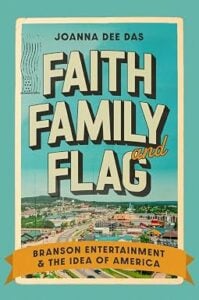
 Faith, Family, and Flag: Branson Entertainment and the Idea of America
By Joanna Dee Das.
University of Chicago Press, 2025.
Hardcover, 272 pages, $27.50.
Reviewed by Jason C. Phillips.
Over the last eighteen months, I have twice visited Branson, Missouri. Over the course of my lifetime, I have visited Branson more times than I can count. Throughout the 1990s, our family vacationed in Branson nearly every year. I have fond memories of miniature golf, Ride the Ducks, going to theme parks like Silver Dollar City and Mutton Hollow, and seeing shows like Country Tonite, Waltzing Water, The Presleys’ Country Jubilee, Jim Stafford, Kirby Van Burch’s magic show, and of course Yakov Smirnoff. This personal connection alone made me excited for Joanna Dee Das’s new book, Faith, Family, and Flag: Branson Entertainment and the Idea of America. From a professional perspective, I also have an interest due to the question of regional identity that Branson finds itself in. Das explores Branson’s competing Ozarks, Midwest, and even Southern claims to identity. Even more meaningful is the deeper conversation between rural America and coastal elites that this book centers on.
Das argues that “Branson functions as a litmus test for where you stand in America’s long culture wars.” On the one hand, Branson is much beloved by rural America, the more Christian and conservative the better. From its humble beginnings as a tourist destination inspired by Harold Bell Wright’s novel The Shepherd of the Hills to the modern day with its Sight & Sound theatre and the Trump Store along 76 Country Boulevard, Branson has held firm to its roots. For many rural Americans, Branson represents a family-friendly destination filled with entertainment options reflective of their most sincerely held beliefs. At the same time, Branson is viewed with ridicule by more cosmopolitan Americans. The cultural tastemakers have always looked down their noses at Branson and the sort of people who would attend something like Branson’s Famous Baldknobbers Show or spend an evening watching Mel Tillis perform live. Das argues this was true of Wright’s novel and those who enjoyed it long before Branson became a tourist hub. For example, she quotes Barnard College professor Charles Baldwin who said in 1924, “[Wright] and his kind, in their exalted manhood…are the rank and file of the Ku Klux Klan.” Baldwin’s quote echoes how many today see those who espouse any sort of Christian or conservative belief.
Harold Bell Wright, regardless of how literary tastemakers viewed him in the 1920s, is the central figure in the origin of Branson. Though denigrated by the Baldwins and H. L. Menckens of his day, Wright was one of the century’s best-selling novelists. Das notes he was the nation’s first literary millionaire, and The Shepherd of the Hills was the most-read book in the 1910s after the Bible. Readers of The University Bookman are probably familiar with Wright’s first novel, That Printer of Udell’s, which was a beloved favorite of Ronald Reagan’s. It was The Shepherd of the Hills, and its strong Christian themes and Ozarks setting, that created the Branson of today. In addition to inspiring five feature films, including a 1941 version starring John Wayne, the novel spurred millions of Americans to travel to the Branson area to see the region that had inspired Wright. In 1926, Lizzie McDaniel purchased the homestead that had inspired the novel and christened it the Shepherd of the Hills Farm. She also built a hotel, gift shop, art gallery, and even a gas station on the property to attract visitors. Twenty years later, Bruce and Mary Trimble would move from Kansas City to Branson and purchase the Shepherd of the Hills Farm. The Trimbles would further transform the property, including renovating the home into a museum and commissioning statues of the novel’s characters that still stand at the site’s Inspiration Point today. In 1955, the Shepherd of the Hills became a theatrical performance, one of the longest-running shows in Branson’s history. When combined with nearby Eureka Springs’s The Great Passion Play, the Ozarks can lay claim to decades worth of hosting the nation’s largest outdoor dramas. It may not be Broadway, but millions of Americans have flocked to see these Christian performances. Speaking of Broadway, The Shepherd of the Hills kickstarted a tradition of live performance in Branson that would see it boast more theater seats than Broadway by the dawn of the twenty-first century.
Das argues that The Shepherd of the Hills alone would not be enough to sustain Branson’s tourism industry. Branson needed things for people to do during the day and prevent them from heading home early. The Herschend family purchased Marvel Cave in 1950, which would become a fully interactive theme park, Silver Dollar City, in 1960. The theme park would follow Colonial Williamsburg’s lead in having a cast fully in character as citizens of an 1880s Ozarks village. It would draw even more inspiration from the originator of the theme park idea, Walt Disney. Disney’s Midwestern roots are often overlooked, but as a child, he lived in the small town of Marceline, Missouri. This left a strong impression on Disney, especially compared to the bustling Kansas City his family moved to after Marceline. As a result, when Disney opened Disneyland, he resurrected Marceline as Main Street, USA. Das argues, “Silver Dollar City went a step further than Disneyland. Instead of a Missouri Main Street transplanted to suburban California, the Herschends built their Missouri Main Street upon the literal ashes of an actual Missouri main street.”
With The Shepherd of the Hills and Silver Dollar City laying a foundation, it didn’t take long for others to seek opportunity in Branson’s growing tourism industry. The Presleys’ and Baldknobbers would soon open, and they would be followed by more and more shows every year. Das provides a helpful appendix at the end of the book to keep track of the numerous shows that have performed in Branson. The success of these shows in Branson should remind the reader that though the tastemakers in New York City might look at this mid-century Branson as ‘hokey’ or ‘old fashioned’ in comparison to the Swinging 60s, ‘hokey’ was in. Das notes the popularity of shows like The Andy Griffith Show and The Beverly Hillbillies during this initial boom period for Branson. One could easily add Petticoat Junction, Green Acres, Mr. Ed, and the popular film series Ma and Pa Kettle. Indeed, The Beverly Hillbillies would even film five episodes in Branson in 1969, contributing to the town’s surge in tourism. From then to now, Branson has proven that there is a mass market for alternatives to what our nation’s self-declared tastemakers deem culturally “in fashion.”
Overall, Das attempts to maintain an objective view of Branson and those who work and play there. Das is herself a former professional dancer and currently an Associate Professor of Dance at Washington University in St. Louis, so she brings a sincere respect and appreciation for all of those who perform in Branson’s many live shows. She repeatedly shows in Faith, Family, and Flag that she sincerely wants to understand rural America by examining the Christian and conservative overtones of Branson. However, there are also several times where her implicit bias comes through. One example of this would be when discussing how a then 20-year-old Gary Presley, of the Presley’s Country Jubilee family, spent the summer of 1967. Das writes, “[He] did not put on a tie-dyed t-shirt to participate in the iconic ‘Summer of Love.’ He did not participate in any of the more than 150 rebellions against racism and police brutality erupting in cities across America. He did not set foot on a college campus to protest the Vietnam War or join a meeting of the Students for a Democratic Society. Instead, he donned his grandfather’s oversized overalls, plopped a broken straw hat on his head, and blacked out several of his teeth with an eyebrow pencil to transform himself into Herkimer, a hillbilly.” Were those truly the only other alternatives to performing in his family’s show for a 20-year-old in 1967? I bring this up not to denigrate Das’s work, but to emphasize that even in a work that genuinely seeks to build a bridge with and better understand rural America, there is a level of separation that will always exist between a Columbia PhD and those who flock to Branson. Das takes it for granted that belonging to the Students for a Democratic Society or engaging in protests and the “Summer of Love” are objectively good things; the notion that others might disagree never seems to cross her mind.
Das’s Faith, Family, and Flag is, on the whole, a superb book for all who have been to Branson or are curious about Branson. For readers who have been to Branson, especially repeat visitors like me, this book will constantly bring back memories of vacations and the loved ones with whom that time was spent. This trip down memory lane is strengthened by the historical context and understanding Das provides. For readers who might be interested in visiting Branson in the future, the book offers a perfect summation of Branson’s history. This is useful information for first-time visitors trying to figure out which shows and attractions to visit. Whether one loves or hates Branson, Das shows it is a place that needs to be considered seriously.
Jason C. Phillips is an Assistant Professor of History at Peru State College in Peru, Nebraska. He received his PhD from the University of Arkansas in 2019 with a focus on German history, but has since changed his research direction and is currently focused on American political history. He is working on a book entitled Reagan’s Women, which explores the role Republican women played in shaping party politics and conservative debate throughout the 1980s.
Support the University Bookman
The Bookman is provided free of charge and without ads to all readers. Would you please consider supporting the work of the Bookman with a gift of $5? Contributions of any amount are needed and appreciated!

