
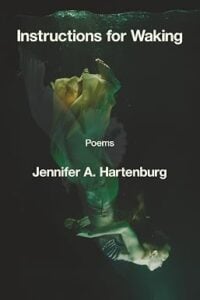
 Instructions for Waking
By Jennifer A. Hartenburg.
Kelsay Books, 2026.
Paperback, 70 pages, $20.
Reviewed by Matt Miller.
I’m not much of a birdwatcher. We keep a few feeders, and I’m always pleased to spot a bald eagle, a pileated woodpecker, or a Baltimore oriole. But I don’t stalk waterfowl on the weekends with a camera, and identification of warblers defeats me entirely. I’m not much of a poet, either; my various English degrees mean I can natter on a bit about iambs and trochees, line length and rhyme scheme. But intelligent analysis of prosody is mostly beyond me. Still, in my inexpert way I find it indispensable to watch birds and to read poems. They are habits that wake me to the world and to words. And waking means attending. I must be conscious of what is taking place around me, in flesh and in language, if I am to care for it, to nurture it, to give it life.
Jennifer A. Hartenburg’s debut collection of poems, Instructions for Waking, offers such a poetic practice of waking, attending, and caring. These are poems rich with the life of the world, flocking with birds and bees both literal and metaphorical, but also closely attentive to the quiddities of language and the motions of the soul. Rather than stopping with an arresting image or a surprising turn of phrase, as some contemporary poetry tends to do, Hartenburg takes the risk of making meaning. The result is a lush selection of memorable poems reminiscent of contemporary masters like A.E. Stallings, Scott Cairns, and Ben Myers.
I begin with birds because they are a predominant image here, from the collection’s opening poem, which figures a palpating heart as a “little grackle,” to a consideration of Kierkegaard’s canary to songbirds and waterfowl flitting in and out of many poems. In Hartenburg’s poetry birds are a call to notice the world: whether a decaying icterid in “Elegy for a Blackbird,” “glutting / black ants with your eyeballs,” or a clumsy duck struggling to take off in the wry “Black-Bellied Whistling Duck.” Attending to the seemingly inconsequential, like the species of bird at a feeder, however, is about more than showcasing the poet’s observational skills. The poem “Strange Birds” begins with three stanzas describing common feeder birds—blue jay, goldfinch, cardinal—in a rich color vocabulary: “a dart of blue against the blue,” “a clinquant hint,” “a branch ablaze but not consumed.” However, the fourth and final bird evades the speaker’s glimpse, remaining strange, “out-of-reach,” “elusive.” The poem concludes: “Yet I am Eve regenerate / sighting among the ashes / new strange and feral graces.” Observation leads here to sanctification. Naming the birds, like our foreparents in the Eden garden, leads to reverent joy in Creation. Like a worshipper coming to the altar rail with empty hands, the person who looks to the world in a receptive spirit must practice the discipline of receiving gifts. To watch birds and name them is part of our first duty as creatures made in the image of a loving God: to gratefully receive the gift of being.
To follow “instructions for waking” to the beauty of Creation leads also to delight in the gifts of language. Any competent poet must be a lover of words, but Hartenburg has a special facility with diction and a magpie eye for vocabulary. “Found Blood Moon” revels in the astronomical language, “totality,” “refracting,” “Rayleigh scattering”; “Deciduous” finds humor in arborists’ language, the “dripline” and the “critical radius.” Any true lover of words will smile repeatedly at the unusual vocabulary Hartenburg weaves throughout her verse: words like “melisma,” “labellum,” “ardent cadmiums,” “rachis,” or the onomatopoetic birdcalls: “chitip,” “reedle-eek.” Poetically, Hartenburg demonstrates comfort with metrical forms as well as free verse. Though the majority of the poems in the collection employ unrhymed syllabic verse (following a set number of syllables per line, like a haiku), in “Turtle Fountain” she essays a compelling sestina; “Deciduous” is in a fluid blank verse; “Sunday After Pentecost” employs sprung rhythm with a strong caesura; and “Persephone Home for Spring Break, Demeter Talks Herself Down” is a prose poem. I was particularly taken by the original form of “Tango Botánico” four eight-line stanzas of lines varying from four to two syllables, taking on a subtle hint of a shape poem with the appearance of the bee to which the poem is addressed.
Hartenburg’s attention to word and world does not terminate in poetic virtuosity, however. Instead, poetry here is an act of giving life, something ordered to a love bigger than the poet’s fascination with her craft. We can see this first in the long poem, anchoring the middle section of the collection, “Eve and Her Daughters: A Geneology Transposed.” The four sections of the poem are captioned in Greek, oikogéneia (family, household, kin); phulé (tribe, clan, ); éthnos (nation, people, host); kósmos (world, order, adornment), suggesting Eve as the mother of all life. The whole of Creation arises from “deep in her body,” from coves and coastlines to needle and cookpot. But the culmination is her body (and perhaps the body of her distant daughters) giving life to another body, figured here once again with a bird:
Deep in her body a cormorant.
submerges for a count of forty—
within her body, another.
body—new orchards within orchards,
each small branch flush with song-ripened fruit.
Similarly, in the arch and witty “The Marriage of Poetry & Philosophy,” Hartenburg tells the story of the fervent relationship between two lovers whom Plato never thought could get together. In her telling, “they were fruitful again and again. / … / Bride and groom held fast together, / Wandered down semantic lanes.” After years of life together in which “they made and loved, and made love,” poetry and philosophy die together: “Neither could outlast the other.” Buried together by the mystics, “words winged out of their grave and flew— / a star-bright flock fluttering up / into the vast and singing sky.” The craft of attention, whether imagined as birdwatching, making words or making love, is fecund, life-giving. This is so whether we consider its practice as part of the disciplines of language, poetry and philosophy, or merely making a life. Attention extends the self out into the world. It is motherhood, giving new life to word-children, fluttering out into the world in joy.
This vision of the poet as life-giver culminates in “Hundred-Feathered Love Song,” a fitting and masterful conclusion to the book. The poem proceeds syllabically in five sections, each employing a different syllable count, reminiscent of the structure of W.H. Auden’s “Horae Canonicae.” And, like Auden’s great poem, this long poem takes the measure of a life—not the daily grind of the world conducting an ordinary Friday, but the passion and fecundity of two lovers making a long life together. Each section of the poem is named after a different bird, and some sections employ refrains that exploit the musical potential of bird names: “Yellow flicker, sapsucker, great / kiskadee, waxwing, meadowlark.” Across the sections, the poem tells the story of a lifelong, loving relationship with a precision of imagery and intimacy of detail that’s arresting and alluring but not prurient. At times, the economy of its imagery will make you draw in your breath, as with Hartenburg’s multifaceted use of the word “buckling” here: “Slow tree rootes ripple the pavement / the way our hands grope and hunger / beneath the other’s clothes, buckling / and unbuckling.” Although “We enter the world / wordless, and we leave all / words behind,” confronting the world only with “frail hands” ready to receive, that openness makes love and poetry fruitful. Birdwatching, marriage, child-rearing, crafting poems—all these acts of attention lead to care, which leads to begetting and nurturing new life. “Now the earth is a new earth; it is a bee nectar-deep / in the throat of a sword lily.”
Poetry ought not to be mere self-expression, but a means of expanding the self, helping it to see and love something beyond itself: the world, the gifts of language, the blessings of love and children, devotion to God. Hartenburg’s poems show poetry turned to this end, writing aimed at waking to life.
Matt Miller is the author of Leaves of Healing: A Year in the Garden (Belle Point Press, 2024) and Associate Professor of English at College of the Ozarks. Find him online at matt-miller.org.
Support the University Bookman
The Bookman is provided free of charge and without ads to all readers. Would you please consider supporting the work of the Bookman with a gift of $5? Contributions of any amount are needed and appreciated!

