
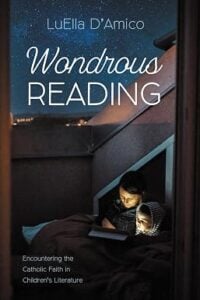
 Wondrous Reading: Encountering the Catholic Faith in Children’s Literature
By LuElla D’Amico.
Cascade Books, 2025.
Paperback, 162 pages, $23.
Reviewed by Christine Norvell.
A Presbyterian minister told me that many of the young parents in her inner city church were and are in great need of basic training, so she extended help by offering a Sunday afternoon class. No, not the kind of class with a popular Christian parenting book or a video channel with the latest blend of faith and child psychology. Rather, her session centered on healthy family habits, beginning with the most basic interactions.
In this class, she described a typical parenting day with ups and downs and casually mentioned bedtime prayer and stories. By the expressions she saw, she instantly knew that few of the parents and guardians prayed or regularly read to their children. She hadn’t even made it to the point in her notes where she asked them to read the Bible. And so, a solitary parenting class became a full year of discipleship.
Yes, studies show that the ease and rise of screen time competes for these precious evening minutes or any gap of time in the day, but the HarperCollins UK survey from 2025 also reveals that fewer parents see a purpose for reading together. They simply don’t do it. The lack of purpose is altogether disheartening. It is likely what my minister friend discerned—that all families do not know that spending purposeful time interacting together as readers can strengthen God-given bonds, love, and affection. My friend responded to the need by adding weekly classes and introducing these families to many activities and ideas, not to fill schedules but to show them that they could shape who they were becoming as families with God in the center.
According to cognitive scientist Daniel Willingham, when children develop a sense that being a reader is part of who they are, a virtuous cycle of growth begins. It’s not just how they feel about reading. It becomes a daily choice whenever time offers an opportunity. And reading together is about what we give and receive. It can be more than a school reading program, more than minutes we count, more than conversation, even more than the nurturing moments of holding a child on a lap. These times can hold greater potential if we can see it.
In Wondrous Reading: Encountering the Catholic Faith in Children’s Literature, LuElla D’Amico makes a spiritual distinction that equips those struggling to see reading’s purpose. The shared literary space with our children not only cultivates reading habits but also “nurture[s] a space for meaningful conversations that can bond you and develop your spiritual acumen.” This intention sets it apart from other family guides. It is with others, in communion, that our minds and hearts are engaged, not only our emotions but also our spirits.
This relational tone is central to D’Amico’s work, and it easily extends into the book’s structure. “Reading experiences… make us feel,” and how much greater is the effect of reading when it is connected to doctrine and faith. She writes that though reading with children begins as an interaction or transaction, it progresses into potential transformation when the Catholic faith is placed at the forefront of reading with children.
D’Amico grounds us in four chapters that examine a spiritual theme alongside two children’s books. Chapter One, “Liturgical Living,” addresses the family’s need for rhythm in our days and weeks. Being present at Mass together and celebrating feast days mirror being in communion with Christ. Homily and catechism are echoed in the moral and anagogical senses of reading of children’s literature. This type of reading explores spiritual dimensions “in our domestic churches at home.”
Within this chapter, D’Amico summarizes Shel Silverstein’s classic about a boy and an apple tree. In The Giving Tree, the boy visits the tree, which gives him various parts of herself. Yet as time passes and as the boy grows older, he forgets the relationship and uses the tree for his gain. D’Amico describes how her daughter came to the moral of the story and how it led their family to look at how they view time and what they make time for within their faith.
That theme of material versus spiritual rewards is carried forward by Cecilia’s Magical Mission by Viola Canales. This chapter book is a coming-of-age story about a girl who is part of a Mexican-American Catholic community in California. After the death of her baby sister, Cecilia wrestles with her faith and receives help from her godmother and others. She knows she wants to go through Confirmation and discover what gifts she has. It is a clear spiritual mission.
As in the first chapter, each core chapter is accompanied by a range of questions that are designed to generate discussion. They are paired with embodied learning, something active and responsive like taking a nature walk, writing a letter, reading a favorite passage, or planning an outdoor adventure. These sections include things to make or parallels to find in other parts of life, especially within the church.
In Chapter Two, “The Interplay of Faith and Reason,” D’Amico argues that faith and reason must merge as they do in Scripture when we consider the miracle of the Canaanite woman who sought Jesus for help with her demon-possessed daughter. Their interaction illustrates this need for faith and reason. Faith should intertwine with all of our studies, and “we ought to encourage our youth not only to combine those two ways of understanding the world from their very youngest days” but to continue as they grow older.
This chapter explores Margaret Wise Brown’s Goodnight Moon and Mary Pope Osborne’s contemporary Magic Tree House series. Using reason, the first book guides the youngest children to name and hone what they know. It’s an appreciation of the everyday in simple wonder, a natural step toward worship. In the Magic Tree House series, the main characters “embark on adventures of reason.” Yet, as the children enter the magic portal, facts merge with imagination and intuition as they enter historical worlds. They have to discern what is real and what is not, a fitting parallel to discussions about faith and reason and discerning what is true and what is untrue.
How D’Amico frames this receptivity to story, how she aspires to nurture the adult guiding the child, is quite similar to Vigen Guroian’s Tending the Heart of Virtue: How Classic Stories Awaken a Child’s Moral Imagination. Guroian is clear—“The deep truths of a good story, especially fairy tales, cannot be revealed through discursive analysis—otherwise, why tell the story? Rather, these truths must be experienced through the story itself . . .” Fairy tale, story, and parable are not a substitute for life experience, but they are “lived” when they are experienced “vicariously and imaginatively” and in conversation with others. In this midway point, D’Amico illustrates this same concept, often narrating her own or her children’s journey through story and deep moments of faith.
With Chapter Three, “Culture of Life,” D’Amico confronts the idol of individualism, the need to promote self. She cites the example of the Magi, who selflessly traveled for months to worship, to see the salvation “beyond themselves.” It is in communion together, seeing and living for salvation for all, that this chapter’s stories come to life. The first is Juana Martinez-Neal’s Alma and How She Got Her Name followed by Louisa May Alcott’s Little Women. Each focuses on building up a culture of life through family generations, but neither story is so romanticized that sin, death, or consequence are ignored. By chapter’s end, D’Amico, like Guroian, encourages parents to choose books that lead their children to make morally good choices.
The final core chapter, “Care of God’s Creation,” continues to emphasize a reorientation with Ezra Jack Keats’s The Snowy Day and Kenneth Grahame’s The Wind in the Willows. Whether in an urban setting or in the countryside, D’Amico implores us to take time to “sink into the wonder” that our children feel for the big and small details in creation as they see God’s plan unfolding in the world. Parents and caretakers are responsible “to invite sacred interpretations of real-life experiences” by pursuing natural moments of curiosity.
The theme of intention is clear. Throughout her guide, D’Amico mentions a number of her favorite books from childhood and frequently invites us, her readers, to do the same. How can we look outside of ourselves? How do we retain wonder? How can we consider community, the sacraments, virtue, vice, and liturgical living? But she does not leave her readers without further help. The final Appendix includes four annotated book lists and discussion questions for all ages. Each list follows the theme of the core chapters.
This guide is indeed a companion for families of every shape and size as they seize the task of exploring faith and truth in literature. D’Amico’s invitation is to be spiritually aware—to be intentional with those we care for, to look for shared moments to see and know God through relationship with written words and with each other. These are vital choices as much for parenting as they are for reading because our God is relational, and it is with Him and with others that we choose to become love and pursue the work of His kingdom.
Christine Norvell is a writer and classical educator living in Arkansas. She is the author of Till We Have Faces: A Reading Companion and The Sycomore Fig Tree: Biblical Botany and Scriptural Truth (Stone Tower Press, 2026).
Support the University Bookman
The Bookman is provided free of charge and without ads to all readers. Would you please consider supporting the work of the Bookman with a gift of $5? Contributions of any amount are needed and appreciated!


