
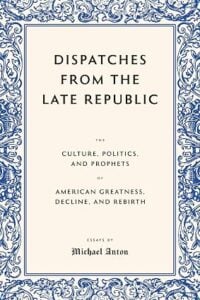
 Dispatches from the Late Republic: The Culture, Politics, and Prophets of American Greatness, Decline, and Rebirth
By Michael Anton.
Encounter Books, 2026.
Hardcover, 408 pages, $34.99.
Reviewed by Bradley C. S. Watson.
Michael Anton burst onto the national political stage in 2016 with the publication of his essay, “The Flight 93 Election.” He went on to serve in national security and foreign policy roles in both the first and second Trump administrations. But he hasn’t confined himself to writing and politics. He has also found time to be a chef, sartorialist, and intellectual socialite, amongst other things. His latest book is a collection of essays that reflect the breadth of his interests and the power of his pen. Dispatches from the Late Republic: The Culture, Politics, and Prophets of American Greatness, Decline, and Rebirth contains delightful ruminations on matters as diverse as his home state of California, his teachers and heroes, domestic culture and politics, foreign affairs, and the miscellaneous diversions that have occupied his lively mind.
Anton is a man for all seasons. Often mordant in print and person, he aims with this book “to lighten the mood a little,” remarking in his preface that politics is not the overriding theme of the volume. But it is fair to say it’s never far below the surface.
Of California, he laments that much of what he loved about the state slipped away in the new millennium. And as California goes, so goes the nation. From “almost an Eden” in its primitive condition, through two centuries of buccaneering and reinvention in its various American incarnations, California is now the exporter of “San Francisco Values,” the unholy and unstable blending of “old-time materialism and hippy ‘morality.’” The Bay Area’s two elite universities, Berkeley and Stanford, capture the terms of this uneasy reconciliation: the former “exemplifying the priggish, scolding, left-wing fanaticism” and the latter “the hyper-ambitious, status-seeking, white-hot money lust more scorching than any found on Wall Street.”
The terms of the San Francisco compromise require “complete submission to the Left on cultural matters.” How long a republic can endure such an unstable equilibrium remains to be seen. But it’s not Anton’s nature to be optimistic. Yesterday’s kooks become today’s politicos and cultural avatars, largely oblivious to the carnage they’ve visited on those who can’t afford to buy themselves blissful isolation.
To be sure, California still produces great things, like wine. But even Anton’s historical survey of this industry has undertones of cultural despair. It’s in wine country that the two Californias—coastal elite and rural—still meet, but the former now overwhelms the latter. Blessed by nature to produce vintages that range from good to perfect, culture intercedes to set oligarchs against the demos, bestowing even more blessings on the former, while pricing out the latter, except as day laborers who toil the valley floors.
But it wasn’t always so. A long time ago, in a California far, far away, the American dream of mobility—lateral and upward—thrived, as the Beach Boys produced the soundtrack of this paradise in motion. Their album, Smile, represented “the pinnacle artistic achievement of a lost civilization, the middle-class, baby-boom, sun-soaked…culture of post-war California.” It was a paradise not only for the common man, but one that helped the West win the Cold War through the thriving aerospace industry. The album’s lyrics betray the optimism and “exuberant innocence” of the time and place, with no trace of the 60s counterculture that would soon give way to San Francisco Values and spawn policies that ensure California dreaming is only a memory and punchline.
All this and more was foreshadowed in the works of Tom Wolfe, whose acquaintance Anton was privileged to make. Anton notes a major insight of Wolfe concerning the democratization of style, of which California was the leading indicator. The creation of immense wealth ensured that the masses could celebrate their own styles. California was built on the stern Protestant virtues that domestic migrants imported from the heartland and Europe. But it was also on the geographic and cultural edge of Western civilization, and attracted more than its share of “loners, dreamers, and outliers” who would sweep aside old modes and orders as they created new ones. The land of possibility caused “everyone’s inner weird” to pour out. The old, schoolmarmish moralism remained, albeit devoid of its ancient substance and discipline. No center can hold under such conditions.
Anton’s reflections on Wolfe carry over into his consideration of his teachers and heroes. Here, he finds good reason to be upbeat. Anton knew Wolfe, both personally and through his writings, to be a patriot rather than a man of the Right. Although patriotism seems more aligned with conservative than liberal politics nowadays, Anton tries, as his teachers insisted, to understand serious men as they understood themselves. He characterizes Wolfe as a philosopher in writer’s guise, “a conveyor of unvarnished, unsentimental, often uncomfortable or unwelcome, truths.”
The teachers who brought Anton to full consciousness of the philosophic enterprise were Harry V. Jaffa and his students, including Tom West, John Marini, Angelo Codevilla, and Michael Uhlmann. But anyone who knows the lives and works of these men knows that philosophy was not their only concern. Strikingly, Anton describes Jaffa, the godfather of the “Claremont school” of political science, as “the most American man I ever met.” Anton reminds—or perhaps surprises—his readers with the observation that Jaffa loved not only the European philosophers, but American literature, American music in the form of swing and big band, the Hudson River School, American sports, American food, and even American ways of (decidedly casual) dress. “If you were writing a movie and needed a stereotypically American character, and you wrote Harry Jaffa, a studio exec would order a rewrite on the grounds that he was too on-the-nose corny for the audience to believe.” Jaffa and his students were largely responsible for inventing the constitutionalist strain of modern American conservatism, and continue to play an outsized role in defining its terms. Like Anton himself, many have not confined themselves to the classroom, but have engaged the practical politics of the modern administrative state, favoring what Codevilla referred to as the “country class” over the ruling class.
Turning directly to domestic regime politics, Anton maintains that “our country is no longer a republic, much less a democracy, but rather a kind of hybrid corporate-administrative oligarchy.” The ruling class no longer insists that the millions of newcomers they’ve imported must adapt themselves to republican ways, but instead offers myriad encouragement for them to remain foreign, and indeed to see their adopted country, and the majority of its existing inhabitants, as enemies—“inherently evil and out to get them.” This is another expression of the ruling class’s contempt for the country class, conveniently incentivized by the former’s self-interest in importing cheap labor and plentiful voters.
Anton is emphatic: “The ‘Great Replacement’ is happening, not just in America but throughout the West.” Paradoxically, our elites “both deny and affirm it,” depending on expedience. Regime propaganda and gaslighting have reached such a level of shamelessness that the youth are taking note, to the point that “conventional conservatism no longer holds much purchase with large swaths of the under 40, and especially under 30, crowd. Tax cuts, deregulation, trade giveaways, Russophobia, democracy wars, and open borders are not, to say the least, getting the kids riled up.” Regime change, in an important sense, is identical with generational change. And the times they are a-changin’. Anton’s book, and his entire worldview, stand as direct challenges to elite preferences and institutions: Okay, boomer, what next?
On foreign policy, Anton notes he is an autodidact, which is as good a qualification as anything, given the abysmal track record of our professionally trained “best and brightest.” Early in the second Trump administration, Anton served as Director of Policy Planning at the State Department, the office first occupied by the legendary George F. Kennan, for whom “our ruling class still professes reverence.” They lionize him for being an architect of the liberal postwar international order from which they derive their power, but conveniently forget “the real Kennan—the isolationist Russophile immigration hawk” (to mention but a few of his many deviations from present elite orthodoxy). But such cognitive dissonance is easy enough to account for if we recognize that “[o]ur ruling elites are dumber than the Bourbons: they’ve learned nothing, remember nothing, and will believe anything.”
As he surveys the hard realities of world politics, Anton aligns himself with President Trump in at least two important respects. First, we should be serious about building a military whose raison d’etre is prevailing decisively, thereby deterring all enemies. Second, we should be bold and honest enough to recognize that some nation states simply work better than our own, that “there are viable alternatives to ‘our’—that is, our ruling class’s—‘democracy.’” If “our democracy” actually functioned as such, “elected officials would heed the people and give them what they insist they want: crime control, a secure southern border, reduced immigration, inflation relief, abundant energy, safe distance from foreign wars. Instead, they get the opposite.”
Anton places so much weight on the manifest corruption of our elites, and the dysfunction of our institutions, that he doesn’t spill much ink on the corruption of the people themselves, who are more divided on ends, and certainly means, than he suggests. Nevertheless, those who love the art of the essay, and their country, will find this book richly rewarding.
Bradley C. S. Watson teaches at the Van Andel Graduate School of Government at Hillsdale College in Washington, D.C. He is a past president of The Philadelphia Society, and has authored and edited many books, including Progressivism: The Strange History of a Radical Idea (Notre Dame).
Support the University Bookman
The Bookman is provided free of charge and without ads to all readers. Would you please consider supporting the work of the Bookman with a gift of $5? Contributions of any amount are needed and appreciated!


