
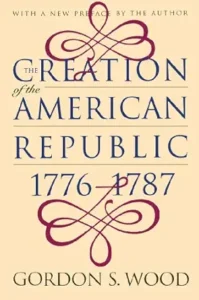
 The Creation of the American Republic, 1776-1787
By Gordon S. Wood.
UNC Press, 1969/1998.
Paperback, 680 pages, $45.95.
The Rising Glory of America, 1760-1820
Edited by Gordon S. Wood.
Northeastern University Press, 1971/1990.
Hardcover, 352 pages, $44.42.
The Radicalism of the American Revolution
By Gordon S. Wood.
Vintage Press, 1993.
Paperback, 464 pages, $22.
Empire of Liberty: A History of the Early Republic, 1789-1815
By Gordon S. Wood.
Oxford University Press, 2009.
Hardcover, 778 pages, $47.99.
The Idea of America: Reflections on the Birth of the United States
By Gordon S. Wood.
Penguin, 2012.
Paperback, 400 pages, $32.
Reviewed by Nicholas Mosvick.
Gordon Wood, who recently died after being struck by a car, was the consummate historian of his age. Working for six decades and focusing almost exclusively on the American Revolution, which he maintained was the most important event in American history, Wood embodied the virtues of humility and modesty, always mindful that one should treat people in the past on their own terms and according to how they understood the world. His scholarship was inestimable in its impact not only on the academic field, but on the public understanding of the American Revolution and founding. Wood proved to be that rare generational talent able to write successfully for both an academic and a broad public audience, much like his PhD advisor, Bernard Bailyn.
Wood’s first book may well have been his finest work, a stunning and still impressive achievement. 1969’s Creation of the American Republic, resulting from Wood’s dissertation work under Bailyn, looked to show the deep and radical transformation that occurred between the Declaration of Independence and the ratification of the Constitution, in which the revolutionary idealism of 1776 came up against the considerations of practical politics. The result was a system of government that reflected a new philosophy and new definitions of democracy and republicanism. Republicanism itself was a utopian ideal, strikingly anti-capitalistic in Wood’s vision, for early revolutionaries who believed that society and not just government would be reformed and made pure, with citizens working for the good of all and hierarchy and distinctions done away with. Importantly, Creation emphasized not consensus but ideological conflict.
That idealistic and utopian spirit which characterized revolutionary republicanism led to the crafting of state governments with typically weak executives against a dominant legislature. Wood’s first work shows how these Revolutionaries became studied in political reality, with exposure to the ugly reality that the people’s representatives and the people themselves had equal proclivity towards tyranny as the executive. Wood’s argument is that the Constitution reflected these lessons, as the revolutionaries looked to protect against the tyranny of any governmental body by ensuring competition among the branches. In the minds of James Madison and Alexander Hamilton, among others, the social, political, and economic turmoil that resulted from the excessively democratic experiments at the state level showed that peace with England and domestic stability could only be achieved through a restructured and empowered national government.
J. Edwin Hendricks, reviewing Creation in 1969, argued that the “sheer magnitude of the work” was “perhaps its greatest drawback,” since Wood had relied upon such extensive documentation to prove the new course he had drawn. That is, Hendricks worried that the reader might be overwhelmed by the magnitude of Wood’s evidence, yet he also rightly predicted that Creation was a “magnificent work which will influence the writing of American history for years to come.” This was precisely because of the depth and complexity of the work, in which Wood managed, among other things, to show the lack of interest among most colonists in democracy and the way in which the Imperial Crisis forced American leaders to formulate out of their own experience, combined with English history and philosophy, a “Whig Science of Politics” to justify the revolution and a “republican society.” That project, Creation, reminds readers that it was full of ambiguity and put into practice between the Declaration and the Constitution. The American Founders modified their practice of politics when they learned that “the people” were a collection of interest groups with competing ambitions and motives.
Creation and its follow-up, The Rising Glory of America, presented the Revolutionary generation as essentially utopian reformers seeking to redeem America against both the threat of British enslavement and the social tensions driven by class division and growing individualism. Throughout his scholarship, Wood argued that the revolutionary force of the Revolution—the radical democracy at its heart—broke down all hierarchy and social distinctions from religion to science to business and citizenship. It was thus an anti-conservative force, as it greatly disrupted communities and social relations, changing America from its republican roots into a “sprawling, materialistic, and licentious popular democracy.” In Wood’s telling, however committed the Revolutionaries and the Founders were to republicanism and its commitment to public virtue and character, that world was quickly eclipsed by the total democratization of every facet of American life. Commercial liberty and self-interest, not public or private virtue, came to define American culture and life within a generation.
Wood’s scholarship in the years and decades following Creation saw him maneuver away from being pigeonholed as a “consensus” or “neowhig” historian. Instead, just over two decades after Creation, Wood published another book that shattered the historiographical inertia. 1991’s The Radicalism of the American Revolution presents the shift, over time, from monarchy to republicanism to radical democracy in the United States in a way that might bedevil conservatives. In Radicalism, Wood claims that the Revolution was “not conservative at all; on the contrary, it was as radical and as revolutionary as any in history and was as radical and social as any revolution in history.”
In the second half of his career, beginning with Radicalism, Wood focused on and embraced the rise of liberalism and democratization throughout the 19th century. In Radicalism, Wood argued that the Revolution was so transformative that it created “almost overnight, the most liberal, the most democratic, the most commercially minded, and the most modern people in the world.” The old world, based on monarchy, kinship, and patronage, was swiftly replaced with a democratized culture based on merit, talent, and self-interest. Wood’s revolutionary generation was characterized by their modernism and optimism, thoroughly convinced they had the ability to “shape their politics and society as they saw fit.” Americans, he thought, had come to believe that greatness came not out of public virtue, disinterestedness, and character in the classical republican sense, but by “creating a prosperous free society belonging to obscure people with their workaday concerns and their pecuniary pursuits of happiness—common people with their common interest in making money and getting ahead.”
Other scholars of the intellectual history of the American Revolution were unpersuaded. On the left, Pauline Maier complained that Radicalism saw Wood falling into a time-bound assumption—the modern conviction that real revolutions are fundamentally social. Michael Zuckert, a Straussian professor of political science, acerbically deemed Wood’s view one of “Genteel Radicalism,” complaining that Wood denied “class at every turn,” along with race, gender, and ethnicity. The Southern conservative historian Forrest McDonald, on the other hand, found all histories of the Revolution that reduced it to ideology or ideas lacking because such works did not consider the practical men, like George Washington and Robert Morris, who were so integral to the success of the Founding and did not understand that while the Framers were committed in the abstract to republicanism, they were “far from agreed as to what republicanism meant, apart from the absence of hereditary monarchy and hereditary aristocracy.”
Ultimately, Wood’s bold and consistent emphasis was on the revolutionary nature not just of the American Revolution but of America itself. That is, as he put it in The Idea of America, Americans were an ideological people who had an “obsessive concern with our own morality and our messianic sense of purpose in the world” precisely because we were a “revolutionary nation operating out of a revolutionary tradition.” The only sense of nationhood and national purpose, in Wood’s rendering, came from the Revolution and the idea that we were a “special people with a special destiny to lead the world toward liberty and democracy.”
In his Oxford history of the Early Republic, Empire of Liberty, Wood tells a similar story of the total, seismic, and permanent change brought on by the Revolution. He argues that while by 1815, the United States remained a predominantly rural, agricultural society on the surface, much had already changed, as the Republic was now “overwhelmingly commercial, perhaps, in the North at least, the most thoroughly commercialized society in the world” and the vision of the Americans as being a “world within ourselves, sufficient to produce whatever can contribute to the necessities and even the superfluities of life,” was being realized. Politically, Wood sees the second decade of the 19th century as the “overwhelming victory” of the Republicans and Jeffersonians, such that the aristocratic Federalists “no longer seemed to matter either politically or socially.”
As a result, in his telling, the “middling people” in the North who mostly constituted the Northern Jeffersonian Republicans, lacked the “acute self-consciousness” of their counterparts in England and these commercial farmers, mechanics, clerks, teachers, businessmen, and self-made men of industry could “scarcely think of themselves as the ‘middle’ of anything; they considered themselves to be the whole nation and as a consequence gained a powerful moral hegemony over the society, especially in the North.” Going back to the Revolution, Wood noted that for these “egalitarian-minded middling sorts” to justify and legitimate “their claim to be all the people, they needed to link themselves to the greatest event in American history and since “most of the political elite who had led the Revolution were gentlemen-aristocrats, and slaveholding aristocrats at that, they had little to offer the burgeoning groups of enterprising artisans and businessmen as models for emulation or justification.” Thus, they centered on Benjamin Franklin, the self-made former printer who, like the middling men of the Early Republic, emphasized good education.
Empire of Liberty also offers not only a coherent and detailed narrative of how the United States became a commercial democratic nation, but also the judiciary’s role in the transition. Wood shows that for many Americans in the 1790s, judicial review was at most an “extraordinary and solemn political action” and “something to be invoked only on the rare occasions of flagrant and unequivocal violations of the Constitution.” It was not yet “accepted as an aspect of ordinary judicial activity,” given that some Congressmen in 1792 even debated establishing a procedure for federal judges to notify Congress if they declared a law unconstitutional. Wood’s observations here can and should be appreciated by conservatives who can look back to figures like Charles Hyneman and Brent Bozell, who, in their research and scholarship, similarly found that the founding-era understanding of “judicial review” was entirely alien to the dominant judicial supremacy of the modern period.
What changed, as with all other significant aspects of American life, was the radical spirit of democracy. He notes the “curious paradox” in these legal developments that just as the private rights of individuals expanded during the early Republic, so too did the public power of the states and municipal governments. Older states retained a republican faith in the power of government to promote the public good, while western states hewed to the republican belief that “government should have a distinct and autonomous sphere of public activity.” This meant that the courts often had acted as mediator between conflicting claims of public authority against private individual rights—that is, as Wood suggests, it was “precisely because of the exuberantly democratic nature of American politics the judiciary right from the nation’s beginning acquired a special power that it has never lost” in becoming a “major instrument for both curbing that democracy and maintaining it.”
Many of Wood’s conclusions do not intuitively fit within a conservative sensibility. His quintessential view of the American Revolution and Founding directly asserts that the American tradition, if there is one to be conserved, is a revolutionary tradition that still manages to influence radical movements in the modern world. It is based on a democratic force that destroyed all existing social relations and hierarchies, the sort of levelling influence conservatives would naturally malign. In the way that Russell Kirk described, conservatives generally aimed to preserve the roots of the American order. But in Wood’s telling, any roots of the American order were cut down by the very uncontrollable force of the American Revolution.
Conservatives in the past generally took a different view of the Revolution, aiming to cast the Patriots as men who wished to restore and preserve an existing order and tradition based in English rights and common law. There was no desire, thus, to “make the world anew.” Yet, even if Wood’s conclusions and narrative do not fit with the conservative sensibility, his methodology and disposition do. Wood was a humble man who always operated on the moral principle that one should not easily or reflexively judge men and women of the past. Rather, as historians, we should understand them on their own terms, according to their own worldviews, language, aesthetics, and sensibilities. Further, Wood understood that history was not simply a story of progress but of ruin, with tragedy inherent to the human condition. That approach, regardless of his claims about the radical nature of American democracy, is eminently worthy of admiration and respect from American conservatives.
Nicholas Mosvick holds a PhD in American History and J.D./M.A. in legal history. He writes about the intellectual history of the American conservative movement, the constitutional history of the Civil War, and historic meaning of free speech, the right to bear arms and the right to trial by jury.
Support the University Bookman
The Bookman is provided free of charge and without ads to all readers. Would you please consider supporting the work of the Bookman with a gift of $5? Contributions of any amount are needed and appreciated!

