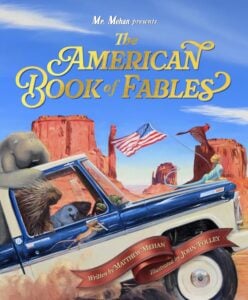
 The American Book of Fables
By Matthew Mehan.
Sophia Institute Press, 2026.
Hardcover, 396 pages, $39.95.
Reviewed by Shaun Rieley.
“If a man were permitted to make all the ballads,” wrote eighteenth-century Scottish political theorist Andrew Fletcher, “he need not care who should make the laws of a nation.” Fletcher was rightly observing the crucial role that the imagination plays in the formation of a people and their character. Laws derive from the pre-existing imaginaries that constitute a people, and, absent the character restraints necessary to attune one’s behavior to them, they become little more than what James Madison termed “parchment barriers.”
This quote from Andrew Fletcher has often been referenced by those who desire to restore America to its constitutional foundations. And yet, it is more often quoted than followed. Conservatives have tended, for the past 50 years and more, to focus primarily—or almost exclusively—on electoral politics and policy wonkery, aiming to make inroads by means of power and logical argumentation rather than appeals to the imagination. Culture-making and imagination formation—in short, the education of the affections—though movies, music, and literature have been left almost entirely to those who view the inherited Western and American tradition with suspicion, if not outright contempt. Worse, what little has been attempted is often overly didactic—telling more than showing, as it were—leaving the deep, preconscious affections to be formed by images and stories that are often at odds with explicit commitments.
To address this, my friend and colleague Matthew Mehan has dedicated his creative talents and immense learning to authoring books aimed at educating the imagination of the young. His first two books (Mr. Mehan’s Mildly Amusing Mythical Mammals and The Handsome Little Cygnet) are explicitly aimed at children and are written to be no less beneficial than they are entertaining.
Now he has released The American Book of Fables, just in time for the celebration of America’s Semiquincentennial—250 years of American independence.
The first thing that catches one’s attention upon perusing the book is the artwork. Like each of the other books, this one is beautifully illustrated with engaging original watercolor paintings by artist John Folley. The illustrations capture topographical and faunological scenes from across the United States: from the purple mountains’ majesty to the amber waves of the Great Plains, from the bays of the mid-Atlantic to the lakes and rivers of the Midwest, from the canyons and mesas of the high deserts to the rugged beauty of Yellowstone, and beyond.
The next thing one observes is the introductory note, which includes a guide to the book. The striking thing here is that, despite first impressions suggesting that this is a children’s book, there are, in fact, sections for “Littles” (“the youngest explorers”), “Middles” (those who are neither little nor big”) and “Bigs” (“adult readers”), each labelled with a special icon (an acorn, a sapling, and an oak tree) for easy identification. It becomes clear, then, that this is not merely a children’s book but is in fact a family book, with material for everyone (and, as is also noted, even the Bigs have things to learn from the wisdom contained in the rhymes for Littles and fables for Middles).
The book has a dual organizational structure, one overlayed on the other. The first is geographic: the book is broken into 13 parts (calling to mind the original 13 colonies), with each exploring a different region of the United States. Each region is, in turn, connected with a part of the Declaration of Independence, such that each is made to explain “what our forefathers meant when so many years ago they wrote….” It is especially noteworthy that the book does not take the well-trodden path of focusing only on the first two paragraphs of the Declaration but instead moves through the entire document—including the often-overlooked “bill of particulars” detailing specific grievances—and connects each part to an aspect of American geographical culture.
The content contained in each section is a lively mix of nursery rhymes (some old, some original), “greatly adapted” Aesop’s fables, and excerpts from letters, poems, stories, Federalist papers, and numerous other sources.
Tying it all together is a running narrative, featuring anthropomorphic animals, headed by “Hugh Manitee” (get it?) as he travels the country (collecting a band of other animals along the way) to tell the story of America.
Each section then ends with some “Witty-Wise Sayings” drawn from the Western and American tradition—names include Aristotle, Cicero, Seneca, St. Augustine, St. Thomas Aquinas, John Adams, Daniel Boone, George Washington, Thomas Macaulay, Calvin Coolidge, and far too many more, both famous and obscure.
If all this sounds complicated, it is. It is not always immediately apparent what a given rhyme, story, or excerpt has to do with the theme of the section, much less how it all fits together. But, to paraphrase St. Jerome, there are parts of the book shallow enough for babes to come and drink without fear of drowning, and parts deep enough for thoughtful patriots to swim in without ever touching the bottom. And, as with any book worth the effort, fully understanding what the book is doing takes some time and effort. But with some patience, the book’s riches open and a cornucopia of wisdom—and delight—comes forth.
The American Book of Fables is a love letter to America and to the Western tradition that brought her forth. It is an exercise in anamnesis, recalling to mind the complex strands that were woven together to form our nation. But more than mere instruction, it is designed to educate the affections of the American people, drawing them back to the foundations of their country, and renewing an earnest love of patria that must lie at the center of any hope for renewal.
Shaun Rieley is Director of Educational Programs and Teaching Fellow at Hillsdale College’s Washington, DC campus. He holds a Ph.D. in political theory from the Catholic University of America and an M.A. in liberal arts from St. John’s College.
Support the University Bookman
The Bookman is provided free of charge and without ads to all readers. Would you please consider supporting the work of the Bookman with a gift of $5? Contributions of any amount are needed and appreciated!

