
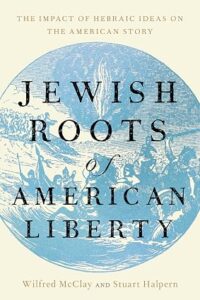
 Jewish Roots of American Liberty: The Impact of Hebraic Ideas on the American Story
Edited By Wilfred McClay and Stuart Halpern.
Encounter Books, 2025.
Hardcover, 304 pages, $32.99.
Reviewed by Daniel James Sundahl.
When approaching the American Founding, it’s typical to refer to British and Continental influences, which suggests that the foundations of American law and government drew heavily on such figures as John Locke for his theories on natural rights, Montesquieu for his The Spirit of Laws, and the Scottish Enlightenment folks to which one might add Burke and Blackstone. It’s a good list, but is there room for Jews and Christians to draw closer together adding Hebraic ideas into the treasury of American self-understanding?
I recall a visit to Charleston some years ago. I donned my tennis walking shoes and set off for a look-about the historic district. Oodles of churches. The Cathedral of Saint John the Baptist was ornate with marble and stained glass. St. Phillip’s was unique. As were others, many with guided tours. The Unitarian Universalist was breathtaking. The dates of the churches were interesting too, including First Baptist dating to 1682 and a church named after Morris Brown who was a pastor during earlier times and who escaped hanging during the Denmark Vesey slave rebellion.
What struck me as odd was the Kahal Kadosh Beth Elohim synagogue I found on 90 Hasell Street organized in 1824 as the birthplace of American Reformed Judaism. The synagogue was formed in 1749, making it the fourth oldest in continuous use. I might add that “Reformed” is an indication of “liberal,” which also means it faced headwinds of various accounts. The oldest synagogue is in New York, Congregation Shearith Israel, and dates to 1654 when a group of Sephardic Jews arrived from Brazil fleeing an inquisition. That in itself is interesting since the history suggests discrimination and a struggle for rights in keeping with the Old Testament Hebrews’ “errand into the wilderness.”
With that in mind, we then turn to an anthology titled Jewish Roots of American Liberty: The Impact of Hebraic Ideas on the American Story, edited by Wilfred McClay and Stuart Halpern. The volume’s content consists of papers and presentations from a conference held at Yeshiva University in Spring of 2023 with the caveat that the net effect would be a demonstration of the closeness and foundational character of the relationship between the American experience and the Jewish experience to show that the two are not antagonistic to one another. In other words, the argument suggests that the institutions Americans cherish are similar in many respects to Hebraic antecedents.
The anthology is divided into four parts following a preface. Readers should note that each part is akin to an audience assembling in a conference room and, after a brief introduction, conference papers are delivered now referenced as chapters.
Part One: The Influence of the Hebrew Bible on the American Founding.
Part Two: Influences of the Hebrew Bible on American Culture.
Part Three: American Presidents’ Appreciation of Jewish Contributions.
Part Four: The Meaning of Jewish History for Americans.
Some brevity is needed, thus this review will survey Part One and Part Four with chapter contributions by Mark David Hall, Daniel L. Dreisbach, and Jonathan D. Sarna.
Professor Hall’s presentation begins with the argument that the main reason Americans embrace religious liberty is found in the influence of the Judeo-Christian tradition which plays a key role in defining and supporting what many of the Founders called the sacred right of conscience. When added to freedom of worship, citizens owned the right to act according to their religious convictions, which meant religious liberty was granted to all, including citizens who do not share the majority faith. Professor Hall adds the fact that in 1776, 98% of the population were Protestant, 2% Catholic, and some two thousand Jews were practicing in a handful of cities.
When the colonies were being established, religious liberty quickly gained ground. At the same time, many Protestants looked to the Hebrew Scriptures whenever and wherever citizens were establishing a civil body compact.
There was some disorderly dissent, such as the executed Quaker Mary Dyer. But there was more tolerance than often assumed and the manner in which America approached religious liberty changed largely at a practical level when diverse groups of immigrants began arriving. And there were arguments from pious men, including Roger Williams, who argued that the Bible and Christian theology required liberty of conscience without which true religion will not flourish for a variety of reasons, including the conviction that persecution never works. There were, of course, various religious tests in various state constitutions. In time they were amended to provide freedom of conscience.
Professor Hall includes a discussion of George Washington’s letter to the Hebrew Congregations in Newport Rhode Island, a tiny religious minority. Washington writes that the congregation deserves effective support and good will because every one deserves to sit in safety “under his own vine and fig tree and there shall be none to make him afraid.”
Then there’s the cogent argument in Chapter Four from Daniel L. Dreisbach concerning how the Hebrew Bible informed the political culture of the American founding and an illustration of the faith of the founders with the caveat that religious toleration arose from the Enlightenment, which would seem to most a tight fit. But once again Biblical and theological arguments played key roles in defining and supporting the sacred right of conscience. Thus by the end of the Revolutionary era, although there was no religious liberty provision in the Federal Constitution of 1787, the first Congress proposed and the states ratified a constitutional amendment stating that “Congress shall make no law respecting an establishment of religion or prohibiting the free exercise thereof.”
We know this as one of the five core beliefs ensuring the expression of beliefs and practice of faith. Professor Dreisbach adds the nuanced statement that some commentators describe the Bible as America’s “founding document” or quote Samuel Langdon, a Congregational clergyman who wrote in an election sermon that the twelve tribes of Israel parallel the thirteen American states.
What’s also interesting is Professor Dreisbach’s argument that for the early Republic the civil polity of Israel is not only conducive to the general welfare but is also a general model at least for some principal laws and orders and may be copied to some advantage. What the founding generation knew about the Hebrew Republic was learned from the Hebrew Bible to the point that although the Founders did not seek to replicate the Hebrew model in all its details, its republicanism was a political system that enjoyed a divine imprimatur. The evidence Professor Dreisbach marshals leads to the conclusion that the Bible’s influence on America’s constitutional provisions far exceeds the example illustrated in his presentation. As any serious scholar knows, the hours spent tracing intellectual influences is not always easy or certain and is much more serious activity than simply counting references to God or the Bible, complicated by living in a secular age. Still, he concludes, and the evidence warrants the conclusion, that the “political experiments in republican self-government and ordered liberty cannot be adequately understood without acknowledging the Bible’s contributions.”
In Part Four, Jonathan D. Sarna’s essay “Why Study American Jewish History” argues that for many years history held a central place in Jewish schooling. The point? It taught in a textbook manner heroic history intended to educate students toward steadfast and loyal witness and not to forget and to keep them true to their faith, and their knowledge of their own Jewish history.
When a history of Jews in the United States first entered into the history curriculum in 1930, the aim was to create intelligent American Jews since in the American story there was little heed paid to Jewish history—if it was mentioned at all. With time, Jewish scholars concerned about this lack of Jewish history proposed some thirteen or so arguments of which the general purpose was itemized with these three illustrative examples:
- Jewish history contextualizes contemporary challenges facing American Jews.
- American Jewish history communicates the enduring power of religion in America and shows how Jews have formulated religious identity in a distinctively pluralist setting.
- American Jewish history is a form of collective Jewish memory.
As one might expect, such a noble endeavor raises significant problems. Here Professor Sara makes the salient argument about the difficulty in justifying American Jewish history in a non-Jewish setting as part of the American experience as a whole. In other words, it’s complicated since the relationship between Jewish history and Jewish memory is anything but simple.
Here, for example, is part of a back story very often not found in American history writ large but perhaps should be included in Jewish American history: the role Jews played in the American War for Independence. The answer is unquestionably important and should be widely known. It’s the story of Haym Solomon of Philadelphia whose fundraising and personal lending helped provide over $650,000.00 to General Washington’s war effort. The sad fact is that he died penniless.
Of course what’s missing is to have had the opportunity to attend this conference, to sit and listen and then enjoy the questioning and the answering from this array of fine scholars. Perhaps more than anything else, this anthology should move us to study the institutions we value so much and which are grounded in American History.
Daniel James Sundahl is Emeritus Professor in English and American Studies at Hillsdale College where he taught for thirty-three years.
Support the University Bookman
The Bookman is provided free of charge and without ads to all readers. Would you please consider supporting the work of the Bookman with a gift of $5? Contributions of any amount are needed and appreciated!

