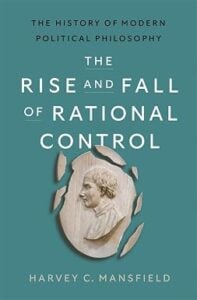
 The Rise and Fall of Rational Control: The History of Modern Political Philosophy
By Harvey C. Mansfield.
Harvard University Press, 2026.
Hardcover, 336 pages, $35.00.
Reviewed by Jesse Russell.
There is a critical dividing line in contemporary academia. It is not a dividing line between conservative and liberal academics, nor is it a divide between Marxists and those who advocate studying the “Great Books.” Rather, the divide is between those who believe in the university as a place of intellectual formation and those who believe it is something akin to “adult daycare.” Many of the former professors are politically conservative, but not all, and, indeed, perhaps even most, are not. As shocking as it may seem, many professors who claim to be “Marxists” are not Marxists at all and would quickly run out of things to say if they were required to discuss the development of Marxist concepts of “alienation” or “dialectical materialism.” Especially in the past couple of generations, many university professors present themselves as advocates of DEI and “fairness.” They do so not because they genuinely understand or have immersive experiences in poverty or injustice, but because such policies have turned universities into playgrounds for students and faculty alike. It may be equally shocking to learn that there are Baby Boomer New Left as well as Gen X Left-Wing professors who teach with a rigor and seriousness—perhaps even a greater rigor and seriousness than some conservative “Great Books” professors.
One professor who, for much of his life, has taught and written with both rigor and seriousness is Harvard Professor Emeritus, Harvey C. Mansfield. Professor Mansfield throughout his teaching career was known for his seriousness, erudition, and gentlemanly professorial demeanor—something sadly lacking in contemporary academia. Professor Mansfield has been identified as an East Coast Straussian as well as a “neoconservative,” but his writings, although revealing the clear influence of Leo Strauss, present a uniqueness and subtlety that does not easily fit into a political label. In his most recent work, The Rise and Fall of Rational Control: The History of Modern Political Philosophy, drawn from his Harvard Government lecture courses, Mansfield presents a rich and nuanced portrait of the development of modern political thought.
Mansfield’s work begins with the Italian Renaissance philosopher Niccolò Machiavelli (1469-1527), whom Mansfield sees as being the father of modern political philosophy. It must be noted that Harvey Mansfield seems, for better or worse, deeply sympathetic to Machiavelli’s philosophy. While some scholars of Machiavelli who believe the Italian philosopher and native of Florence was, in fact, a Christian, Mansfield believes that Machiavelli reveals—in both subtle and more explicit ways—that he rejects Christianity as a temporary and passing intellectual phenomenon. In Mansfield’s reading, Machiavelli not only criticized corruption in the Church, but he also attacked central Christian ideas. Machiavelli held that this temporal world was the only world that exists. Machiavelli also advocated for rational control as opposed to custom and tradition, thereby inaugurating a key Enlightenment idea that would even be embraced by those who identified as being Christian. The process of establishing rational order, ultimately, for Mansfield’s Machiavelli, involves rejecting God as the source of the allegedly irrational order of custom—Christians would respond that there is a rationality to Christian tradition. Machiavelli thus further inaugurated the mother Enlightenment notion of asserting human rights vis-à-vis the rights of God.
Although Mansfield begins his discussion of Machiavelli’s thought with an analysis of the Italian Renaissance figure’s play Mandragola (1524), Machiavelli’s major political works are Discourses on Livy (1531) and, of course, The Prince (1532). The Prince, dedicated to Lorenzo “il Magnifico” Medici, is Machiavelli’s most influential and famous work, and it has had a pronounced effect on twenty-first century thought and discourse, influencing the work of contemporary author and social media personality Robert Greene, author of the Machiavellian The 48 Laws of Power. The Prince depicts a dog-eat-dog world of “acquisition” and conquest that will later be echoed in the writing of Thomas Hobbes and Friedrich Nietzsche, who also have chapters in The Rise and Fall of Rational Control. Machiavelli also promotes the idea of effectual truth, a pragmatic approach to ethics that emphasizes what works rather than what is morally good. Mansfield’s depiction of Machiavelli as the pragmatic, atheistic realist is convincing (although not without critique—there still is a case to be made for a Christian Machiavelli) and provides a portrait of how modernity became so brutal and secularized. It also provides a key to understanding the realpolitik and sleight of hand of our contemporary political world.
After exploring figures like John Locke, Jean Jacques Rousseau, and Karl Marx, Professor Mansfield ends The Rise and Fall of Rational Control with a treatment of another acerbic realist: Friedrich Nietzsche (1844-1900), who like Machiavelli, is a very popular thinker among online intellectuals. Mansfield, perhaps surprisingly, sees Nietzsche as a moral philosopher as well as a Right-Wing revolutionary. Nietzsche was also among the first Right-Wing atheists. Mansfield rightly notes that Right- and Left-Wing extremists “hate each other” but come together in their atheism. They have also produced the worst regimes in the history of the world: German National Socialism and Soviet Communism. Nietzsche, like Machiavelli as well as Leo Strauss and Harvey Mansfield himself, further believed that many philosophers write behind a mask.
Nietzsche famously critiqued Platonism and later Platonically-influenced Christianity for allegedly weakening Western man with notions of equality and ressentiment toward those who are great. The weak character of man—not just modern liberal man—is something that Nietzsche believes must be overcome. This overcoming will create a new aristocratic class that will dominate the weaker forms of human life. This thought is very popular in some quarters of the New Right, and it is incumbent upon genuine conservatives to engage with it and separate the wheat from the chaff in order to build a society that is not only healthy but also just and compassionate.
There is some question of what exactly the future of higher education is. As professors—both conservative and liberal—of Harvey Mansfield’s stature retire, there is a general sense that younger professors filling the retiree’s shoes are of inferior quality. At the same time, there has been an explosion of intelligent and well-crafted social media accounts and podcasts—often produced by Millennials and Zoomers—that are as high quality as some of the best professors’ lectures. It seems—for better or worse—that much of the vanguard of intellectual development is taking place, not in the classroom, but on the internet. If the university is to survive this threat, then professors are beholden, not to a specific political ideology, but to being what Harvey Mansfield continues to be: a real college professor and a real scholar.
Jesse Russell has written for publications such as Catholic World Report, The Claremont Review of Books Digital, and Front Porch Republic.
Support the University Bookman
The Bookman is provided free of charge and without ads to all readers. Would you please consider supporting the work of the Bookman with a gift of $5? Contributions of any amount are needed and appreciated!


