
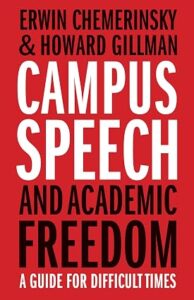
 Campus Speech and Academic Freedom: A Guide for Difficult Times
By Erwin Chemerinsky and Howard Gillman.
Yale University Press, 2026.
Hardcover, 304 pages, $30.
Reviewed by Justin D. Garrison.
In Campus Speech and Academic Freedom: A Guide for Difficult Times, Erwin Chemerinsky and Howard Gillman argue that American universities have long valued free speech and academic freedom. These commitments have helped make American universities “one of the greatest forces for individual freedom and social progress ever invented.” But these values, and the progress they have achieved, are under attack from “authoritarians” (i.e., conservatives in the state houses, in the federal government, and on the Supreme Court) who pose “the biggest threat to campus free speech and academic freedom since the McCarthy era.” Thus, the authors write urgently to remind readers about the importance of protecting free speech and academic freedom from their latest external enemies.
Chemerinsky, a First Amendment scholar and dean of the UC Berkeley School of Law, and Gillman, a free speech advocate and chancellor of UC Irvine, are right to claim that valuing free speech, academic freedom, diversity of thought, and vigorous debate are hallmarks of a thriving American university. But, as will be shown below, what they frame as a defense of campus speech and academic freedom is just as much a defense of other values that are, on the authors’ own showing, often at odds with free expression and intellectual diversity. Ultimately, their book is an apology for a status quo that has generated the growing legislative action the authors abhor. When only 38% of Americans have a great deal of confidence in higher education, such an argument is tone-deaf and self-defeating.
Chemerinsky and Gillman provide many examples of attacks on free speech and academic freedom. They draw attention to protesters on many campuses resorting to property damage and physical violence to stop events and speakers. They also explain that academic freedom protects faculty teaching and research, even when such activity addresses controversial topics. Yet, they also show that such safeguards have not stopped students, faculty, and administrators from trying to punish professors anyway. The authors condemn many of the examples of free speech and academic freedom violations they cite. They also make reasonable policy proposals to universities looking to minimize future campus disruptions while respecting rights. There is no reason to doubt Chemerinsky and Gillman sincerely value free speech and academic freedom.
Unfortunately, the authors cannot seem to break free from the all-too-common academic habit of subordinating these values to leftist ideological commitments. This weakness in their argument is most noticeable in their discussions of using DEI statements in faculty hiring, disciplining faculty for professional or ethical misconduct, and using institutional speech to proclaim community values.
The authors argue that using DEI statements as political litmus tests in faculty hiring is wrong, but they cannot abandon the practice entirely. They claim, “We believe it is possible, in theory, to require DEI statements and yet avoid unethical (likely unconstitutional) viewpoint discrimination.” But they never state this theory. That Chemerinsky was recorded saying his own law school’s hiring practices might have skirted California’s affirmative action ban also casts serious doubts on the plausibility of using such statements in ways that avoid illegal discrimination.
Chemerinsky and Gillman ultimately offer a procedural punt. They recommend allowing programs in which DEI is a prominent disciplinary value to require such statements, as long as they disclose to job candidates how the statements are used. This simply can’t work. DEI statements generate unavoidable viewpoint discrimination because the concept itself is ideologically charged. Universities would do better to prohibit such statements in all job searches, even if some fields embrace ideological discrimination as part of their professional “ethics.” On this issue, the authors’ appeal to departmental federalism is a dodge, not a solution. Their treatment of the topic also raises questions about whether programs that embrace ideological discrimination as a professional norm should exist at all.
The authors also offer an untenable defense of institutional speech. In response to substantial public disapproval of universities taking partisan positions on various issues, many schools have adopted policies of institutional neutrality. Often invoking the University of Chicago’s 1967 Kalven Committee Report, these policies typically identify who is authorized to speak on the university’s behalf and limit all institutional statements to topics directly affecting a school’s core mission. As the Kalven Report explains, “The instrument of dissent and criticism is the individual faculty member or the individual student. The university is the home and sponsor of critics; it is not itself the critic.” Such policies are praiseworthy because they encourage free speech and diversity of thought on campus by prohibiting the institution from putting its thumb on the scale.
Chemerinsky and Gillman reject the Kalven Report’s vision of institutional neutrality because “There are too many circumstances in which silence will be considered heartless or complicity with evil, and will harm the functioning of the institution.” They recommend an alleged alternative to neutrality called “institutional restraint,” something also endorsed by Princeton University President Christopher Eisgruber. They argue, “as long as there are no sanctions for people holding different views, the occasional expression of an opinion one disagrees with does not violate anyone’s rights.” For them, the university makes space for critics and is itself a critic. Under such a policy, they claim leaders should use institutional speech selectively to contrast community values with the disfavored ideas that force themselves onto the campus.
For those wondering what community values might mean, the authors provide UC Berkeley’s principles of community as an example. At Berkeley, these principles include commitments to “freedom of expression” and “dialogue that elicits the full spectrum of views” but also commitments to “active participation and leadership in addressing the most pressing issues facing our local and global communities” and “the intrinsic relationship between diversity and excellence.” The tension within a set of principles claiming to defend free expression while also calling for activism and asserting that diversity is essential to excellence is self-evident. Examining a concrete example of institutional speech invoking such values can further clarify the unavoidable dilemmas awaiting schools that follow the authors’ advice to adopt such principles.
To elaborate on an example they share in the book, in 2023, the UC Davis chapter of Turning Point USA invited Charlie Kirk to speak on campus. Before the event, Chancellor Gary May released a taped statement invoking the university’s principles of community and describing Kirk as “a well-documented proponent of misinformation and hate.” Kevin Johnson, the dean of the UC Davis School of Law, made a blog post titled “UC Davis Stands Against Hate” sharing May’s remarks and the text of an email forwarded by Senior Assistant Dean for Student Affairs Emily Scivoletto. That email claimed that the right that allows hateful speakers on campus also “gives us the right to amplify our message of love and solidarity.” Protesters decided to spread their “message of love” by blocking the entrance and allegedly throwing eggs, using pepper spray, breaking windows, and injuring a police officer.
To be clear, UC Davis administrators did not call for violence. But it would be hard to conclude that their invocations of community principles and descriptions of Kirk as a hatemonger—a perspective clearly not shared by the student organization that invited him or the people who wanted to see him—helped lower the temperature at a volatile moment on campus. Chemerinsky and Gillman do not call for violence either, but it is not always clear on which side these authors will come down when free speech and community values come into conflict. In a book attempting to defend free speech, that is a serious problem.
It may not violate a student’s or a professor’s legal rights to hear their university leaders take positions on institutional racism, the meaning of gender, climate change, the most recent war, the most recent presidential election, or which ideas and speakers are hateful. Yet, when those same leaders play vital roles in the supervision and evaluation of students and faculty, it is hard to adopt the authors’ blasé attitude about chilling effects, self-censorship, and coerced conformity. Even the hope that restraint will minimize the number of partisan institutional statements seems doubtful. Institutional restraint is as strong a limitation on speech as the limitation most Americans solemnly impose on their diets every January and ignore when the next slice of cake comes round.
The authors also give the reader a sense of the consequences awaiting those who refuse to practice free speech and academic freedom within the normative limits set by principles of community. For example, Chemerinsky and Gillman address the case of a Shawnee State University professor who was disciplined and threatened with termination for refusing to follow a preferred pronoun use policy. The professor grounded his refusal in his religious belief in two genders (sexes), male and female. A U.S. appeals court sided with the professor on the grounds that the policy was a form of compelled speech and thus violated the First Amendment.
Chemerinsky and Gillman are flabbergasted by the court’s reasoning. They argue the university took the right action against the professor for acting in a way that “does not contribute to an effective learning environment, does not demonstrate respect for students as individuals, and does not reflect the obligations of professional competence or ethics in the transmission of higher knowledge.” They go on to claim that a right to refuse to use a student’s pronouns is equivalent to permitting professors to refer to black students by the n-word. The stakes are clear in this case: refuse to use preferred pronouns, and you might as well be a racist. On many campuses, such arguments are irrefutable; the damage they do to individuals on the receiving end of them is often permanent.
Though the reductio ad racistum is a common attack in higher education, it is still jarring to see it used by authors in such high academic positions. In the right circumstances, they openly condone the weaponization of standards of teaching effectiveness, respect for students, and professional ethics to punish heterodox individuals. In this case, they would apply them to a professor who refused to say what he thinks is untrue about gender. Although the details are too complex to address here, this is also the framework they use to defend the University of Pennsylvania’s treatment of law professor Amy Wax. Chemerinsky and Gillman write, “Institutions of higher education cannot be in the business of excommunicating heretics.” But the authors are willing to banish heretics to the narthex while the elect remain free to partake of communion. After all, McCarthyism only comes from conservative state houses, politicians, and judges.
Although there are genuinely good parts of Campus Speech and Academic Freedom, the authors’ efforts to defend free speech and academic freedom ultimately fall flat. This is because, for all their handwringing about the red-state barbarians at the gates, Chemerinsky and Gillman cannot or will not see what their own argument and their own evidence of student, faculty, and administrator behavior show to even a mildly attentive reader: The greatest enemies of higher learning in America remain within the walls.
Justin D. Garrison is the research fellow for campus freedom at the American Council of Trustees and Alumni. He earned his Ph.D. in Politics from The Catholic University of America in Washington, D.C.
Support the University Bookman
The Bookman is provided free of charge and without ads to all readers. Would you please consider supporting the work of the Bookman with a gift of $5? Contributions of any amount are needed and appreciated!

