
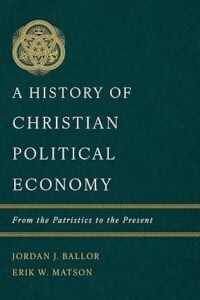
 A History of Christian Political Economy: From the Patristics to the Present
By Erik W. Matson and Jordan J. Ballor.
B&H Academic, 2026.
Hardcover, 432 pages, $54.99.
Sources in Christian Political Economy: A Reader
Edited by Erik W. Matson and Jordan J. Ballor.
B&H Academic, 2026.
Hardcover, 352 pages, $54.99.
Reviewed by Paul D. Mueller.
Erik Matson and Jordan Ballor have done yeoman’s work to fill a major gap in economic history: Christian Political Economy. Their work consists of two volumes: A History of Christian Political Economy (History) and Sources in Christian Political Economy (Sources). Before dismissing a multi-volume history of religious economic thought as dry or irrelevant, let me attempt to change your mind.
These two volumes are highly accessible and interesting. One volume (History) surveys “the broad sweep of specifically Christian reflections on economic thought” and discusses context for economic commentary over the last two millennia. The second volume (Sources) consists of primary source excerpts from forty-nine Christian thinkers (seven thinkers in seven distinct historical periods):
- Patristics (100 – 500).
- Early Medieval (500 – 1225).
- Late Medieval (1225 – 1500).
- Early Modern (1500 – 1725).
- Classical (1725 – 1848).
- Industrial (1848 – 1918).
- Twentieth Century (1918 – 2000).
Organizing sources in this way shows how Christians were thinking about the issues of buying, selling, and accumulating wealth in the intellectual milieus of their time. It also helps the reader understand the development of Christianity and Christian thinking over the centuries. One learns, for example, that Basil of Caesarea and Gregory of Nyssa were contemporaries in the early church, and then were followed by thinkers from Bernard of Clairvaux (twelfth century) to Catherine of Siena (fourteenth century) and by other thinkers through the twentieth century.
Matson and Ballor masterfully extract insights from iconic philosophers such as Augustine, Aquinas, Calvin, Luther, Priestley, and Wesley as well as from lesser known writers like John Chrysostom, William Langland, Pierre Nicole, Anders Chydenius, and Ferdinando Galiani. All have a variety of opinions about Christian ethics in buying, selling, and trading.
Although reading through the excerpts shows why some thinkers were more prominent and important than others, there are still hidden gems of insight. And even where comments were not particularly incisive or groundbreaking, they give the reader a sense of how Christians more broadly saw issues of political economy during certain eras of the church.
Themes of wealth, poverty, and greed pervade early Christian writing about markets. So, too, do concerns about justice in price, profit, and lending at interest. Aristotle’s shadow dominated Christian perspectives on usury until the Protestant Reformation, when John Calvin argued that the Bible does not explicitly condemn all forms of lending and interest (though he personally found lending at interest distasteful).
When it came to usury, Calvin wrote, “[T]he question is only as to the poor, and consequently, if we have to do with the rich, that usury is freely permitted….[because] their declarations ought to be judged by the rule of charity.” Though usury is permitted, he says, “To exercise the trade of usury, since heathen writers accounted it amongst disgraceful and base modes of gain, is much less tolerable among the children of God; but in what cases, and how far it may be lawful to receive usury upon loans, the law of equity will better prescribe.”
I found myself in hearty agreement with some of the sources and deeply opposed to the views of others. For example, Michael Novak’s classic The Spirit of Democratic Capitalism gives a hopeful view of modern commercial society. In contrast, Gustavo Gutierrez’s liberation theology sees the modern world and political community as relentless struggle and conflict whereby wealth and the means of production are important tools of power. Then there is the environmental ethic put forward by E. F. Schumacher that holds markets and commerce to be enemies of the planet.
Or, in a different vein, there is Kenneth Boulding’s remarks about the differences between the “economic ethic” and the “heroic ethic.” I had never read this before but Boulding expresses very similar concerns that I have about the limits of economic theory and reasoning. I believe he is worth quoting at length here:
In facing decisions, especially those which involve other people…we are faced with two very different frameworks of judgment. The first of these is the economic ethic of total cost-benefit analysis. It is an ethic of being sensible, rational, whatever we want to call it. It is an ethic of calculation. … [T]here is in the world another type of decision-making, in which the decision-maker elects something, not because of the effects that it will have, but because of what he ‘is,’ that is, how he perceives his own identity.
This ‘heroic’ ethic takes three major forms—the military, the religious, and the sporting. The heroic ethic ‘theirs not to reason why, theirs but to do and die’ is so fundamental to the operation of the military that attempts to apply an economic ethic to it in the form of cost-benefit analysis or programmed budgeting…are deeply threatening to the morale and the legitimacy of the whole military system.
One could easily add having children and marriage to the list of activities and institutions that do not fall primarily within the economic ethic. This is but a sample of the gems and topics to be found in Sources. The volume will fit nicely in both the theologian’s study and the economist’s library. And I would also commend it to anyone who wants to teach the history of economic thought.
Matson and Ballor also wrote a companion volume on Christian Political Economy that also explores these seven eras of church history. Their chapters are an interesting mix of economic history—what trade, production, property rights, and markets were like during each period—with intellectual and church history. They discuss the lives of various thinkers, the problems they faced, and how they corresponded with one another and interacted with those who came before.
Matson and Ballor rightly distinguished Christian Political Economy from economics more narrowly. The Christian label makes sense for political economy, but less so for economics, because, as they point out, “political economy had been understood since the eighteenth century as a branch of moral philosophy, with interconnected ethical, political, and jurisprudential aspects, [while] economics came to be viewed as a science independent of ethics and politics.”
These volumes only engage Scriptural commentary on wealth and trade indirectly. Most of the authors tie their thinking back to Scripture, but Matson and Ballor do not engage in biblical exegesis because many works in that vein already exist. Their Sources helps the reader understand, however, why there can be such a variety of exegetical interpretations of Scripture on money and wealth.
Some Christian traditions lean more ascetic, others are more focused on the cultural mandate. Some Christians see market activity as ancillary to the life of faith, others view it as deeply connected, even integral, to living faithfully. Matson and Ballor don’t rely too heavily on any individual tradition but allow voices from many traditions to be heard in their Sources.
These volumes are certainly not the only or final word on how Christians have engaged with economic theory and practice, but they are a valuable contribution and should be on any Christian’s shelf who wants to understand how Christians have thought about markets, trade, and wealth.
Though no single or uniform view emerges, one finds that over time, Christians have largely embraced the insight that God extends material blessings far and wide through voluntary, decentralized exchange in the marketplace. This is not the sum of human flourishing, but it is a key component.
Paul D. Mueller is a senior research fellow at the American Institute for Economic Research as well as a research fellow and associate director of the Religious Liberty in the States project at the Center for Religion, Culture & Democracy. He taught economics at The King’s College in New York City. His academic and popular work has appeared in a large variety of publications. Dr. Mueller is also the author of Ten Years Later: Why the Conventional Wisdom about the 2008 Financial Crisis Is Still Wrong.
Support the University Bookman
The Bookman is provided free of charge and without ads to all readers. Would you please consider supporting the work of the Bookman with a gift of $5? Contributions of any amount are needed and appreciated!
