
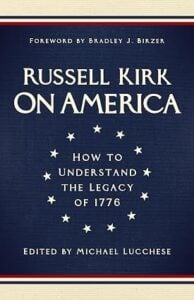
 On America: How to Understand the Legacy of 1776
By Russell Kirk. Edited by Michael Lucchese.
Creed & Culture, 2026.
Hardcover, 234 pages, $28.
Reviewed by Bruce P. Frohnen.
This new collection, On America: How to Understand the Legacy of 1776, is welcome and timely, and not just on account of the anniversary of the Declaration of Independence. It is also timely on account of the current state of our culture and politics. Among its virtues: it affords readers an excellent opportunity to revisit one of the most misunderstood quotations in Russell Kirk’s lexicon. Kirk was fond of quoting T.S. Eliot’s saying: “there is no such thing as a Lost Cause because there is no such thing as a Gained Cause.” These words can give hope to beleaguered defenders of The Permanent Things in our corrupt age. But they are not designed and should not be taken to excuse withdrawing from political struggles or defending business as usual in a time, such as ours, of deep crisis.
Neither Eliot nor Kirk would justify surrender in the face of conflict, especially when order in the commonwealth is at stake. Vague gestures toward cultural continuity, civility, and the possibility of renewal at some future date are woefully insufficient when our patrimony stands on a knife-edge. As the volume’s postscript, “The Constitution and the Antagonist World,” makes clear, since the cataclysm of 1914
whole peoples have been uprooted or transplanted, or perhaps extirpated; complex patterns of life have been devastated or totally supplanted; political systems have vanished almost without trace; classes have been effaced, ancient rights abolished, the cake of custom ground to powder. Constitutions written and unwritten have been subverted almost overnight by conventions of political fanatics, and innovating substitute constitutions in their turn have been expunged within a few years, making way for yet more novel political structures—no less evanescent.
Even the British culture Kirk saw as central to our own traditions has “experienced much constitutional alterations” (by now one might say has been completely overthrown) in recent years. And America’s own constitutional order, long thought beyond possibility of destruction, before the end of the 20th Century already was in danger. “We confront an armed doctrine and are divided in our own counsels.” The doctrine has morphed from simple communism to a strange brew of socialism, race hatred, and radical Islamism but remains armed and determined to destroy our civilization.
And yet our own general complacency scarcely is shaken; most of us behave as if nothing very disagreeable ever could happen in the Constitution of the United States, and as if the political future of this nation would be a mere alternation of Republican and Democratic presidential victories, somewhat less interesting than professional baseball and football.
Things have gotten far worse for our civil social order since Kirk wrote the words gathered in this volume. Our elections have been undermined and taken over by cheats with the nodding approval of activist judges on the left and somnolent judges on the right. After undermining our constitutional order for decades, a majority of Supreme Court Justices recently informed Americans in Watson v. Republican National Committee that there is no “election day” in our Constitution, meaning that ballots can be counted long after that actual, obviously verifiable day, often in secret. Judges of this type have worked to destroy the family itself as the product of “bigotry” in the face of demands that we approve same-sex unions and grant them the status and benefits of the natural, fundamental unit of society. And still, too many of our leaders claim that nothing can be done to salvage our way of life if the proposed legislative means might overthrow recent, artificial rules that allow easy, silent filibusters and other defenses of corrupt business as usual.
How can the words of even the most brilliant scholar and man of letters aid us in such times? By helping us to recur, not merely to a few ideological slogans, but to our tradition, to the institutions, the norms, and the character that once shaped our public life. Kirk’s works show we still have reason and the duty to hope and to fight. To be specific, as Kirk notes in the fine character sketch of Ronald Reagan included here, we can and should recover and act on the often-overlooked virtue of audacity. Reagan, so often praised today for mere optimism, was a master rhetorician (Kirk emphasizes poetry as the source of ideas, understanding, and phrasings important for moving people in the right direction). Reagan also was a man of wisdom and conviction, aware “that great powers can decline and fall; that the American economy is not invulnerable to indolence and sentimentality; that national character may alter for the worse; that the end of man is action.” He took bold action in foreign affairs to protect American interests and fought against American decline even if that meant violating expectations and pushing the perceived limits of “the way we do things in Washington.”
Kirk was no less audacious in his way. He defended our way of life, even when it meant opposing foolish wars or supporting the brave insurgent, Pat Buchanan, in his primary challenge to George H.W. Bush and his mental tyranny of the routine. He knew politics is the art of the possible, and so made compromises and alliances where necessary, but worked to protect and restore our way of life. This volume shows some of Kirk’s audacity, for example through his telling critique of the Caesarism of the bully and attempted tyrant Lyndon Johnson. Kirk was not afraid to rock the boat if necessary to set it back on an orderly course.
Taken as a whole, this volume does an excellent job of highlighting the lessons on American principles and traditions understood by the Audacious Dr. Kirk. It begins with Kirk’s excellent reminder that “America is a religious nation.” While our laws are not aimed at the dangerous goal of establishing any specific religion, they properly are designed to support our natural religiosity in the forms that have been part of our tradition since its beginnings. The second essay, among Kirk’s best, points out the sense in which our Revolution was one, not made, but prevented. The Patriots of 1776 sought no utopian leap into ideological madness like the French Revolution. Rather, Americans sought and reluctantly fought to preserve their already existing political and cultural order from the centralizing innovations of the British Crown. As Edmund Burke, their sometime agent to the British government, had observed of that nation’s Glorious Revolution of 1688, real, beneficial reform may require circling back to the virtues and traditions embedded in the already existing public order.
There follow selections describing American traditions and their literary as well as political and cultural roots as well as their development over time, especially within British culture. Fittingly, the volume moves on to a set of character sketches of important American statesmen. Kirk discusses John Adams, scion of one of the most important American families, leader of the revolution, and through his writings an important shaper of our constitutional order. In the next essay he discusses John Randolph of Roanoke, defender of the doomed Old Republicans of the planter class, whose motives are too often caricatured, then the audacious Ronald Reagan. Throughout we are treated to Kirk’s always enlivening prose and his discerning analysis of the virtues and limitations of those who have risen to high status and cultural importance. The section also includes an obscure but charming sketch of Abraham Lincoln. This previously unpublished essay emphasizes Lincoln’s prudent side and America’s great loss with the assassination of a kind-hearted man who would have done much to limit the hatreds unleashed on both sides as Civil War gave way to Reconstruction.
The volume’s next—again, fitting—section treats American letters and includes an especially important essay on Nathaniel Hawthorne. Hawthorne remains one of the most important American literary figures. His works, from The Scarlet Letter and Blithedale Romance to countless short stories and essays, were aimed at re-grounding American character in recognition of our inability to avoid sin. In explicating this foundational reality, Hawthorne made possible a leavening of our culture’s increasing selfishness and materialism. Kirk’s essay itself also shows the foolishness of that too-common claim that Progressivism and its pernicious effects were brought to our innocent shores by a nefarious invasion from Germany. Such a view ignores the reality and influence of original sin in all of man’s doings. The result is a certain blindness to our own cultural weaknesses and an excuse for the bitter calumnies distorting our real history included in radical critiques like the infamous 1619 Project.
The volume’s editor, Michael Lucchese, has done a worthy thing. He has made wise choices among the wealth of material available in Kirk’s oeuvre. This reviewer might have wished to see something more substantial in the way of social criticism, of which Kirk was a true master. A book on the legacy of 1776 would only be improved by Kirk’s spirited defense of local customs and opposition to the homogenization of cultures brought about by the sin of greed, but also by that drive for national power and a bland “fairness” impossible of achievement in a free, ordered society.
It also would have been beneficial to have an editor’s note explaining the choices made and, more importantly, how various selections were adapted from their originals. As it is, there seem to be very few alterations, but whether this is in fact the case is unclear. But these, along with some small disagreements with the rather structural tone of the introduction, are but quibbles in response to a well-chosen and crafted volume of important writings, for which Mr. Lucchese is to be thanked.
Bruce P. Frohnen is Ella and Ernest Fisher Professor of Law at Ohio Northern University and a Senior Fellow at the Russell Kirk Center for Cultural Renewal.
Support the University Bookman
The Bookman is provided free of charge and without ads to all readers. Would you please consider supporting the work of the Bookman with a gift of $5? Contributions of any amount are needed and appreciated!


