
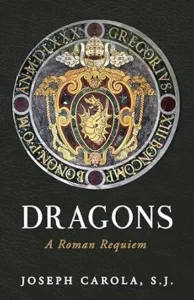
 Dragons: A Roman Requiem
By Joseph Carola, S.J.
Sophia Institute Press, 2026.
Paperback, 256 pages, $19.95.
Reviewed by Rev. Anthony D. Andreassi, C.O.
For much of the nineteenth century, Rome was a city attempting to recover from revolution and war. The certainties of the ancien régime had been shattered, and both Church and society were learning to navigate a profoundly altered world. Cardinal Ercole Consalvi, Pope Pius VII’s brilliant secretary of state and chief diplomat, captured the magnitude of the upheaval when he observed that “the world was changed more after the French Revolution than after Noah left the ark.”
It is precisely this unsettled world that provides the backdrop for Father Joseph Carola’s first novel. Set between the Revolutions of 1848 and the unification of Italy, which brought an end to the Papal States and left Pope Pius IX the self-described “Prisoner of the Vatican,” the novel unfolds amid a period in which revolutionary movements and demands for political and ecclesiastical reform placed both the papacy and its most vigorous defenders, the Society of Jesus, in the line of fire. As if these upheavals were not enough, Carola also weaves in plagues and floods that further underscore the instability of the age. In the midst of these middle decades of the nineteenth century, particular attention is given to the proclamation of the dogma of the Immaculate Conception in 1854, the Risorgimento, and the First Vatican Council.
Although Father Carola is best known as a distinguished patristics scholar who has taught theology at the Gregorian University in Rome for nearly thirty years, his command of history and theology extends far beyond early Christianity and reaches far into the political history and theological developments of the nineteenth century. In addition, having lived in Rome for many years, he knows the Eternal City intimately, and its streets, churches, and neighborhoods are rendered with such vividness that the reader seems to walk beside the characters.
As for the characters, the vast majority are historical figures. To assist readers, the author appends a helpful dramatis personae with concise biographical sketches of each. To lend the narrative greater verve and color, however, he invents six fictional characters, the principal among them being Luigi Colonna. When we first meet Colonna, he is an exceptionally pious scholastic (Jesuit in the early stages of seminary training) from the Colonna family, one of Rome’s foremost noble and powerful dynasties who had gifted the Church both Pope Martin V (r. 1417–1431) as well as twenty-two cardinals over the course of seven centuries. While still early in his Jesuit formation, Colonna chose as his patron the Venerable John Berchmans (canonized in 1888) whose strict observance of the Jesuit rule he sought to emulate.
Serving as a foil to Colonna is the Italian military officer Giorgio Mangiapreti, a man of roughly the same age whose marvelous surname foreshadows his fanatical hatred of the Church. Reminiscent of the unnamed lieutenant in Graham Greene’s The Power and the Glory, Mangiapreti will stop at nothing, including murder of the innocent, to rid a unified Italy of the Church and clear the way for what he believes will be a new and perfect society. Or, as Carola puts it: “The modern Italian state was born of the blood of its own sons.”
One of the novel’s most important historical figures is the Jesuit theologian Giovanni Perrone, a professor at the Roman College (today the Gregorian University) and author of a monumental compendium of dogmatic theology that formed Colonna and thousands of other real seminarians for several decades of the nineteenth century. Perrone was also the theologian to whom Pope Pius IX (r. 1846–1878) turned to draft what ultimately became the solemn definition of the Immaculate Conception. The path from Perrone’s initial draft to the solemn definition was anything but straightforward. Together with two other real-life Jesuits, Carlo Passaglia and Clemens Schrader, Perrone worked tirelessly to ensure that the project came to fruition despite determined opposition from two members of the theological commission charged with examining the proposed definition. In Carola’s telling, Colonna, now ordained, serves as Perrone’s assistant on the commission. This fictional role enables Carola to weave Colonna into conversations of his own creation, all of which are carefully based on historical events here and in many other places in the novel. Conversations between three historical Jesuit lay brothers who worked at the Roman College also help to drive the narrative, and, at times, provide some comic relief.
The day of the solemn definition, Friday, December 8, 1854, dawned cool and cloudless over Rome after several days of rain. As Perrone, Passaglia, Schrader, and Colonna joyfully prepared to walk from the Roman College to St. Peter’s Square for the papal Mass, a far different mood prevailed at Santa Maria sopra Minerva. There, most of the Dominicans, with the notable exception of the Spaniard Mariano Spada (the pope’s personal theologian), had opposed the proposed definition. Once Pius IX had spoken, however, they accepted it with the obedience expected of sons of St. Dominic.
On the way to the ceremonies, Schrader stops for a drink of water, unconcerned about breaking the Eucharistic fast, since regular concelebration was still more than a century in the future (and each of the priests had almost certainly celebrated his own private Mass earlier that morning). Passaglia, however, reminds him not to drink too much, knowing that the papal ceremony will last for hours. (In fact, it lasted nearly four.) It is touches such as these that reveal Carola’s gift as a novelist, reminding the reader that the great theological and ecclesiastical questions of the age were debated and decided by flesh-and-blood human beings with normal needs and emotions.
As the story progresses, two of these key characters depart Rome. Schrader is sent to teach theology at the University of Vienna after Emperor Franz Joseph personally requests that a Jesuit fill the post. In choosing Schrader from among several possible candidates, however, the Jesuit general appears to have been influenced as well by concerns about the increasingly close nature of his relationship with Passaglia. His transfer thus serves both the Society’s needs and the more discreet purpose of creating some distance between the two men. As for Colonna, the Jesuit general appoints him rector of the Society’s college in Orvieto (an institution roughly equivalent to a modern American high school). Given his still relatively young age of thirty-seven, Colonna, not unlike Jeremiah, expresses doubts that he is equal to the task. Little does he know just how formidable the challenges awaiting him in Orvieto will prove to be.
The paths of Colonna and Mangiapreti, now a military commander with the forces of the Risorgimento, finally cross in September 1860, when the papal troops withdraw from Orvieto. An unruly crowd fills the streets, tearing down the papal flag and replacing it with the Italian tricolor. The scene terrifies the Jesuits, especially Colonna, who recalls the revolutionary violence he witnessed in Rome in 1848.
Amid this turmoil, the two men meet. Mangiapreti arrives at the Jesuit college to requisition the property for use by his troops, bringing him face to face with Colonna, its young rector. Although the lives of the Jesuits in Orvieto were threatened, all escaped death and eventually fled the city with Colonna returning to Rome. The fate of the Society throughout Italy, however, was far more severe. In the space of only two years, the Jesuits were expelled from fifty-three of their eighty-six houses across the Italian peninsula.
As the novel draws to a close, Colonna and Mangiapreti meet once again amid circumstances that echo their first encounter in Orvieto. With the First Vatican Council underway, the French garrison is recalled to fight in the Franco-Prussian War, leaving Rome exposed to the Italian forces that finally capture the city in September 1870. Colonna, now back at the Roman College teaching in the high school division, once again confronts Mangiapreti when the military officer arrives to requisition Jesuit property. The new government also strips the college of its authority to confer degrees and confines the Jesuits to part of the building, where they are permitted to continue teaching seminarians. In Mangiapreti’s eyes, at least, the Jesuits would no longer be free to “infect” the minds of young Italians. A few years later, the Jesuits would be expelled even from this remaining portion of the Roman College.
Throughout the novel, dragons appear as a recurring motif. They derive from the coat of arms of Pope Gregory XIII, a member of the Boncompagni family, whose heraldic dragon was carved into the façade of the Roman College. When the new Italian state finally took full possession of the building, the dragon from Gregory XIII’s coat of arms, along with other Christian and Jesuit symbols such as the IHS monogram, was erased. Yet not every dragon disappeared. A few remain on the façade to this day, quiet reminders that history is never erased as completely as its conquerors intended. Indeed, despite the losses chronicled in Carola’s novel, the Society of Jesus was on the threshold of what might reasonably be called a new golden age of missionary, educational, and intellectual activity.
Rev. Anthony D. Andreassi, C.O., Ph.D., is the author of Teach Me to Be Generous: The First Century of Regis High School in New York City.
Support the University Bookman
The Bookman is provided free of charge and without ads to all readers. Would you please consider supporting the work of the Bookman with a gift of $5? Contributions of any amount are needed and appreciated!

