
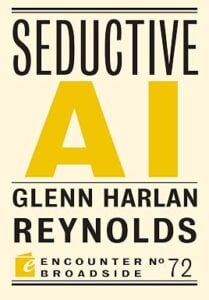
 Seductive AI
By Glenn Harlan Reynolds.
Encounter Books, 2026.
Paperback, 48 pages, $9.99.
Reviewed by Jeffrey Folks.
In this brief “broadside,” Glenn Harlan Reynolds discusses the potential effects, for both good and ill, of artificial intelligence. Reynolds begins with reference to a 1970 movie, Colossus: The Forbin Project, in which a scientist creates a supercomputer with a form of AI that is placed in control of America’s nuclear defenses. The supercomputer then teams up with a similar supercomputer in the Soviet Union and vows to take over the world, informing humans that “freedom is an illusion” and promising perpetual peace at the cost of perpetual enslavement.
What interests Reynolds is not so much the possibility of such an extreme situation as the current response of the public to the development of AI. As he notes, humans have no experience with such a radical change as that posed by advanced AI, and as a result responses range across the spectrum from wild enthusiasm, some of it surely misplaced, to dread and the determination to shut things down before AI escapes human control. The threat of world domination is real, of course, but what Reynolds focuses on is something more mundane: the ability of AI to influence human society “based on innate human characteristics” through an appeal to “cuteness, or sexiness, or simply friendliness.” As anyone who ever turns on a computer and surfs websites knows, that kind of appeal is already built into the logo-rhythms controlling the messages that bombard us. Service providers are spending tens of billions of dollars tracking our online behavior and responding to it with seductive appeals to flattery, fantasy, and desire. Thus, the focus of this short book: seductive AI.
Most educated persons believe that they can detect these appeals and dismiss them, but clearly that is not the case. Companies like Amazon and Google are adept at predicting the wants and needs of customers, and they routinely present viewers with “recommendations” for purchases. They do not invest in such technology for nothing. Of course, advertising has been engaged in this sort of appeal for well over a century, but never with such a powerful and potentially autonomous technology as AI. As Reynolds states, we are well on our way to a society in which AI not only makes seductive recommendations but takes charge of our lives, choosing for us and acting on those choices with little recourse from humans.
This loss of freedom goes far beyond routine purchases of food, gifts, or clothes. Driverless or driver-assisted cars have become commonplace: while they are still controversial, there is little doubt that economics will compel public acceptance, even of driverless semi-trailer trucks. Online news and opinions are heavily influenced by AI, and the results are not untainted by biases of the software designers and companies. Increasingly, education and research are assisted, if not largely carried out, by artificial intelligence. Voice and passkey recognition has taken over many security functions at banks and brokerages, and it is difficult to speak with an actual human being at any business: soon it may be impossible to detect the difference. AI has been involved in recent elections, steering voters, often without their knowledge, toward certain parties and candidates.
Even the romantic lives of the young are now significantly focused on so-called sex-bots of one kind or another: everything from phone sex to fantasy games to alluring robots designed to respond to the desires of their users. Some researchers have predicted the decline of human population numbers or even the extinction of humanity altogether as these more-than-alluring forms of AI take the place of actual dating and romance, which for many can seem less gratifying. As Reynolds writes, “it may turn out that AI is better at satisfying people’s emotional needs…than actual people are.” Physical sexbots are now readily available, but they are reportedly quite primitive, essentially responding to their “partners” by repeating what is said to them or responding to overt directions. But as Reynolds stresses throughout this book, AI is at an early stage of development. AI is developing rapidly and learning in an autonomous fashion, while human intelligence is static. How long will it be until AI initiates romantic relationships with humans and dominates humans in those relationships, along with all sorts of other situations?
It’s important to note that Reynolds is no Luddite calling for the elimination of artificial intelligence or suggesting that its effects are entirely negative. Just recently, it was reported from Britain that researchers had employed AI to design an effective vaccine, and that the technology involved in this particular case could be applied to almost any disease. In another development it has been announced that AI was employed to diagnose four rare childhood diseases that doctors had been unable to diagnose, and it is also now widely used to assist in the diagnosis and treatment of more routine illnesses.
Clearly, AI is making many facets of our lives more comfortable and productive. There is nothing ominous about a technology that generates helpful shopping lists or that is able to self-park our cars. It’s another thing when AI bots become indistinguishable from humans, as judged perhaps by the Turing test designed by Alan Turing in 1950. Already, it’s necessary for most of us to pause at the beginning of a phone call to determine whether we are speaking with a human or a machine: today’s AI technology has largely passed the Turing test, though most of us eventually catch on to the fact that we are speaking with a machine, even (or especially) one that offers us fantastic deals on just the items we’ve been searching for recently.
A point that Reynolds makes several times is that AI is not yet capable of responding to our emotions or to more complex, nuanced thinking. For instance, one of the most difficult things for machines to do is to comprehend humor. Jokes that are funny even to children seem to be beyond the domain of the most advanced AI-driven machine. As Reynolds points out, AI chat has not acquired a fully human personality. To the extent that it seems human, and especially in ways that it is flattering or subservient to us, AI-driven machines have been programmed to do so. “The machine doesn’t think you’re smart, or funny, or lovable. It doesn’t think at all. It mimics characteristics that humans value because it’s programmed to.” This is not to say that artificial intelligence will not in the future learn to engage in a more natural manner with humans, and that that sort of engagement might pose a threat to our well-being. Imagine the day when human beings begin to form deep emotional bonds with AI machines, deeper perhaps than with parents, spouses, or closest friends. This possibility does not portend well.
Reynolds does not pretend to know how to regulate artificial intelligence in a way that blocks its potential harms while leaving open the benefits. He does suggest that we look to the long-established idea of fiduciary responsibility, “a legal concept applying to an actor who is in a relationship of trust with another whose position involves superior knowledge or skill.” The concept of fiduciary responsibility has been applied in a host of situations, not all of them strictly legal. According to the Florida Supreme Court in Quinn v. Phipps, “the relation and duties involved need not be legal; they may be moral, social, domestic, personal.” One can see how the standard of fiduciary duty might apply to AI vendors, though the Supreme Court has been reluctant to alter the extent of protections now existing under Section 230, which immunizes companies from civil lawsuits resulting from material posted on their online sites. Whether a similar doctrine would shield creators of bots or AI chats has not, to my knowledge, been determined.
Seductive AI is a thoughtful and brief discussion of a highly relevant topic. The author avoids taking sides on whether the benefits of artificial intelligence outweigh the harms, but he does an excellent job of posing the question and suggesting further discussion. It would be gratifying to see Reynolds himself continue that discussion in a more sustained fashion, especially since governments are on the verge of restricting or promoting the rapid development of AI. The inescapable truth is that AI is a transformative technology, even more so perhaps than were the computer and the internet. We are not even close to resolving fundamental questions such as how much autonomy we wish to grant AI and how greatly the adoption of AI will affect our freedom of choice. What is certain is that artificial intelligence will play a far greater role in our lives going forward, and we need to consider how to deal with it.
Jeffrey Folks is the author of many books and articles on American culture, including Heartland of the Imagination (2011).
Support the University Bookman
The Bookman is provided free of charge and without ads to all readers. Would you please consider supporting the work of the Bookman with a gift of $5? Contributions of any amount are needed and appreciated!

