
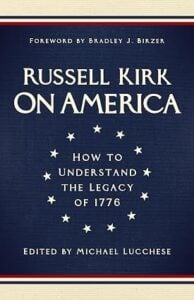
 On America: How to Understand the Legacy of 1776
By Russell Kirk. Edited by Michael Lucchese.
Creed & Culture, 2026.
Hardcover, 234 pages, $28.
Reviewed by Wilfred McClay.
Like any great and influential writer, Russell Kirk has often suffered from being misread, even by those sympathetic to him—not to mention his being breezily dismissed or underestimated by those who are not sympathetic, and have never read him with care, or at all. Among other common misconceptions, there is the tendency to typecast him as someone whose life and work are somehow worlds apart from the American intellectual and political tradition. In this view, his formation as a student at the storied University of St. Andrews in Scotland, and his affinity with writers like Edmund Burke, Sir Walter Scott, T.S. Eliot, George Santayana, Orestes Brownson, and G. K. Chesterton, as well as statesmen like John Adams, Fisher Ames, and Joseph de Maistre, marked him as a dispositional reactionary and romantic who took his stand in the prescriptive and class-conscious conservatism of Europe, rather than the energetic democracy of America.
It is a little difficult to understand how a man who chose to spend his adult life rooted in the soil of his ancestral Michigan, and fully owned its tangled history, its local legends, and its humble beauties, could be seen in this way. But in any event, this fascinating collection of Kirk’s writings about America, assembled with care and intelligence by the brilliant young scholar Michael Lucchese, should put paid to all such misconceptions.
Taken together, the essays in this collection have a distinctly American air, but one spiced by the enlivening spirit of a much longer historical consciousness. Unlike his distinguished contemporary, the historian John Lukacs, Russell Kirk did not write a great deal about the subject of historical consciousness. But he didn’t need to. His entire life and work were nothing less than an extended elaboration of that very theme. Historical consciousness seemed to have been infused into the air he breathed and mixed into the soil of the land in which he chose to live. No place or thing, however ordinary, was too humble for him to grant it the dignity of a story.
Although his Gothic and Romantic tastes drew him to old European cathedrals, Roman ruins, and other such haunted sites, he was not prone to sigh, in the perennial complaint of American writers such as Hawthorne and Henry James, that America was too new or raw or commerce-minded to be the stuff of art. On the contrary, Kirk knew how to see monuments, and ruins, everywhere he looked.
What others called “junk” Kirk thought of as “cultural debris,” which is a short way of saying that Kirk took a long view of the disorders of our contemporary American world, seeing them in light of the thousand follies and disorders that have come before us in the human procession. Historical consciousness gave him a broad, capacious vision, which always insisted that the civilization we enjoy has deep living roots. Those roots of American order extend back in time not only to 18th-century Philadelphia, but further back, to London, Rome, Athens, and Jerusalem.
But his 1974 book The Roots of American Order was not just a way of ordering historical knowledge more charmingly than one would find it in a textbook. He wrote it as a contribution to the American Bicentennial of 1976, a guidebook for the task of cultural renewal, an account of the usable past that was meant to be used. Looked at through Kirk’s eyes, the political ideas of Philadelphia in 1776 (and 1787) could be seen as the convergence and culmination of the ideas to which each of those four predecessor cities had given birth. Lucchese’s collection is offered in much the same spirit, and as its subtitle indicates, it has the Semiquincentennial in mind.
The book consists of some sixteen chapters, which can be read in sequence or as stand-alone reflections, on subjects as various as the American inheritance from the ancients, the character of the American Revolution, the missionary streak in American political life, and the lives and works of such statesmen as John Adams, Abraham Lincoln, Ronald Reagan, and literary figures such as Nathaniel Hawthorne, Mark Twain, Henry Adams, Eliot, and Robert Frost. There is a final chapter called “Mecosta County,” which describes in unsparing but loving tones the rather down-and-out features of the unprepossessing home territory in which he has chosen to root himself.
A few themes stand out. First and perhaps foremost, there is Kirk’s reflection on the American Revolution, that it was “a revolution not made but prevented,” not a radical break with the past, but a conservation of inherited rights that had been established over many generations. The revolution averted, in this view, was what the Parliament had attempted to impose upon colonies that had become accustomed to ruling themselves, and had done so for a century and a half, in some cases.
Such a view has much to be said for it, even if it does not account for the democratizing changes in social structure and mores that the late Gordon Wood pointed to in his book The Radicalism of the American Revolution. But Kirk is surely right to emphasize that the words in the preamble of the Declaration of Independence were not meant to underwrite an ideal of radical egalitarianism and individualism, as they are increasingly read to do today. Instead, the inertial force of tradition has until recently played a role in mitigating the centrifugal forces that might otherwise force society to a disorderly fragmentation. It is not clear that tradition has the same standing in the culture today as it had when Kirk was writing. But perhaps it is not futile to hope that it can regain its rightful place.
He is rightly disdainful of the ideological invention called multiculturalism, which he calls both “puny” and “anticultural,” since culture is something deeper, something that arises organically, and ultimately “from the theophanic events that bring cults into existence.” If it is to be a living thing, it cannot be a work of artifice, not “constructed” or refashioned to fit the ideological needs of a currently dominant group or party.
His treatment of great figures in American political and literary history is both lapidary and surprisingly fresh. His account of Lincoln—entitled “Abraham Lincoln and the Dignity of the Presidency”—pays homage to Lincoln’s deep appropriation of Roman ideals, of a pietas that is willing to be subordinate to the claims of the divine, qualities of his character that only came to be recognized later in his presidential term, and perhaps fully appreciated only after his assassination.
That essay is followed by another, “Will American Caesars Arise?”, which I found to be the most absorbing in the book, an essay one cannot read in the present moment without apprehension, whatever one’s views about our current president. Kirk mainly talks about the figure of Lyndon Johnson, which he does with the skill and political insight of a first-rate political reporter, wielding a sharp scalpel. He admiringly recounts the ways in which Senator Eugene McCarthy, a politician-poet of whose like we have not seen in a long time, was able to block LBJ’s Caesarian tendencies; but concludes that “it is by no means inconceivable that we may look again upon the sardonically smiling countenance of an American Caesar.” His portraits of political figures in that chapter, notably his brief but brutal portrait of Robert F. Kennedy, are unforgettable. So too is his highly favorable account of Ronald Reagan’s presidency, a portrait that credits Reagan with the virtue of audacity, a virtue without which a statesman cannot be successful.
Finally, there are chapters about writers and intellectuals, of which the most interesting may well be a previously unpublished one about Mark Twain, and specifically about The Adventures of Huckleberry Finn. Perhaps I liked it best because it appeals to my prejudice that Twain is an overrated figure. William Dean Howells, who was something of a literary arbiter in his day, called Twain “the Lincoln of our literature,” whatever that means, but Kirk will not have any of that. “Twain is a gadfly,” he says, “not a mentor.” And “his America is only one of many Americas,” valuable mainly for the sheer boyish fun of his work. Kirk detected the profound cosmic gloom that dwelled underneath the comic surfaces in Twain, the archetypal sad clown, and Kirk saw Huckleberry Finn as a refuge of compensation. “That joy of life which Twain never found for himself, he could give to others.” And we should be glad for it, for the book’s ability to give us a “proliferating reality of life,” beyond what Twain himself believed in. As D.H. Lawrence said, we should trust the tale, not the teller.
The postscript with which the book ends is an admonition to us, that we should give to politics its due—no more than that, but no less. He concludes with these words: “A few men and women, like Burke, engage in politics not because they love the game, but because they know that the alternative to a politics of elevation is a politics of degradation.” And then, finally, he closes with these words: “Let us try to be of their number.”
Very good advice, but bracing advice, in this Semiquincentennial year of rage and foreboding, in which the murmuring hint of violence barely suppressed is heard everywhere. But in a republic, especially one that increasingly carries the legacy of Western Civilization on its back alone, we cannot choose to stand apart. We have a duty. Let us try, as Kirk urges us, to be of their number, of those who cherish a politics of elevation.
Wilfred McClay is the Victor Davis Hanson Chair in Classical History and Western Civilization at Hillsdale College, where he is also Professor of History. He is the author of Land of Hope: An Invitation to the Great American Story, which is about to be published in a greatly expanded second edition.
Support the University Bookman
The Bookman is provided free of charge and without ads to all readers. Would you please consider supporting the work of the Bookman with a gift of $5? Contributions of any amount are needed and appreciated!

