
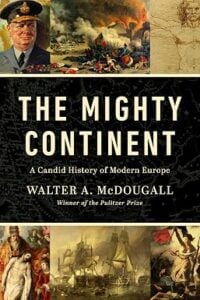
 The Mighty Continent: A Candid History of Modern Europe
By Walter A. McDougall.
Creed & Culture, 2026.
Hardcover, 466 pages, $38.
Reviewed by Michael Federici.
In an era when so many aspects of life are being consolidated, it is refreshing and encouraging to see a new independent publisher emerge. It is especially encouraging that in its first year of existence, Creed & Culture published Walter A. McDougall’s The Mighty Continent: A Candid History of Modern Europe. McDougall is a Pulitzer Prize winner and one of our age’s most engaging and insightful historians. His books tell interesting and meaningful stories about important topics. The Heavens and the Earth, for which McDougall won the Pulitzer Prize, is a book about the space race. Let the Sea Make a Noise: A History of the North Pacific from Magellan to MacArthur explains the history of the North Pacific, including the age of exploration, a topic that is also part of The Mighty Continent. Promised Land, Crusader State tells the story of American involvement in foreign affairs since 1776. The Tragedy of U.S. Foreign Policy, a sequel to Promised Land, Crusader State, explains the role of civil religion in the development and conduct of American foreign policy. His two-volume work on American history, Freedom Just Around the Corner and Throes of Democracy, covers American history from 1585 to 1877.
The Mighty Continent is similar to these earlier books because it combines the three ingredients of McDougall’s success: thematic meaning, interesting and lucid historical narration, and, most importantly, keen insight. McDougall calls his approach in the book “old fashioned, meat-and-potatoes history.” It is the byproduct of teaching a course on modern European history for four decades, and a wonderful example of the symbiosis between teaching and academic scholarship that is also evident in his 2025 book Gems of American History: The Lecturer’s Art. As one reads The Mighty Continent, it is not difficult to imagine how its contents unfold in a semester’s course. It begins with an organizing question: “What does it mean to be civilized—to be civil, to practice civility, to belong to a civilization?” and an organizing theme: the tension and relationship between two attributes of civilization, techne (making, doing, practicing) and themis (culture, the search for meaning, justice, and purpose). These attributes relate to another of McDougall’s themes, the City of Man and the City of God. They indicate that civilization is composed of more than the physical existence, organization, economic prosperity, military success, and material accomplishments of a people. The Mighty Continent traces and explains the development of techne and how Europeans built Western civilization, but it also shows how they imbued it with meaning. Civilizations can be characterized by their institutions, architecture, administration, law, customs, as well as their religious, philosophical, and artistic achievements. In many respects, one cannot be done in isolation from the other. Such things combine to give a civilization identity and character, form and spiritual substance.
The book explains what Western/European civilization is by telling the story of its birth, formation, evolution, and global influence. It ends with McDougall’s statement that from the perspective of the current times, “‘Western civilization,’ however defined, has become decadent, and is perhaps even dying.” The decline of the West is not a new topic, yet McDougall’s conclusion may surprise those who see its current state at the pinnacle of its achievement, part of a golden age. If one focuses exclusively on the state of Western techne, the conclusion seems mystifying. Consideration of themis, however, provides a different perspective. From that vantage point, McDougall asks, What is the purpose of cultural freedom? Europeans, and Westerners generally, have difficulty answering the question because they are experiencing an identity crisis of sorts. Their educational institutions and intellectual elite have been engaged in an assault on the merits and achievements of European civilization that appears to some as cultural suicide. Assessing such criticisms of the West requires knowledge of its history, the topic of The Mighty Continent. With that knowledge in mind, McDougall, as he does in Promised Land, Crusader State, cautions against overstating the virtues and vices of a nation, or in this case, a civilization. In Promised Land, he characterized American involvement in the world as “good, bad, and ugly.” The same can be said for McDougall’s assessment of European history. While it is all too common for Western scholars to disparage their civilization, McDougall avoids one-sided ideological misrepresentation and distortion of European history. He aims instead for a portrayal that is true to historical fact. His conclusions about the contributions and failures of European civilization are based on historical facts, not ahistorical, a priori, disembodied theories.
The first sentence of the book is telling: “Europeans invented the modern world.” The statement is not a boast but a summary of more than four hundred pages of detailed history. McDougall is not a Western or American exceptionalist nor an ideological detractor of the West. The modern world that Europeans invented is fraught with problems traceable to Western civilization. Totalitarianism spread beyond Europe, but its intellectual and political origins are European. Yet, while some Europeans invented and implemented totalitarianism, others fought courageously against it. Some Europeans brought slavery to the continent, but others worked to abolish it. His book finds something akin to the Aristotelian middle; it is neither deficient nor excessive in its assessment of European civilization.
It is important to note why McDougall has a view of European history that is moderate, why he is unlike those who disparage European and Western civilization and those who celebrate it in a one-sided manner. McDougall identifies one of the central insights of Western civilization, the moral duality of human nature. It is part of the ancient traditions of Greece, Rome, and Jerusalem, as well as the medieval ethos of Christian Europe. The insight and identification of human moral duality, the inherent tendency of human beings to exist in tension between good and evil, inspires the creation of much of what is good about European civilization. The rule of law and limited government, integral parts of constitutional democracy and civilization itself, are part of the European response to the challenges of human and societal imperfectability. The failures of European civilization are caused by human imperfection—McDougall invokes the meaning of the word sin: “missing the mark”—but its achievements would not have been possible if human beings did not have the capacity and desire to search for the true, the good, and the beautiful and to preserve insights about them in culture. The point is crystalized by the quote from Aleksandr Solzhenitsyn that ends The Mighty Continent:
The line between good and evil passes not between countries, nor between classes, nor between political parties, but straight through the middle of each human heart. …No one on earth today has any way left to go, except upward.”
What distinguishes McDougall from most historians is his ability not only to highlight the drama of history, but also to place it in the context of the larger, universal quest for meaning and purpose. He mentions a few historians at the beginning of the book who searched for meaning in history. Arnold J. Toynbee, for example, wrote several volumes on the rise and fall of civilizations. Early in his career he overemphasized techne only to overstate in his later works the importance of themis. McDougall, by contrast, understands that “the chronicler of a civilization must begin by studying the early influences that shaped its language, mentality, and attitudes toward the things of techne and themis.” In other words, historians should not impose a theoretical system of interpretation on the study of history but let historical facts determine the meaning in history. This understanding of historical meaning has much in common with Eric Voegelin’s statement at the beginning of his five-volume Order and History: “The order of history emerges from the history of order.” There is meaning in history, but the attempt to identify the meaning of history is a movement in the direction of ideology.
What is apparent from McDougall’s approach is that the moral duality and imperfectability of human beings and human society are evident in all aspects of civilization. The intellectual, artistic, scientific, and political masterminds of European civilization demonstrate both the higher and lower sides of human nature. The consequence of this focus on the human condition is that The Mighty Continent, in McDougall’s words, is “[n]arrative history, loaded with drama, tension, passion, and irony.” McDougall does more than merely describe the drama, tension, passion, and irony of European history. With his eye on themis, he finds meaning in the self-understanding of a civilization that continues to search for its place in the larger cosmological order.
McDougall suggests that on the eve of WWI Europe seemed, from an outsider’s view, to be as mighty as it had ever been. That misperception was based on an overemphasis on techne and an underestimation of the role of themis in the order and health of civilizations. Thinkers like Rousseau, Marx, Darwin, and Nietzsche were, in part, responsible for Western disorientation. They were, from McDougall’s perspective, canaries in the Western coal mine. The hope for the recovery of Western Civilization lies in three things present in The Mighty Continent. The first is the recovery of experiences of order that have been part of the building and achievements of Western civilization. As ideological depictions of European and Western history have erased our memories of the history of Western civilization, there is a great need to call to memory the history and living tradition of the West. Second, McDougall reminds his readers that the things of themis are primary in the work of civilization. Finally, philosophical realism is the foundation for the work of cultural recovery and the reconstitution of Western tradition. Civilizations are dynamic. They change while they remain the same. The work of reconstitution requires judgment that can differentiate between the good, the bad, and the ugly in the drama of history while recognizing that they are, in combination, part of the very texture of history.
Michael Federici is professor of political science at Middle Tennessee State University and the author or editor of several books, including The Political Philosophy of Alexander Hamilton.
Support the University Bookman
The Bookman is provided free of charge and without ads to all readers. Would you please consider supporting the work of the Bookman with a gift of $5? Contributions of any amount are needed and appreciated!

