
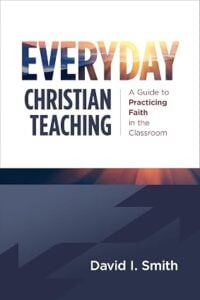
 Everyday Christian Teaching: A Guide to Practicing Faith in the Classroom
By David I. Smith.
Eerdmans, 2025.
Paperback, 227 pages, $22.99.
Reviewed by Christine Norvell.
In my public high school classes, I rarely knew why I was learning what I was. It didn’t occur to me nor, if I could broadly guess, did it occur to my teachers. For the most part as students, we simply followed the teacher. If the teacher was absent, we knew what to do. Cover the material. Do the assignments. Get the grade and move on.
When I was first teaching, I often taught as I had been taught. It took me a few years to ask why—why did I shape each lesson or class the way I did? What was my purpose? My thinking changed. But this was only an advent that begged more questions, and one with which David I. Smith begins. Whether a new or veteran educator, in the world of Christian education we must ask how do we learn to think about teaching from our Christian faith? What does a faith-infused endeavor look like?
“Learning to think faith and teaching together is a pilgrim road,” Smith writes. In other words, faith and pedagogy should be in harmony. Smith’s guide is not a theory of faith and teaching or how to sprinkle faith within teaching. “It offers repeated practice at noticing and thinking through ways in which faith and the process of teaching might connect in everyday practice,” in the mundane moments of elementary, secondary, or higher education classrooms.
Smith begins at the beginning. The semester or school year starts with hope and a prayerful position as we consider the well-being of both student and teacher. Smith introduces his first ideal, that of intention. The intention of the syllabus, the first text the class reads together, how the first class is run, all of these shape both the teacher and the students in its wording and approach—who are we trying to become together? If I begin with prayer, a Bible passage, a chant, or an introduction game, students will imagine what the class will look like in the coming weeks based on what I’ve done. It’s much more than setting the tone. But as the course begins surveying the first content, this framework must stay in place because “the way we begin is part of how our course tells a story about who we think we are and why we think we are learning.” Beginnings set baselines.
With chapters on connecting and community, Smith’s deliberate and care-filled pace continues. He clarifies that academic goals and community purposes in the classroom are not at odds with each other. Since our communion is rooted in Christ first, we have much in common already. A better question to ask ourselves as teachers is how do we help our students know each other? Smith suggests accountability groups that he chooses with care after having met with his students one-on-one in the first weeks. He also adds practices of humility, hospitality, and gratitude. Beyond the classroom, students are encouraged to learn together and not always be on their own for homework. Teachers, for example, can assign occasional work that requires interviews, interactions, feedback from their families or other students. But most importantly, if we recognize that the faith “that we bring to the learning process includes a hope for communion in one another’s gifts and graces,” then it follows that we have room to grow in our way of seeking mutual good.
In his section titled “Framing,” Smith asks us again to consider what we are communicating when we teach. “What do our students think we are doing when we teach? What do they think they are doing when they learn?” Are we pilgrims, observers, or consumers? As teachers, we focus on mastering details at times, but we also invite our classes to look at broad brushstrokes, not to moralize but to be aware of what is in our thinking and imagination about learning how to learn. We wonder about the world we live in, “a divinely composed creation originally marked by a wholeness in which all things cohere.”
Though my chapter summaries here may be broad, Smith consistently draws from his personal classroom experiences as well as from those of his teaching peers. This concrete nature balances each chapter with both the finite and infinite. That same duality is also present in the Exercises section at the end of each chapter. Smith asks us as educators to consider his statements, to write out our thoughts, to talk to others, to read a Bible passage, to remember a time we taught a particular approach, to consider change, and so forth. These question sections are incredibly incisive in their call for true reflection, and they are unlike anything I’ve read within Christian considerations of teaching.
“Assigning” is perhaps my “gold” piece of the book. I folded page corners and took many notes for this favorite section that is mined with “designing assignments that match our hopes” and questions like “What kinds of readers are we becoming?” As always, his innate care for students and teachers alike is tangible. Smith provides dozens of classroom ideas and also asks us to consider which types of students do well on the assignments we create. How can we avoid sameness and offer support to students through the work we ask of them?
The final pages center on pausing, repetition, and ending. Smith encourages us to allow for pausing for breath, connection, and hospitality in our instruction and with our students. Silence, too, can be a reflective and receptive tool. Yet for hospitable spaces, we must also look intently at ourselves. What biases do we bring, knowingly or unknowingly? Smith humbly moves from the inner examination to the external. Just as we deeply consider our beginnings, so too we scrutinize our endings and look backward. Have we done what we set out to do in our classrooms? How do we end the semester or year? It cannot just be a final project, exam, grades, and goodbyes. Surely we can end with care. Since learning remains a form of care in the community of Christ, how will we frame what we say? How can a final class survey be reflective and supportive?
I borrow from Smith’s closing questions for his college students and ask myself, “What is one thing I learned this semester [or from this book] that I do not want to lose hold of going forward? How can I carry it forward?” I hope to plan and act and speak with intention in and out of the classroom, knowing that my efforts as a teacher are one small part of shaping my students in their everyday habits but more importantly, their eternal purpose.
Christine Norvell is a classical high school English teacher, a senior contributor at The Imaginative Conservative, and author of Till We Have Faces: A Reading Companion.
Support the University Bookman
The Bookman is provided free of charge and without ads to all readers. Would you please consider supporting the work of the Bookman with a gift of $5? Contributions of any amount are needed and appreciated!

