
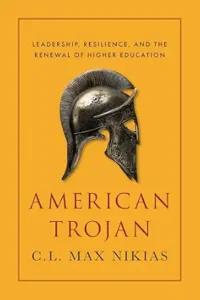
 American Trojan: Leadership, Resilience, and the Renewal of Higher Education
By C.L. Max Nikias.
Encounter Books, 2026.
Hardcover, 552 pages, $39.99.
Reviewed by Christopher R. Green.
Max Nikias’s memoir of his career, especially his time as president at USC, is a fascinating tale of how a man from the world of STEM worked at great length trying to get one of our nation’s great educational machines to perform better. USC clearly gained a lot from Nikias’s public spirit, energy, and concern with detail, all of which practically leap from the pages of his book. The university could have benefitted a lot more, though. Nikias’s stories are always useful—sometimes as positive models and sometimes as cautionary tales—for those seeking to reform universities and make them better versions of themselves.
Tolstoy famously said that all unhappy families are unhappy in their own way, and university bureaucracies seem the same. Much of what Nikias had to deal with at USC—broadly speaking, gatekeeping and rent-seeking by entrenched, sclerotic legacy units, unions, and local government—will be familiar to those engaged in higher-ed reform work. That dysfunction manifests itself, though, amid a blizzard of specific details. Those who lived through the same episodes at USC will undoubtedly look through the index for particular names. Nikias remembers, for instance, who was available for a phone call during a crisis and who let him go to voicemail. Several of the forces opposing reform are nameless, and their motivations generally left unexplained, but not too hard to guess: the English department (demanding an administrator be fired and opposing partnership with the Department of Homeland Security), unions, local government, and the Academic Senate (opposing background checks for new faculty).
Nikias’s USC presidency ended, ostensibly, because of the university’s failure to remove a sexual predator sufficiently quickly, a failure due more to ossified HR procedures than to anything Nikias did. Still, faculty undoubtedly opposed to Nikias on other grounds used it as an occasion to demand his firing, and the board of trustees arranged his retirement as a way to get past the crisis. The bureaucracy was thus able to use its own need for reform to remove a reform-minded president from power. Though Nikias does not offer any general theory of tenure in office, the general institutional pressures for rotation in office—as President Obama once put it, the desire for a “new car smell”—seem likely to have been decisive. He had been president for 8 years, considerably longer than the average top university executive, and served as a USC administrator for nineteen years (associate dean and center director, engineering dean, and then provost) before that. As a former president told Nikias as part of an exhortation not to work too hard, “USC is a mistress that will never love you back.” But that seems a general tendency of all universities, not just USC, and indeed of all bureaucracies, not just educational ones.
The story begins with an inspiring picture of Nikias coming to America as the land of opportunity, equal rights, and “[t]he American dream that built this nation,” escaping the violence that had gripped Cyprus on and off ever since the British decolonization in 1960, when Nikias was eight years old. Finding himself “lost in the intellectual wilderness searching for meaning and purpose,” he found his way in an unusual place: a passion for digital signal processing. That engineering background perhaps contributes to his very direct, no-frills literary style. Almost all of his paragraphs are a single sentence long, akin to a dialogue-heavy novel. Section divisions play for Nikias the role that paragraphs sometimes serve for others. His move from STEM to administration as he moved from his 30s to his 40s is an interesting example of the distinction Arthur Brooks has drawn between “fluid intelligence,” characteristic of raw speed and innovative creativity, and “crystallized intelligence,” characteristic of wisdom. The 30s are when researchers “are the most productive and are filled with the most original ideas,” says Nikias, and while he enjoyed considerable success as a researcher, he was also happy to transition out of it into administration.
Nikias comments at several places about the need to be able to work at the boundary between the technical and human worlds. His opportunity to explain digital signal processing to radar experts at the Navy recalls Billy Mitchell’s critical arguments about the importance of air power to non-specialists during the 1920s. Another time he draws the lesson from a failed proposal of the dangers in focusing merely on technical excellence, rather than the importance of understanding the needs of potential partners. While he does not discuss artificial intelligence at any length, he would doubtless note how it raises the stakes for those able to navigate the boundary between the portions of our world that are distinctively human and those that have become automated.
Security and architecture are two aspects of university administration that outsiders might underrate in importance, but which play important roles in Nikias’s story. USC is surrounded by a high-crime part of LA, and Nikias describes several ways he made security an important priority in response to crimes on campus. He speaks warmly of his relationships with the defense industry during his digital-signal-processing days—“the U.S. Navy has always been very, very good to me!” and clearly understands the importance of safety at the bottom of Maslow’s hierarchy of human needs, ranking “safety and security” as of “paramount importance” for a building project.
Nikias also worked hard to preserve the beauty of traditional architecture, something that makes a surprisingly large contribution to the life of the mind in a university setting, but which provokes opposition that is a bit hard to understand. At one point some faculty were lobbying a donor behind his back to oppose a collegiate-gothic style for a new journalism building: “the building should reflect 21st century architecture to make it consistent with the teaching of modern journalism,” the argument went. But Nikias successfully charmed the donor with a traditional style. Another project noted that a Harry-Potter-style dining hall “brings the great tradition of the academic hall of the past to current students.” It is unsurprising that a leader who would work hard to foster a love of the true, the good, and the beautiful in such ways would also act to preserve the teaching of Latin.
A few topics could have been discussed in greater depth. He notes threats to the rigor of education as universities cater to students’ immediate desires rather than their long-term best interests, but it would be nice to have his perspective on ways in which grading reform might help with the issue of grade inflation. Another area that he touches on several times, but without getting into the sort of detail that caused so much trouble for Larry Summers, is how best to promote the well-being of both men and women in the world of engineering. While Nikias, as engineering dean, increased the number of female engineering faculty from an extremely low level, female engineering professors are still outnumbered 4-to-1 or 5-to-1 at USC, as they are nationwide. He notes very briefly about his hiring of female engineering faculty, “Some believed there weren’t enough qualified female candidates. That was not the case, of course.” But would that still be true, and what sort of engineering education would emerge, if a university pushed toward equal numbers of men and women professors? Nikias refers twice elsewhere to “gender equality” as a “core value,” but does not say quite how far he would be willing to take it. It would be fascinating to see Nikias’s engagement with some of the latest research on the issue.
In the end, Nikias’s story illustrates a recurring truth about bureaucracies: reformers often find themselves defeated not by external enemies but by the accumulated habits, incentives, and procedures of the organizations they serve. That lesson makes this book valuable well beyond USC. Although every educational bureaucracy may indeed be unhappy in its own way, readers will recognize in Nikias’s account patterns that extend across American higher education. For those concerned with the governance and future of universities, this memoir is well worth reading.
Christopher R. Green is a professor at The Ohio State University in the Chase Center for Civics, Culture, and Society and the Moritz College of Law.
Support the University Bookman
The Bookman is provided free of charge and without ads to all readers. Would you please consider supporting the work of the Bookman with a gift of $5? Contributions of any amount are needed and appreciated!

