
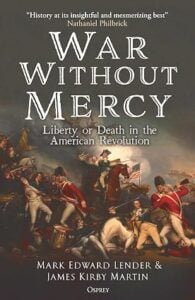
 War Without Mercy: Liberty or Death in the American Revolution
By Mark Edward Lender and James Kirby Martin.
Osprey Publishing, 2025.
Hardcover, 288 pages, $32.
Reviewed by Gil Barndollar.
Amid tepid national fairs, cinematic slop, and sporting exits, America is slumping through its semiquincentennial. As anniversaries tick by, the revolution itself—a successful armed struggle for independence against the preeminent power in the world—can feel like background haze, the efforts of Ken Burns notwithstanding. The history wars rage on in 2026, to be sure. But the character of the fighting that birthed America receives far less attention than the motivations, achievements, and failures of the Founding Fathers.
In War Without Mercy, historians Mark Edward Lender and James Kirby Martin argue that the historiography of the American Revolution is dominated by a narrative of a temperate and reasonably gentlemanly war, at least on the patriot side. America’s founding was long portrayed as a “revolutionary immaculate conception” without the murder, plunder, and score-settling that has characterized almost all armed political upheavals.
This is a highly dubious contention. Academic and popular history of the period has long noted the early intimidation and violence that accompanied the rise of an American political consciousness and revolutionary movement. As a New Hampshire schoolboy thirty years ago, I was taught about tarring and feathering, if perhaps not in particularly graphic detail. Our lessons included John Adams’s successful defense of the British “lobsterbacks” indicted for the propagandized Boston Massacre. More recent and detailed scholarship has also expounded on the American Revolution’s savagery.
The campaign in the South, though it ended in the conventional and indeed romantic victory at Yorktown, has always been portrayed as a bloody backwoods brawl between patriot and loyalist neighbors, rife with reprisals, murders, and fatherless families fleeing their burning homes. Patriot guerrillas Francis Marion, Thomas Sumter, and Andrew Pickens both suffered and inflicted their share of terror. In an inversion of the imperial boomerang, the centuries-long incessant bloodletting of the Anglo-Scottish borders made its way to Appalachia and the Southern Lowcountry. The bloody battle of Culloden, the death knell of the Jacobites, was well within living memory when Scots again drew broadswords at a North Carolina creek.
In America, frontier fighting also took on a racial cast. One can dismiss the 1619 Project’s inflated claims while still grappling with the Revolution’s bouts of racialized violence. Scorched-earth tactics and the erasure of the lines between combatants and civilians were not new to American colonists. They had been engaged in cycles of warfare with native Americans from the beginning. Lender and Martin quote historian John Grenier’s conclusion that in the unrestrained violence of colonist campaigns against the Indian tribes, America’s first “way of war” predated the nation itself.
Horrors begat horrors. In March 1782, with British forces defeated and the war awaiting its formal end, patriot militiamen at Gnadenhutten in the Ohio Country slaughtered 96 Moravian Christian convert Indians, the vast majority women and children. Three months later, vengeful Indians overwhelmed nearly 500 Virginia militiamen near modern Sandusky, Ohio. Colonel William Crawford, one of their captives and a friend of George Washington, was tortured and burned at the stake. It was a clear-cut consequence of “the present Exasperation of their Minds for the treatment given their Moravian friends,” a stunned Washington wrote.
When the revolution began, about one in five American colonists was a slave. In 1774, Samuel Johnson scathingly replied to the rebellious colonists by asking “How is it we hear the loudest yelps for liberty among the drivers of negroes?” When war came, Virginia royal governor John Murray, Lord Dunmore, raised the Royal Ethiopian Regiment with slaves who were offered freedom to fight their former masters. They were repulsed by Virginia militiamen at the Battle of Great Bridge, the first major engagement in the South. This story is well known and even featured at the National Museum of African American History and Culture.
“War Without Mercy” does illuminate a lesser-known story of black resistance to the Revolution. Titus Cornelius, who went by Colonel Tye, was an escaped New Jersey slave, former property of one of the last Quakers in Monmouth County to defy the sect’s ban on slaveholding. An alumnus of the Royal Ethiopian Regiment, he went on to form his own partisan unit back in New Jersey. Tye’s Black Brigade, often multi-racial, was one of the most effective loyalist guerrilla bands in the mid-Atlantic states until its leader was struck down by tetanus and gangrene brought on by a wrist wound. Lender and Martin argue that white loyalists’ willingness to fight alongside former slaves testified to their hatred of the patriot cause and the war’s existential stakes for both sides.
Lender and Martin’s focus on New Jersey buttresses their thesis about the existential nature of America’s revolution. A fairly small, homogenous, and insulated colony, New Jersey seemed predisposed toward loyalty to the crown. But revolutionary and counter-revolutionary fervor, the former abetted by scores of alleged rapes by British troops and the latter by the brutality of rebel hard-liners, soon swept through the future Garden State. Though regular troops marched through and fought in the state, irregular warfare became the norm. The Black Brigade had numerous co-belligerents, not least the “pine robbers” of Monmouth County’s Pine Barrens, outright banditti who call to mind Tony Soprano’s fictional gang, burying victims in this same terrain two centuries later. The deposed royal governor, Benjamin Franklin’s illegitimate son William, became one of the most vengeful of the loyalist leaders.
Some commanders attempted to restrain their men. Two of the most prominent examples were the opposing commanders on the war’s final battlefield, George Washington and Lord Charles Cornwallis. In Washington’s case, the missteps of youth had inculcated an abiding and insistent military rectitude. In 1754, the 22-year-old Washington had first experienced combat, leading a force of colonials and Indians to confront the French as they built Fort Duquesne (at present-day Pittsburgh). Ambushing a French force and killing its commander, he ignited what amounted to the first world war.
Forced to surrender to a superior French force a month later, Washington unwittingly signed a document asserting that he had “assassinated” the French commander in the earlier fight, Joseph Coulon de Jumonville. The latter, it turned out, had been carrying a diplomatic message to the British when Washington’s force intercepted him. Though the future president redeemed himself during General Edward Braddock’s disastrous expedition the following year, he was denied a royal commission in the British Army. Thereafter, Washington was zealous in defending his reputation and “scrupulous in observing the canons of jus in bello.” He respected civilian authorities, prevented his army from pillaging, and treated British prisoners humanely.
Cornwallis generally behaved in a manner befitting the Cambridge-educated gentleman he was. During his Southern campaign of 1780–81, the Earl sought to encourage loyalists and reconcile rebels. Though his hungry troops often disobeyed him, Cornwallis also banned plundering; he even went so far as to ask paroled rebels (a common practice) “to seize, & Bring to head Quarters all stragglers from the British Army, particularly those whom they may detect in committing depredations & Robberies in the Country, that they may be punished.”
Other British commanders were less scrupulous. Cornwallis’ cavalry commander, the flamboyant and feared Banastre Tarleton, was infamous for the conduct of his men at the Battle of Waxhaws, where they killed colonial troops attempting to surrender (though Lender and Martin attribute the killings to messy command and control and the chaos of the battle).
At the Battle of Bunker Hill, the Boston patriot leader Dr. Joseph Warren was martyred as the rebels’ defense collapsed. His face shot away by a British officer, Warren’s lifeless body was then mutilated by repeated bayonet stabs. The abuse allegedly resumed a full two days later, when another British officer is said to have decapitated Warren’s corpse.
The treatment of patriot prisoners was particularly horrific. Derelict prison hulks floating off Brooklyn, New York, “hell ships” in patriot parlance, interred many. Overcrowding, malnutrition, and smallpox felled prisoners daily. Despite letters of protest from Washington, the treatment continued until late 1779. More than 10,000 rebel prisoners are thought to have perished from neglect on the prison ships.
Lender and Martin do offer a surprising defense of one of the Revolution’s foremost villains. After his attempted betrayal of the fortifications at West Point to the British, the undeniably talented and courageous turncoat Benedict Arnold was set loose on his native Connecticut. Arnold’s September 1781 raid on New London has long been portrayed as parting barbarism from a damned man. In 1835, Harvard historian Jared Sparks described Arnold watching fires rage in his hometown from a church steeple, “like Nero delighted with the ruin he had caused, the distresses he had inflicted, the blood of his slaughtered countrymen.”
A more dispassionate evaluation of the attack recognizes New London as a center for privateering on the Eastern seaboard, as entrepreneurial commerce raiders substituted for the small Continental Navy. Over 500 British merchant vessels were captured by Connecticut crews during the Revolution, a large tally for a small state. Pretending privateers were civilian mariners and not legitimate wartime targets was disingenuous; jus in bello did not protect the captains of Connecticut.
In previous raids into Virginia the winter before, Arnold had been notable for his forbearance and his attempts to woo rebels and fence sitters to the loyalist cause. His failure to do so may have changed his approach, but Lender and Martin find little evidence that a desire for vengeance against his old neighbors influenced Arnold’s conduct. As a privateer hub and haven, “The busy port town had done virtually everything it could to place itself in harm’s way.” Traitor Arnold may have been, but at New London he appears to have led a brutally efficient but lawful operation.
“War Without Mercy” may not offer anything genuinely new to the historiography of the American Revolution. But in this year of many milestones but little reflection, it is an engaging and salutary reminder of the consequences of existential strife and the brutality of civil war.
Gil Barndollar is a senior research fellow at the Catholic University of America’s Center for the Study of Statesmanship, where he studies America’s all-volunteer military and its impact on American national security and society. A U.S Marine Corps veteran, he holds a PhD in history from the University of Cambridge.
Support the University Bookman
The Bookman is provided free of charge and without ads to all readers. Would you please consider supporting the work of the Bookman with a gift of $5? Contributions of any amount are needed and appreciated!

