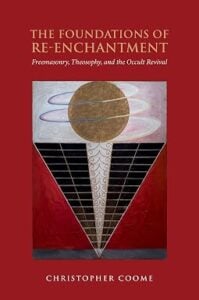
 The Foundations of Re-Enchantment: Freemasonry, Theosophy, and the Occult Revival
By Christopher Coome.
Oxford University Press, 2025.
Hardcover, 392 pages, $99.
Reviewed by Camilo Peralta.
The decline of faith in the modern world remains a popular and contentious subject. Some believe it was inevitable that, as our lives have become more comfortable and safe, we would feel less need to seek comfort and security in religion. Others insist, contrarily, that the present and future are so bleak that it strains credulity to believe in a higher power. Christian Smith, a retired sociologist formerly based at the University of Notre Dame (of all places!), declares confidently that religion has become “obsolete” in twenty-first century America. In a book published last year, he points to the growth of a vague spiritualism among youth as proof of this claim.
But there is nothing new about the “spiritual but not religious” crowd: they are, in a certain, degraded sense, merely the spiritual and intellectual heirs of the occult revivalists who popped up in the late nineteenth and early twentieth centuries, themselves only the latest in a long line of charlatans and frauds dating back to the Gnostics of the first and second centuries AD. In The Foundations of Re-Enchantment: Freemasonry, Theosophy, and the Occult Revival, Christopher Coome, a Postdoctoral Associate at Duke University, relates the curious history of some of these individuals and the fancifully named groups they founded.
Coome focuses primarily on four of the most influential: the Hermetic Order of the Golden Dawn, the Anthroposophical Society, the Ordo Templi Orientis, and the Theosophical Society. His main thesis is that each was heavily influenced by Freemasonry, a fact most of the extensive literature on the subject has neglected. That argument is very convincing: in many cases, the founders of these groups were, at one point, themselves Freemasons. A notable exception is Helena Blavatsky, the unconventional though energetic founder of the Theosophical Society, which started in New York in 1875. The story of her eventful early life is told by Coome in Part I: unable to become a Freemason due to her sex, she decided to invent her own secret society, which she could dominate with the help of a group of wise though conveniently unseen “Masters,” who inducted her into ancient rites and charged her with passing them on to others. Coome also discusses the rise and inevitable fall of the Golden Dawn, which was founded by a group of Freemasons and based in England. It counted Aleister Crowley and W. B. Yeats among its members. (If, for no other reason, the occult revival ought to be condemned for spoiling the work of one of the most naturally gifted poets of the twentieth century.)
The book is well-researched and methodical. Its central argument is convincing. But it is not without flaws. At times, it reads more like an unrevised dissertation than a proper monograph. It includes too many summaries of previous scholarship, and it repeats the main thesis an inordinate number of times, as if Coome were writing more for the benefit of a half-interested committee member than an alert reader. Surprisingly little attention is paid to what might interest the wider audience of such a book: namely, detailed descriptions of initiation rituals, formulae for summonings and spells, etc.
Instead, Coome focuses on the theoretical underpinnings of each group, tracing their development through a diverse and seemingly incompatible lineage of sources: Jewish and Egyptian mysticism, astrology, medieval superstition, and, eventually, an influx of Eastern religion. Frequent quotations from the movements’ founders help him make a case for the strong influence of Freemasonry on their thought. Coome must be commended for having the patience to sift through so much of the ridiculous prose they committed to paper. Here is a brief sample, courtesy of the self-declared magician and prophet, Crowley:
Logic is responsible for most of the absurd and abominable deeds which have disgraced history. Given Christian premises, the Inquisition was acting in accordance with the highest humanitarian principles in destroying a man’s body to save his soul. The followers of Descartes were right to torture animals, believing them to be automata. Genuine determinists would be justified in committing any crime, since the fact of its occurrence would prove that it was unavoidable.
The book includes many similar quotes, often sprinkled with references to Isis, Baphomet, the Templars, and so on. Coome tries to argue that the mish-mash of half-invented doctrines and creeds offered by Blavatsky, Rudolf Steiner, and others anticipated the work of later scholars in the field of comparative religion, but the latter would surely not find the comparison flattering.
Perhaps because he had to endure so much textual palaver, Coome adopts a scrupulously unbiased attitude towards his subject. No claim is too ludicrous to be dismissed outright, no incident too improbable to reject. Blavatsky, for instance, claimed to have developed her knowledge of esotericism after traveling the world at the behest of her Masters, who sent her to Tibet for spiritual enlightenment. “Whether the Masters were real people or simply invented by Blavatsky and other theosophists, no one can say for sure,” Coome concludes, though he later admits that she likely made it all up. He also lapses occasionally into the sort of grandiose but hollow rhetoric favored by his subjects. “To make a priori claims that ghosts do not exist is just as unscientific as making a priori claims that they do,” he argues at one point. “While today we might say that the science is settled, it was our Victorian pioneers who actually settled it.” Did they? That would come as a surprise, both to them, and to the many millions who still believe in the existence of the supernatural today.
Of course, there is a difference between the traditional belief in ghosts, which one can easily reconcile with Christianity, reason, and modern science, and the sort of random gibberish spouted by Blavatsky, Crowley, and the Freemasons. Yet Coome is unwilling to grant that such a distinction can or should be drawn. And he seems disinterested in the broader implications it suggests. In his conclusion, he returns again to his thesis, expressing the hope that those who read his book will appreciate the influence of Freemasonry on the occult revival.
The Foundations of Re-Enchantment will likely join the long list of sources Coome cites as an important text on esoteric societies, Freemasonry, and the colorful individuals involved in both. But if the study of such things has any broader relevance today, it must remind us that the yearning experienced by those who claim to be “spiritual but not religious” is neither new nor likely to lead to any lasting happiness (let alone genuine enlightenment). There is, in fact, nothing new under the sun. That is a piece of very old wisdom, which those eager to explore exotic beliefs and practices would do well to remember.
Camilo Peralta is an Associate Professor of English at Joliet Junior College. He has written one book, The Wizard of Mecosta: Russell Kirk, Gothic Fiction, and the Moral Imagination, and is editing a forthcoming collection on conservative cultural criticism. He lives in the Chicagoland area with his wife, daughter, and cat.
Support the University Bookman
The Bookman is provided free of charge and without ads to all readers. Would you please consider supporting the work of the Bookman with a gift of $5? Contributions of any amount are needed and appreciated!

