
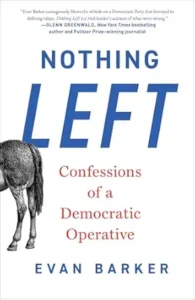
 Nothing Left: Confessions of a Democratic Operative
By Evan Barker.
Simon and Schuster, 2026.
Hardcover, 288 pages, $29.
Reviewed by John C. “Chuck” Chalberg.
The journey from left to right is a staple of American political memoirs. But few journeys have been as brief and intense as this one. Then again, this one is far from complete and may well never be completed. In addition, many such journeys have been both gradual and intellectual, especially since reading oneself in any direction can take a good while. Not so with this one. If Evan Barker ever managed to find time to read her way through chunks of Russell Kirk or William F. Buckley or Robert Nisbet, she didn’t bother to find space in this memoir to mention it.
Still barely thirtysomething, Barker might be described as a wunderkind heavyweight in her fundraising exploits for Democrats, but she is neither an intellectual heavyweight nor does she claim to be.
With an upbringing that strikes one as a midwestern version of J. D. Vance’s Hillbilly Elegy, the story of Barker’s youthful life in Kansas is thoroughly hardscrabble and somewhat similarly chaotic. There is even a semi-savior grandparent. Still, Dorothy in Oz she was—and is—not. What she was instead was a young girl with few prospects and a serious lung disease.
In fact, it was her own precarious condition that triggered her leap into Democratic Party politics. And once she was enmeshed and involved in those politics, the role of government in ensuring health care was the issue that drove her to become the fundraising demon that she was. For that matter, it is that very same issue that continues to outrank and outflank any other political interest or issue for her.
And yet this chronically ill young woman, this strong supporter of Barack Obama and Obamacare, this self-described populist and leftist, cast her presidential vote in 2024 for Donald Trump. And therein lies both a tale and the reason that her memoir is of some importance, not earth-shattering importance, to be sure, but of some importance nonetheless.
The story that she tells in these pages is one of a brewing and ongoing civil war, a civil war not between left and right in America, but a civil war within the Democratic Party. Rather than continue to fight that war, a war that the party’s Evan Barkers seem to have lost, she has opted to remove herself from the battlefield. A clear step toward her surrender was her decision to cast her 2024 presidential vote as she did.
While it would neither be fair nor accurate to label her a single-issue warrior, the issue of health care and the need for a considerable governmental presence to ensure it is clearly primary for her. That said, she winds up falling somewhere short of endorsing “Medicare for all” or anything that smacks of full-scale socialized medicine.
In addition, she had never been either a “woke” leftist or a hard-core leftist of any sort at any point before or during her years as a “Democratic operative.” And she continues to refuse to be typecast as a member of either camp today. If anything, she is now further removed from both types because of her encounters and experiences with both types when she was consumed by her drive to be a money-gathering machine for her party.
And oh yes, there was one more factor that contributed to her change of heart. Somewhere along the way she fell in love, got married, and had a baby. Suddenly politics wasn’t everything—or anywhere close to everything—for this wife and mother.
To be sure, one Evan Barker hasn’t left politics entirely behind. This book alone is sufficient evidence of that.
A populist of some sort, she is certain that a populism of some sort will dominate the American political scene for the immediate future. She is just not at all certain it will be the left-wing or right-wing variety. Apparently, she is prepared to follow either path, depending not just on which of the two manages to dominate, but on whether it dominates in a way that wins her endorsement.
If the Republican Party moves to the left on health care issues, she believes that it will dominate and she likely will tag along. If it doesn’t, and if the Democratic Party abandons its wokeness, its emphasis on cultural and identity issues, its open border policies, its arrogance and smugness toward the working class, and, yes, its barely disguised anti-Americanism, she is prepared to convince herself that it could return to dominance and she will then choose to tag along with them.
Given her “confession” that is this book, the likelihood of the latter is, at best, somewhere between minimal and non-existent; hence the difference between what she “believes” could be the case and what she hopes to “convince herself” might happen.
Whether intentionally or unintentionally, the story she tells is something much less than a confession. Actually, it is something other than a confession. As such, it is less a story of a sinner redeemed than it is a story not exactly of the sins of others, but certainly of the priorities of others, as well as a story of scales falling from her eyes as she becomes aware of those priorities–and then tries to come to terms with them.
Along the way, it is also an account of an internal civil war within the Democratic Party. Whether intentionally or unintentionally, it also amounts to an autopsy of the losers (meaning her side) in that war.
And those losers are? The losers are every Democrat from Hubert Humphrey to Evan Barker, meaning every Democrat who saw their party as a vehicle for promoting and acting on behalf of what they presumed were the legitimate interests, values, and concerns of an always beleaguered American working class. But those Democrats are long gone. In truth, they were largely gone by the time one Evan Barker was beginning to cut her teeth as a fundraiser for them.
Here there might have been a confessional dimension to her story. Did she see this early on and remain silent? She doesn’t say. Might she have done more to defeat wokeism and leftism along the way? Once again she is silent.
And the villains are? Names could be named, but any names mentioned here are irrelevant minor players, minor players who nonetheless regard themselves as important major players, while simultaneously oozing an unwarranted sense of self-importance. Besides, she changes some of the names to protect the guilty, not guilty of crimes, mind you, but guilty of excessive wokeness—which might translate to being guilty of excessive guilt.
Besides that, the real villain in her eyes and in her story is singular and nameless. It is money. That would be the money required to run successful modern campaigns, meaning the money required to buy television ads. Therefore, the villains are also the legions of moneyed Democrats whose interests and concerns have little to do with and/or little interest in the working class, especially the white working class.
An alternative to collecting money to fuel campaigns would be to have people with money run for office themselves. Their stories dot these pages as well. By and large, and either way (meaning both the funders and the office seekers), theirs are the stories less of the guilty than of the guilt-ridden, at least guilt-ridden in the sense that they either inherited or achieved success in a country that they have decided treats so many others so unfairly.
Her solution, of course, is to get money out of politics, which is much easier said than done. So she doesn’t bother offering any impossible solutions or any impossible-to-implement non-solutions.
If Barker isn’t about to solve the money-in-politics problem, and if she doesn’t have either an intellectual conversion story or a fully redemptive confessional story to tell, might there at least be a spiritual dimension to her “confessions.” Not really.
And yet, in an accidental sense, there is. Well, at least her story has a religious dimension, if not exactly a spiritual one. One comes away from reading this entirely secular account of the actions and beliefs of highly secular people with the sense that one has acquired a much clearer picture of political operatives for whom politics has become a religion. Driven by politics, they have become devoted to politics. For them it is the only life that matters. Convinced as they are of their own rightness and righteousness, they are also convinced that nothing else is truly important.
Convinced that the civil war within her party has been at least temporarily lost, Evan Barker is at least somewhat content these days to live a life away from what politics has become—especially what Democratic Party politics has become and emphasizes.
Who knows how much reading time this young mother will have in the days ahead. But if Evan Barker does find the time, she might well begin to read herself away from her past preoccupations and in a direction that her vote in 2024 seemed to be pointing her. Only then might she make not one, but two discoveries. She might one day discover that there really is something, rather than nothing, left, and also realize that she, too, has something, rather than nothing, left.
John C. “Chuck” Chalberg writes from Minnesota and once performed as G. K. Chesterton.
Support the University Bookman
The Bookman is provided free of charge and without ads to all readers. Would you please consider supporting the work of the Bookman with a gift of $5? Contributions of any amount are needed and appreciated!

